


Healthcare App Development Cost: A Real Breakdown by App Type and Complexity

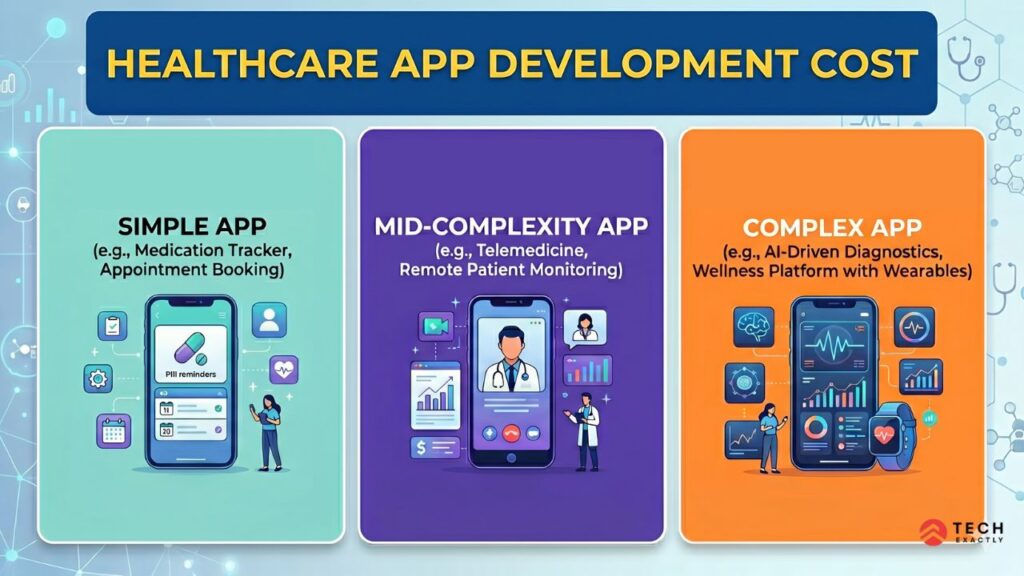
If you ask three development agencies what a healthcare app costs, you will get three wildly different quotes: $25,000, $150,000, $450,000 with almost no logical explanation of what separates them. Most agencies either avoid anchoring to a number (to keep room to negotiate) or anchor too low (to win the deal, then expand scope).
After a decade of building HIPAA-compliant apps at Tech Exactly, including a fair number of projects we’ve been hired to rescue from other vendors, I’ve watched enough budgets come together and fall apart to know where the money actually goes. This guide covers the specifics: cost ranges by app type, what drives the number up or down, and the line items that quotes routinely leave out.
Quick Answer: Healthcare App Development Cost by Complexity
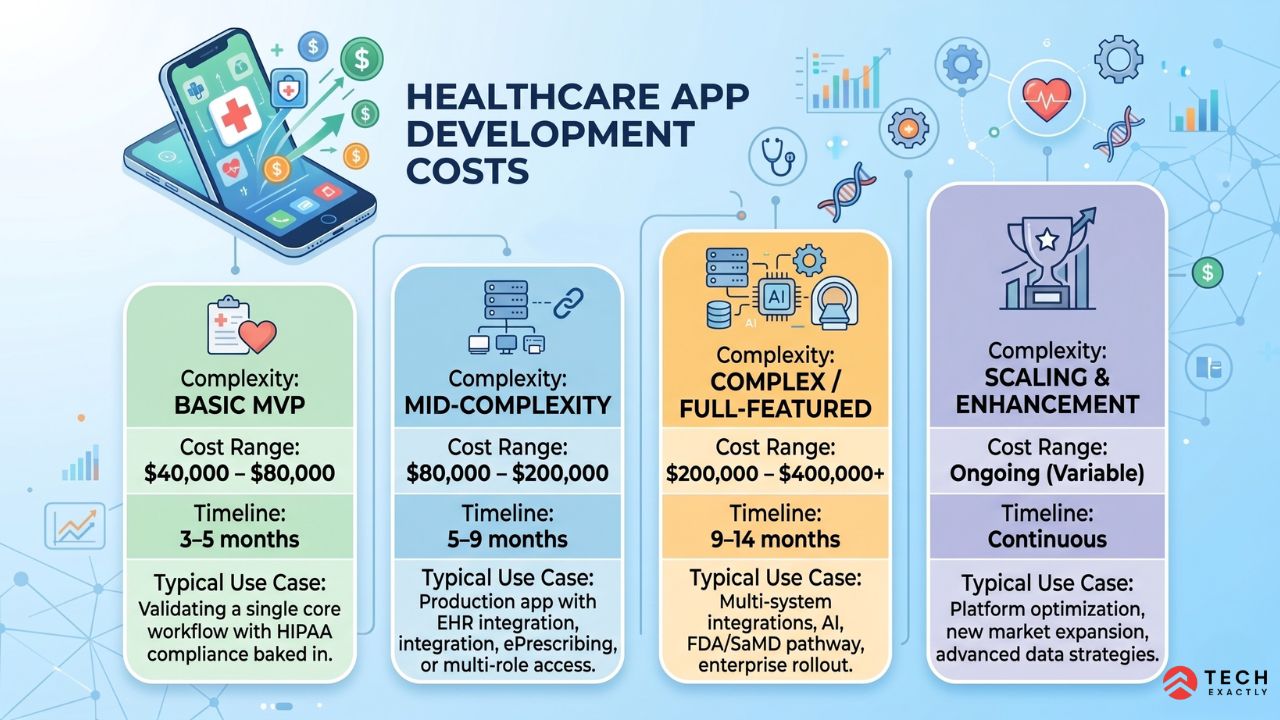
| Complexity | Cost Range | Timeline | Typical Use Case |
|---|---|---|---|
| Basic MVP | $40,000 – $80,000 | 3–5 months | Validating a single core workflow with HIPAA compliance baked in |
| Mid-Complexity | $80,000 – $200,000 | 5–9 months | Production app with EHR integration, ePrescribing, or multi-role access |
| Complex / Full-Featured | $200,000 – $400,000+ | 9–14 months | Multi-system integrations, AI, FDA/SaMD pathway, enterprise rollout |
These numbers work on the assumption that a team has built HIPAA-compliant apps before. If the team is learning HIPAA on your project, you need to add 30–50% for rework. A noticeable share of the rescue projects we’ve taken on fell into that bucket of lower original quote, higher final total.
Healthcare App Development Cost by App Type
Cost ranges shift significantly by category because compliance surface area, integration complexity, and clinical risk vary. Here’s what each major type of healthcare app typically costs to build in 2026.
Telemedicine App Development Cost
| Scope | Cost Range |
|---|---|
| MVP | $40,000 – $80,000 |
| Growth-stage | $100,000 – $250,000 |
| Enterprise | $300,000 – $400,000+ |
Telemedicine app development sits at the higher end because nearly every feature touches compliance from end-to-end encrypted video, HIPAA-compliant messaging to ePrescribing (which pulls in DEA EPCS requirements for controlled substances), and cross-state licensing logic. A production-grade video consultation module alone costs around $25,000 and takes 4–6 weeks. This is all before you wire it into scheduling, billing, or EHR. If you’re still deciding between telemedicine vs telehealth, the distinction matters for cost.
Patient Portal Development Cost
| Scope | Cost Range |
|---|---|
| Basic Portal | $30,000 – $60,000 |
| Full-Featured | $75,000 – $250,000 |
| AI-Enhanced | $250,000 – $500,000+ |
The 21st Century Cures Act’s information blocking rule made patient access to electronic health information effectively non-optional for most providers, which is one of the reasons why portals moved from “nice to have” to table stakes. Patient portal development has its own cost and compliance breakdown.
Mental Health & Behavioral Health App Development Cost
| Scope | Cost Range |
|---|---|
| Basic (mood tracking, journaling) | $15,000 – $40,000 |
| Mid-range (therapist matching, video sessions, crisis resources) | $50,000 – $120,000 |
| Advanced (CBT tools, wearable integration, risk scoring) | $150,000 – $400,000+ |
The compliance overlay here is closer to telemedicine than to consumer wellness. PHI handling, encrypted sessions, and crisis protocol integration all apply. Behavioral health software build vs buy covers the trade-offs between building from scratch and going with an existing platform.
Remote Patient Monitoring (RPM) App Development Cost
| Scope | Cost Range |
|---|---|
| Basic Monitoring | $100,000 – $200,000 |
| Advanced Platform | $200,000 – $500,000+ |
RPM costs sit higher than most categories due to factors such as medical device integration (Bluetooth LE, cellular), real-time physiological data streaming, and FDA exposure when the software interprets clinical signals. Remote patient monitoring app development covers the full technical and compliance ground.
Other Healthcare App Development Costs
| App Type | MVP Cost | Full Product Cost | Primary Cost Driver |
|---|---|---|---|
| Healthcare CRM | $40,000 – $80,000 | $80,000 – $200,000 | Practice workflow customization |
| Medical Billing | $50,000 – $100,000 | $100,000 – $250,000 | Claims processing, payer integrations |
| Hospital Management | $80,000 – $150,000 | $200,000 – $500,000+ | Multi-department workflows, inventory |
| Pharmacy App | $40,000 – $80,000 | $80,000 – $200,000 | ePrescription compliance, inventory |
| Health Insurance App | $50,000 – $120,000 | $150,000 – $350,000 | Claims adjudication, provider networks |
| Fitness/Wellness | $25,000 – $60,000 | $80,000 – $200,000 | Wearable integrations, content delivery |
The types and features each one requires are covered in the healthcare application development guide.
Note on EHR/EMR: EHR integration work has its own cost profile — covered in a dedicated breakdown.
Our HIPAA-compliant therapy platform case study walks through how this breaks down on a real build.
Factors Affecting the Cost of Hiring Healthcare Mobile App Developers

Two apps in the same category can vary by 3x in build cost. These are the factors that actually move the number.
1. HIPAA Compliance Cost: Where the $40K–$60K Actually Goes
HIPAA compliance cost in healthcare app development typically falls between $40,000 and $60,000 when built into the project from day one. That’s 20–30% on top of base development cost. Retrofitting compliance after launch runs 5–10x higher because you’re rearchitecting the database layer, the API layer, and often the hosting stack.
Here’s where that $40K–$60K actually goes:
| Line item | Estimated cost | What it covers |
|---|---|---|
| Encryption (at rest + in transit) | $5,000–$8,000 | AES-256 for databases, backups, file storage. TLS 1.2+ on every connection. Key management through KMS. |
| Audit logging | $8,000–$12,000 | Logging every PHI read and write, not just modifications. Immutable storage. Six-year retention. |
| Access controls (RBAC) | $6,000–$10,000 | Role-based access at three layers: UI, API middleware, and database. Session timeouts. Immediate revocation. |
| Authentication (MFA) | $3,000–$5,000 | Multi-factor authentication for any user accessing PHI. Token management. |
| BAA management | $2,000–$4,000 | Identifying every third-party service that touches PHI, getting signed BAAs, documenting the chain. |
| Breach notification system | $3,000–$5,000 | Automated breach detection, notification workflows, HHS reporting compliance. |
| Security testing | $8,000–$15,000 | Penetration testing, vulnerability scanning, remediation. |
| Compliance documentation | $3,000–$5,000 | Risk assessment, policies, procedures, training documentation. |
The cost increases when your app handles higher-risk data flows — push notifications with clinical content, in-app messaging between patients and providers, or caching layers that temporarily store patient records. Each of those adds compliance surface area that generic apps don’t have. The security architecture for healthcare apps guide covers how to design for these edge cases without overengineering.
The risks of skipping this become obvious fast. Teams that vibe code healthcare apps without thinking about compliance from day one end up spending far more than the $40K–$60K they tried to save.
One more thing to factor in: the 2025 HIPAA Security Rule update. The Notice of Proposed Rulemaking published by HHS in December 2024 proposes stricter requirements — annual penetration testing, mandatory encryption of ePHI at rest and in transit, vulnerability scanning every six months, and written documentation of every technical safeguard. The rule is still under review, but building to the stricter version now means you won’t need to retrofit later. Regulatory-compliant app development doesn’t have to slow your timeline — the approach is covered in a separate piece.
2. FDA / SaMD Classification: $25K–$80K+
Apps that interpret medical data, support clinical decisions, or control a medical device may fall under FDA oversight as Software as a Medical Device (SaMD), which includes Quality Management System requirements (typically ISO 13485), IEC 62304 lifecycle documentation, and potentially a 510(k) or De Novo submission. Administrative and general wellness apps are usually exempted; diagnostic support and AI-driven clinical tools usually aren’t. IEC 62304-compliant app development covers the full regulated build process.
Our IEC 62304-compliant app case study walks through the cost and compliance overhead on a real regulated build.
3. AI and ML Features: $20K to $300K+
The AI cost spread is the widest of any category:
- Basic chatbot or symptom triage: $20,000 – $50,000
- Diagnostic support (radiology, pathology, dermatology): $50,000 – $300,000
- Predictive analytics (readmission risk, sepsis alerts, adherence): $80,000 – $200,000
The moment your AI influences a clinical decision, SaMD oversight enters the picture. This will further add to the FDA budget on top. Generative AI in healthcare development covers where this category is heading.
4. Integration Depth
Every external system you connect to, like EHRs, lab systems, payment processors, pharmacy networks, medical devices, and insurance clearing houses, adds $15,000–$80,000, depending on complexity and whether the target has a sane API. FHIR integrations are cheaper than custom HL7 v2 work, but FHIR support means very different things across Epic, Oracle Health (Cerner), Meditech, and Athenahealth.
5. Platform Strategy
Cross platforms like React, Native, Flutter cut 30–40% vs. parallel iOS and Android builds and is the right call for most patient portals, telemedicine apps, and scheduling products. Go native when you need Bluetooth medical devices, real-time biometric streaming via HealthKit or Health Connect, or on-device ML.
Let's Start Your Project Today
Ready to build your Healthcare App Development with us? Reach out now – our experts are just one click away.
Healthcare App Development Cost Breakdown: Where the Budget Actually Goes
| Phase | % of Budget | What’s Happening |
|---|---|---|
| Discovery & compliance scoping | 5–10% | Requirements, risk assessment, HIPAA gap analysis, and SaMD determination |
| UX/UI design | 10–15% | User flows, clinical workflow mapping, accessibility |
| Core development | 40–50% | Frontend, backend, database, auth, PHI handling |
| Integrations | 15–25% | EHR, payments, devices, third-party services |
| Testing | 10–15% | Functional, security, performance, and clinical validation |
| Launch & deployment | 5% | App store, infrastructure, and monitoring setup |
Discovery is the phase that founders most often ignore and the one where shortcutting costs the most. We’ve seen projects overrun budgets by 40–60% because a compliance requirement surfaced in month 5 that forced a data model to be rewritten. A two-week scoping engagement would have caught it on day 4.
MVP vs. Full Product: The Decision That Most Often Saves Startups
| MVP | Full Product | |
|---|---|---|
| Cost | $40,000 – $80,000 | $150,000 – $400,000+ |
| Timeline | 3–5 months | 6–14 months |
| Risk profile | Lower, validate before scaling | Higher, more capital committed earlier |
| Compliance | HIPAA from day one (non-negotiable) | Full regulatory stack |
| Features | One core workflow and one differentiator | Complete feature set |
The MVP route in healthcare means cutting features and not compliance. You need to ship with secure scheduling and messaging before adding AI prioritization. Integrate with one EHR before five. Launch in one state before tackling cross-state licensing. The compliance platform stays the same; what changes is the scope on day one.
We default to recommending the MVP path for almost every startup we talk to, because the alternative (burning $300K before validating whether providers actually want the thing) is the most common way healthcare startups run out of runway.
Hidden Healthcare App Development Costs You Can't Ignore
The quote you get from a vendor generally covers writing code. These line items are the ones that show up after launch.
Annual Compliance
| Item | Annual Cost |
|---|---|
| Penetration testing (increasingly required under tightening HIPAA rules) | $8,000 – $25,000 |
| Vulnerability scanning (semi-annual) | $2,000 – $8,000 |
| HIPAA risk assessment | $5,000 – $25,000 |
| BAA review and renewal across vendors | Legal hours, routinely overlooked |
| Compliance documentation updates | $2,000 – $5,000 |
If you’re building in a multi-jurisdiction context — selling to UK or EU healthcare clients alongside US ones — annual compliance costs go up. HIPAA, GDPR, and UKCA each have their own audit and documentation requirements. The healthcare app compliance guide for US, UK, and international markets breaks down what each jurisdiction requires.
Ongoing Operations
| Item | Cost |
|---|---|
| HIPAA-eligible cloud hosting (AWS, Azure, GCP with BAA) | $2,000 – $15,000/month |
| Third-party services (analytics, push, crash reporting, monitoring) | $1,000 – $8,000/month |
| Maintenance & incremental updates | 15–25% of initial dev cost annually |
For cloud infrastructure specifically, the cost varies by provider and configuration. Not all services on AWS, Azure, or GCP are HIPAA-eligible — only specific services covered by the provider’s BAA qualify. Using a non-eligible service, even accidentally, breaks your compliance chain. Cloud healthcare computing covers which services are eligible on each platform and how BAA coverage actually works.
One-Time Costs That Get Missed
- Staff and clinician training:$10,000 – $50,000
- Clinical validation testing (separate from QA): $5,000 – $25,000
- App store compliance and medical app disclosures: variable
It’s worth noting that healthcare has been the highest cost industry for data breaches for 14 consecutive years, with IBM’s Cost of a Data Breach Report 2024 putting the average healthcare breach at $9.77 million. A low-five-figure annual compliance spend pays for itself the moment it prevents one.
Let's Start Your Project Today
Ready to build your Healthcare App Development with us? Reach out now – our experts are just one click away.
How Team Structure and Geography Affect Cost
| Team Model | Blended Hourly Rate | Mid-Complexity App Total |
|---|---|---|
| US-based team | $150 – $250 | $200,000 – $400,000 |
| Western Europe | $85 – $150 | $120,000 – $250,000 |
| Eastern Europe | $40 – $100 | $60,000 – $150,000 |
| South / Southeast Asia | $20 – $50 | $40,000 – $100,000 |
| Hybrid (US leads + offshore build team) | $60 – $120 blended | $80,000 – $200,000 |
Healthcare experienced offshore teams typically charge 25–40% above generic software development rates. A team that quotes $30/hr for a consumer app might charge $50/hr for HIPAA work if they have the expertise at all. The ones quoting $25/hr for healthcare are usually the ones you end up paying twice. Once for the build and the other for the rebuild. Software development outsourcing covers what to look for in a vendor.
Time zones are more significant than many quotes capture. A 10.5-hour US–India gap can extend timelines 20–40% without deliberate overlap hours. Hybrid models, like a US product lead and offshore engineering, usually land in the best total cost spot. This is why most mature healthcare dev companies run that way. Finding the right mobile app development partner is harder than most founders expect.
Tech Exactly’s telemedicine app development projects run $180K–$400K for a compliant MVP, within the range above.
Healthcare App Development Cost in the USA: Which Model Fits Your Stage

US-based founders typically choose between three engagement models, and the right one depends on stage and procurement context more than pure rate:
- Fully offshore with healthcare expertise ($40K–$150K for mid-complexity) works when the vendor has worked on HIPAA-compliant apps before and can provide US client references. It is a best fit for pre-seed and seed-stage startups.
- Hybrid, US product lead and offshore engineering ($80K–$200K for mid-complexity) is a sweet spot for most Series A-stage companies, providing timezone overlap without a fully onshore price tag.
- Fully US-based team ($200K–$400K+) is appropriate for enterprise health systems, funded startups with strict procurement requirements, or regulated contexts where onshore data handling is a contractual term.
For most early-stage US founders, the fully onshore math rarely works out. This is the reason why so many health-tech startups we talk to have already burned 6–12 months with a $300K+ US build that didn’t validate the core hypothesis.
How to Reduce Healthcare App Development Cost Without Cutting Compliance
Six levers that can help you are:
- Launch an MVP, validate, then scale. It saves 40–60% up front and derisks the bigger spend.
- Use a cross-platform. React Native or Flutter over parallel native builds saves 30–40% for most healthcare use cases.
- Build on HIPAA-eligible managed services. AWS with BAA, Azure Healthcare APIs, or Google Cloud Healthcare API. The managed tier costs more per hour but saves months of compliance engineering.
- Phase integrations. One EHR first, then the rest later. One payer first, the rest later.
- Use pre-built compliance modules. HIPAA-as-a-Service platforms and BAA-covered SDKs cut compliance work from months to weeks.
- Scope aggressively in discovery. Every hour in discovery saves five in development.
If a vendor’s quote is significantly below the ranges in this article, the first question to ask is which piece of the compliance floor they are cutting (encryption, audit logging, pen testing, BAAs, or access controls). None of those are optional.
Tech Exactly’s healthcare app development work spans the full spectrum above — from simple patient portals to Class II SaMD builds.
Let's Start Your Project Today
Ready to build your Healthcare App Development with us? Reach out now – our experts are just one click away.
Getting a Realistic Cost Estimate for Your Healthcare App
Generic cost ranges can help you in the budget conversation with investors. However, they don’t get you to a spec that a development team can price against. For that, you need someone who’s built in your specific category, like telemedicine, RPM, patient portal, or behavioral health, to review your workflow and compliance footprint and give you grounded numbers.
If you are planning a healthcare app or want a second opinion on a quote you have received, we’ll do a free scoping call and give you real numbers for your use case.
FAQs on Healthcare App Development Cost
A basic HIPAA-compliant MVP costs $40,000–$80,000 and takes 3 to 5 months. Apps having medium complexity with EHR integration or ePrescribing costs around $80,000–$200,000 over 5 to 9 months. Complex apps with AI, a SaMD pathway, or multi-system integration cost around $200,000–$400,000+. These ranges are based on the assumption that the team has prior healthcare experience. For teams learning HIPAA on the job, you typically need to add 30–50% for rework.
HIPAA compliance cost in app development runs $40,000–$60,000 when built in from the start — covering encryption, audit logging, access controls, authentication, BAA management, security testing, and compliance documentation. The biggest single line items are audit logging ($8K–$12K) and security testing ($8K–$15K). Beyond the initial build, annual compliance adds $17,000–$63,000 for penetration testing, vulnerability scanning, risk assessments, and documentation updates. Retrofitting compliance after launch typically costs 5–10x the build-in price because you're rearchitecting the database layer, the API layer, and often the hosting stack.
A HIPAA compliance audit for a healthcare app costs $5,000–$25,000 for a self-directed risk assessment using internal resources or a consultant. A formal third-party audit with penetration testing runs $15,000–$40,000. The range depends on the app's complexity — a single-workflow patient portal sits at the lower end, while a multi-integration platform with telehealth, messaging, and device connectivity sits at the higher end. Under the proposed 2025 HIPAA Security Rule update, annual penetration testing and semi-annual vulnerability scanning are moving toward becoming mandatory, so this is increasingly a recurring cost rather than a one-time expense.
There's no official "HIPAA certification" — HHS doesn't certify apps or organisations as HIPAA-compliant. What exists are third-party compliance assessments from firms like HITRUST, which issues the HITRUST CSF certification. A HITRUST assessment costs $40,000–$100,000+ depending on scope and can take 6–12 months. Most startups and mid-stage companies don't need it — a documented self-audit with penetration testing results is sufficient for most hospital vendor assessments. HITRUST becomes relevant when you're selling to large health systems that require it as a procurement condition.
Yes, you can, with a focused MVP on one workflow, built on cross-platform frameworks and HIPAA-eligible managed cloud services. You cannot skip HIPAA compliance in any budget. If a vendor quotes $10,000–$15,000 for a healthcare app, ask how they are handling PHI encryption, audit logging, and BAAs. If the answer isn't specific, walk away.
It is about 15–25% of the initial development cost per year. For a $150,000 app, that's $22,500–$37,500 annually covering hosting, security patching, compliance updates, and maintenance. HIPAA-eligible cloud hosting alone costs $2,000–$15,000/month, depending on patient volume.
Not always. Administrative apps (scheduling, billing, messaging) and general wellness apps are typically exempted. Apps that interpret medical data, make clinical recommendations, or control a medical device may fall under FDA oversight as Software as a Medical Device. You need to get an SaMD classification assessment before you start building. It is far cheaper than pivoting the architecture mid-development.

Pallabi Mahanta, Senior Content Writer at Tech Exactly, has over 5 years of experience in crafting marketing content strategies across FinTech, MedTech, and emerging technologies. She bridges complex ideas with clear, impactful storytelling.