


Behavioral Health Software in 2026: A Build vs. Buy Guide for Growing Practices


Key Takeaways
- Off-the-shelf behavioral health software works for solo practitioners and small groups. TherapyNotes, TheraNest, and SimplePractice are solid under 10 clinicians.
- Add-on costs turn affordable platforms into expensive ones. AI notes, ePrescribing, telehealth, and claims processing add $500–$1,200/month on top of base pricing for a mid-size practice.
- Integration is where every platform breaks. Metered APIs, closed ecosystems, and limited interoperability mean you’re locked into whatever the vendor gives you.
- Custom development pays for itself at scale. A 20+ clinician practice paying $2,000–$3,000/month in SaaS fees will spend $120,000–$180,000 over 5 years, which is often more than a custom build that they own outright.
- Billing and revenue cycle management is the tipping point. The moment your practice deals with Medicaid, multi-payer complexity, or denial management across programs, off-the-shelf billing modules start costing you money instead of saving it.
Most behavioral health practices don’t outgrow their software because they’ve scaled. They outgrow it because their clinical workflows get more complex, and the $1,500/month platform they rely on can’t keep up.
Behavioral health is one of the most operationally demanding parts of healthcare. You’re juggling treatment plans across different modalities like billing Medicaid and private insurers, each with its own rules and tracking outcomes for CCBHC or grant requirements.
And on top of this, working with strict privacy laws like HIPAA and 42 CFR Part 2. It’s a different level of complexity compared to general healthcare.
At Tech Exactly, we’ve built HIPAA-compliant therapy platforms with telehealth, patient registration, secure audio/video consultations, data encryption, and the full stack. We know what behavioral health software looks like from the inside. And we know when a practice has hit the ceiling of what off-the-shelf can do.
This guide breaks down the real options. What the best behavioral health software platforms offer, where they fall short, and when building custom makes financial and clinical sense.
Why Behavioral Health Software Is a Different Problem
General EHRs don’t really work here. Behavioral health needs longitudinal care tracking, more detailed narrative documentation, 42 CFR Part 2 compliance for substance use, and a level of billing complexity that these systems just weren’t built for. That’s why a dedicated behavioral health software market exists.
The question isn’t whether you need specialized software. You do. The question is whether the off-the-shelf options can keep up as your practice grows. Additionally, whether you’re paying enterprise prices for a platform that still can’t do what you need.
Best Behavioral Health Software Platforms — and Where Each Breaks
The “best behavioral health software” articles online fail to provide a clear picture, as they are written by the vendors themselves. Here’s a more honest look at the landscape where these platforms actually work, and where they start to fall short.
| Platform | Price Point | Works Well For | Where It Breaks |
|---|---|---|---|
| TherapyNotes | $69/mo solo, $79 + $50/clinician | Solo–small group, simple commercial billing | No mobile app, no API, rigid templates, add-ons double cost |
| SimplePractice | $49–$99/mo per clinician | Solo clinicians wanting polished UI | Thin beyond basic documentation, not built for complexity |
| TheraNest | $29–$89/therapist/mo | Budget-conscious small groups | 4.0/5 ratings, limited reporting, no state-specific tools |
| Valant | ~$90–150+/provider/mo (quote) | Mid-size outpatient, 100+ templates | Repeated downtime during business hours; API costs $25–750/mo |
| Credible (Qualifacts) | Enterprise (hundreds/user/mo) | Multi-location agencies, CCBHCs | Support rated 3.5/5, updates introduce bugs, complex setup |
| Netsmart | Enterprise | Large CMHCs, state reporting | 6–18 month implementation timelines |
For solo therapists and small groups under 10 clinicians with straightforward commercial insurance billing, TherapyNotes, SimplePractice, or TheraNest will handle the job. Pick one and go. You don’t need custom software.
The problems start at 10–15+ clinicians, multi-payer Medicaid billing, or any scenario requiring integrations. That’s where every platform starts hitting its limits and where the real cost analysis begins.
Where Off-the-Shelf Behavioral Health Software Falls Short
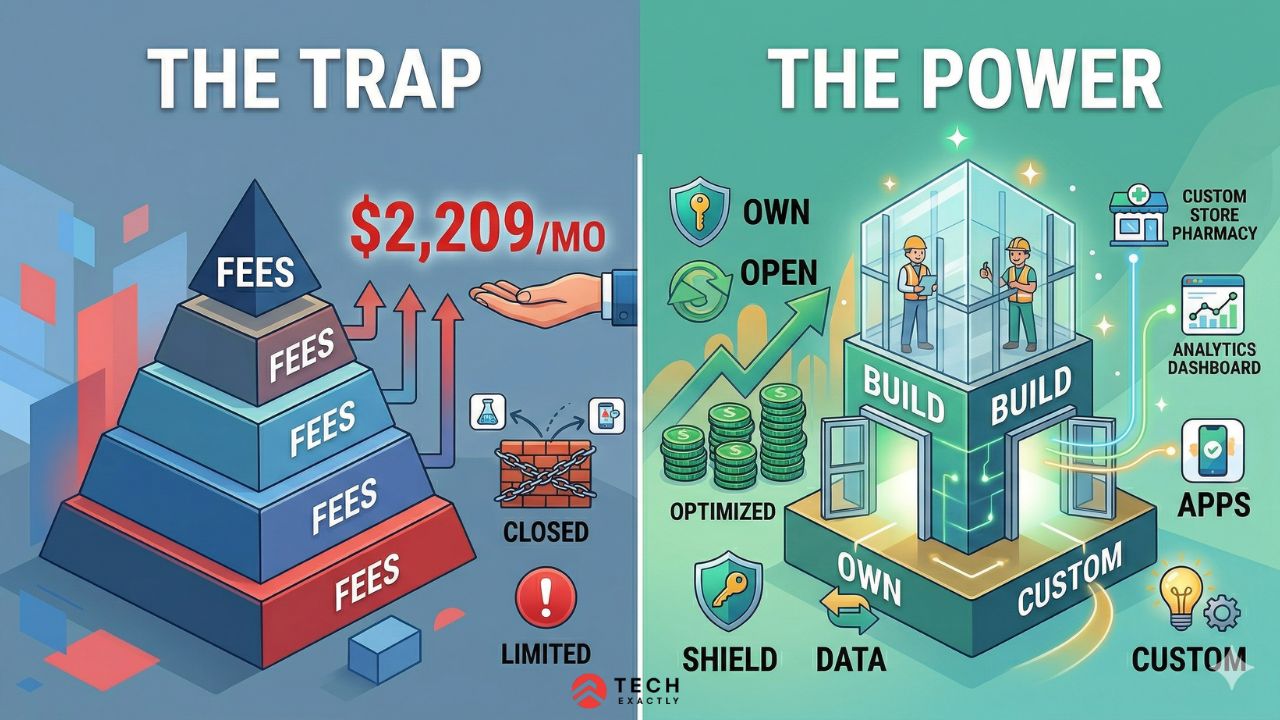
Comparing Pricing of Practice Management Software for Behavioral Health
Base pricing looks reasonable until you add what you actually need. Here’s what a 15-clinician practice pays on TherapyNotes, which is the most transparent platform:
| Line Item | Monthly Cost |
|---|---|
| Base (1 lead + 14 additional clinicians) | $779 |
| AI-powered notes ($40 × 15) | $600 |
| ePrescribe ($65 × 5 prescribers) | $325 |
| Premium telehealth ($15 × 15) | $225 |
| Claims processing (~$0.14 × 2,000 claims/mo) | $280 |
| Total | $2,209/mo → $26,508/year |
That’s over $26,000 annually for a platform you don’t own, can’t customize, and can’t integrate with external systems. Over the next 5 years, that costs around $132,540. This is before accounting for the 3-8% annual price increases, which most vendors build into their contracts.
Integration Walls
This is the real deal-breaker for growing practices:
- TherapyNotes: No public API. Essentially a closed system.
- TheraNest: Limited API. No HL7 FHIR or standard interoperability.
- Valant: API exists but is metered: $25/month for 75 calls, scaling to $750/month for 25,000 calls, then $0.03 per call after that. Want to build a patient-facing mobile app that pulls data from Valant? You’ll pay for every single API call.
- Credible: HIE and lab integrations exist but are poorly documented and complex to implement.
If your practice needs to connect with external labs, pharmacies, state reporting systems, custom analytics dashboards, or a branded patient engagement app, you’ll hit a wall with every major platform.
Behavioral Health Billing Software: Where Revenue Cycle Falls Apart
Behavioral health billing is brutal. Multi-payer claims, Medicaid with state-specific rules, authorization tracking across programs, carve-out arrangements, and denial management all require flexibility that most platforms still treat as an afterthought.
Common pain points we hear from practices that have outgrown their software:
- Secondary insurance billing requires manual workarounds on most platforms
- Denial management is reactive, not predictive. There are no analytics showing why claims are getting denied
- Authorization tracking doesn’t connect to clinical workflows. Thus, clinicians don’t see when authorizations are expiring
- Medicaid billing rules vary by state, and platforms that work in one state break in another when a practice expands
When your revenue cycle management ends up costing more in denied claims and manual rework than the software actually saves, you’ve crossed the build vs buy threshold. Especially if you’re also struggling with CRM and practice management workflows.
Data Ownership
Every SaaS platform holds your patient data in its cloud. Whenever you want to switch vendors or build your own system, data migration costs $2,000-$25,000, which takes months. Some vendors make exporting intentionally painful. Custom software means you own your data, your infrastructure, and your exit strategy.
Let's Start Your Project Today
Ready to build Behavioral Health Software with us? Reach out now – our experts are just one click away.
When Custom Behavioral Health Software Development Makes Sense
Not every practice needs custom software. Here’s a clear decision framework:
Stay with off-the-shelf if:
- You’re under 10 clinicians
- You bill primarily commercial insurance with straightforward claims
- Your clinical workflows fit standard templates
You don’t need external integrations beyond what the platform offers - Your annual software spend is under $15,000
Consider custom development if:
- You’re 20+ clinicians and growing across locations or states
- Your annual SaaS spend exceeds $25,000–$30,000 (and rising with each new clinician)
- You need integrations that existing platforms can’t support or charge $500+/month for API access
- Your billing complexity involves Medicaid, multiple payers, and program-specific rules
- You need HIPAA-compliant + 42 CFR Part 2 compliance baked into your architecture, not bolted on
- You want to build proprietary clinical tools such as custom outcome tracking instruments, AI-driven documentation, or predictive analytics
- You want a branded patient-facing experience (mobile app, patient portal) that looks like your practice, not your vendor
The Cost Math
Here’s the comparison most practices never see:
| Off-the-Shelf (5 Years) | Custom Build | |
|---|---|---|
| Year 1 | $26,000–$36,000 | $80,000–$150,000 (build + launch) |
| Years 2–5 | $110,000–$160,000 (with annual increases) | $48,000–$90,000 (maintenance at 15–20%/year) |
| 5-Year Total | $136,000–$196,000 | $128,000–$240,000 |
| You own it? | No | Yes |
| Data portability? | Vendor-controlled | Full ownership |
| Customization? | Limited to vendor’s roadmap | Unlimited |
| Integrations? | Metered, restricted | API-first, open |
For a 20+ clinician practice, the 5-year total cost of ownership is comparable. However, with custom, you end up with an asset you own rather than a subscription you rent. And you’re not paying $750/month just for API access to your own patient data.
💡 Expert Tip: Don’t build everything from scratch. The smarter way to approach this is to build custom solutions where off-the-shelf tools fall short, like billing logic, clinical workflows, outcome tracking, and integrations. And for everything else, like video calls, payments, and appointment reminders, use what already works.
What a Custom Behavioral Health Platform Costs to Build
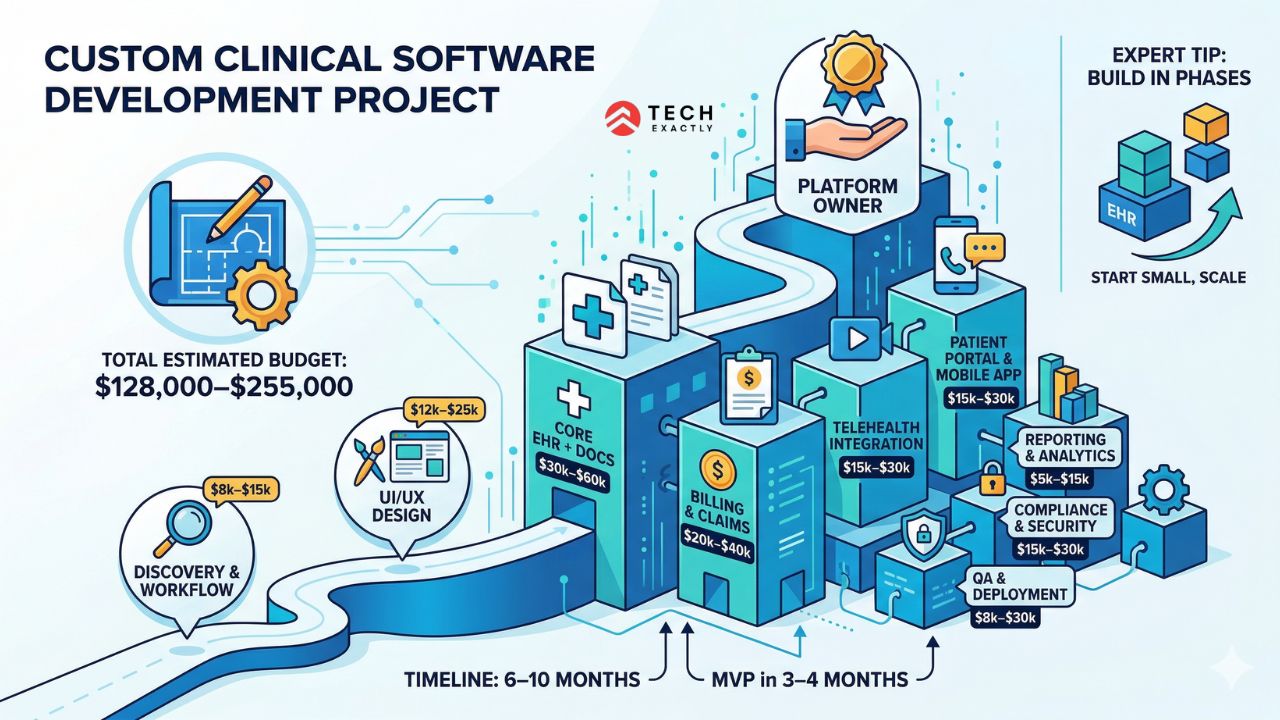
If you’ve crossed the threshold, here’s what to budget:
| Component | Cost Range | What It Covers |
|---|---|---|
| Discovery & clinical workflow mapping | $8,000–$15,000 | Stakeholder interviews, workflow documentation, compliance requirements, architecture design |
| UI/UX design | $12,000–$25,000 | Clinician-facing dashboards, patient portal, mobile app design |
| Core EHR + documentation engine | $30,000–$60,000 | Treatment plans, progress notes, assessment tools, template builder |
| Billing & claims module | $20,000–$40,000 | Multi-payer claims, Medicaid rules engine, authorization tracking, denial analytics |
| Telehealth integration | $15,000–$30,000 | HIPAA-compliant video, scheduling integration, and session documentation |
| Patient portal + mobile app | $15,000–$30,000 | Appointment booking, secure messaging, intake forms, outcome measure completion |
| Reporting & analytics | $10,000–$20,000 | CCBHC reporting, outcome dashboards, revenue cycle analytics |
| Compliance & security | $8,000–$15,000 | HIPAA + 42 CFR Part 2 architecture, encryption, audit logging, penetration testing |
| QA & deployment | $10,000–$20,000 | Cross-browser testing, load testing, staging environment, production deployment |
| Total | $128,000–$255,000 | Full platform, owned by you |
Timeline: 6–10 months for a full platform. 3–4 months for an MVP focused on the modules where off-the-shelf fails most (typically billing + clinical documentation + integrations).
💡 Expert Tip: Start in phases. Most practices don’t replace everything at once. They keep their existing EHR for scheduling and basic documentation, and build custom pieces around it for things like billing, outcome tracking, or patient engagement. It lowers the risk and lets you move step by step instead of replacing everything on day one.
How to Choose a Behavioral Health Software Development Partner

Building behavioral health software is quite different from building a consumer app. Your development partner needs to understand clinical workflows, regulatory compliance, and payer complexity. Here’s exactly what to look for:
1. Healthcare-specific experience. Ask for case studies in behavioral health, mental health, or therapy platforms. A team that’s built healthcare applications or HIPAA-compliant platforms already understands the compliance constraints that general dev shops often miss.
2. Compliance-first architecture. 42 CFR Part 2 compliance for substance use disorder records is not something you can just add later. Ask how they’d handle segmented access controls, consent management, and audit trails. If they haven’t heard of Part 2, they’re probably not the right partner.
3. Billing domain knowledge. Behavioral health billing is uniquely complex. You are dealing with multi-payer, authorization-dependent, state-specific Medicaid rules. Ask how they’ve handled claims management or built regulatory-compliant healthcare applications in past projects.
4. Integration architecture. Your custom platform will need to connect with clearinghouses, labs, pharmacies, state HIEs, and potentially your existing EHR during migration. Ask about their approach to API design and third-party integrations. A strong software development company will have documented patterns for this.
5. Post-launch support. Behavioral health regulations change. Medicaid rules shift by state. CCBHC requirements evolve. Your development partner needs a maintenance model that keeps your platform current and not just a build-and-walk-away engagement.
Let's Start Your Project Today
Ready to build Behavioral Health Software with us? Reach out now – our experts are just one click away.
The Bottom Line
Off-the-shelf behavioral health software is the right choice for small practices with simple workflows. But the moment your practice hits 15–20+ clinicians, expands across states, deals with multi-payer Medicaid billing, or needs integrations that vendors charge hundreds per month to access, you are basically paying enterprise prices for a platform you don’t own and cannot control.
Custom development isn’t cheap. However, over 5 years, the total cost of ownership is often comparable to SaaS. Thus, you end up with a platform built around your clinical workflows, not a vendor’s template.
If you’re figuring out whether your practice has outgrown its current software or you’re scaling and want to build it right from the start, let’s talk. We’ll assess your workflows, compare the real cost of build vs. buy for your specific situation, and tell you honestly which path makes more sense.
FAQs on Behavioral Health Software
For practices under 10 clinicians, TherapyNotes ($69/mo solo, $79 + $50/clinician for groups) offers a solid balance of reliability, documentation, and billing. SimplePractice is a strong alternative if you care more about UI and design. TheraNest is the more budget-friendly option at $29 per therapist per month. All three work well if you’re dealing with straightforward commercial insurance billing and standard workflows.
Off-the-shelf platforms range from $29/clinician/month (TheraNest Essentials) to several hundred per user/month for enterprise solutions like Credible or Netsmart. But base pricing is usually misleading. Add-ons for AI notes, ePrescribing, telehealth, and claims processing can double your monthly cost. You need to budget $1,500–$3,000/month for a fully featured 15-clinician practice on a commercial platform.
When your annual SaaS spend exceeds $25,000–$30,000, you need integrations that the platform can't support, your billing complexity involves multi-payer Medicaid across states, or your clinical workflows don't fit the vendor's templates. At 20+ clinicians, the 5-year total cost of ownership for custom development is often comparable to SaaS licensing, but now it's your own platform.
HIPAA is just the starting point. Behavioral health adds 42 CFR Part 2 for substance use disorder records, with stricter privacy, segmented access, and consent management. On top of that, there are state-specific Medicaid billing rules, CCBHC reporting, and EPCS requirements for controlled substances. Most off-the-shelf platforms handle HIPAA, but start to fall short on Part 2 and state-level compliance.
An MVP focused on the modules where off-the-shelf fails, which is typically billing automation, clinical documentation, and integrations, takes anywhere between 3 and 4 months. A full platform with EHR, billing, telehealth, patient portal, and reporting takes 6–10 months. A lot of practices take a phased approach, keeping their existing EHR and gradually adding custom modules over time.
It is nothing but integration. Every major platform either has no API (TherapyNotes), charges metered API fees (Valant: $25–750/month), or has poorly documented integrations (Credible). The moment you need to connect with external labs, pharmacies, custom analytics, or a branded patient app, you reach a limit that no amount of monthly subscription fees will solve.
Ready to Get Started?
Get a free quote and see what we can do for you.

Pallabi Mahanta, Senior Content Writer at Tech Exactly, has over 5 years of experience in crafting marketing content strategies across FinTech, MedTech, and emerging technologies. She bridges complex ideas with clear, impactful storytelling.