


Cloud Healthcare Computing: HIPAA, Provider Choice, and the Surprising Bills


Cloud healthcare computing is no longer a differentiator, but a necessity. Today, every serious MedTech startup, digital health platform, and healthcare app development project delivers on AWS, Azure, or GCP. The US healthcare cloud market is on track to hit $75 billion in 2026 and $312 billion by 2035, growing at roughly 17% CAGR. The question isn’t whether to adopt, it’s whether your cloud strategy will survive a BAA scope audit, a HIPAA breach notification, or a surprise $80,000/month when an imaging workload goes viral.
This guide is written especially for the founders, CTOs, and product leaders who already understand the basics of SaaS development, IaaS, and PaaS. We’re skipping the basics and jumping to the decisions that actually move money and timelines. These are mainly HIPAA BAA realities, AWS vs. Azure vs. GCP for healthcare workloads, migration phases that don’t collapse, the reality of your cloud bill, and the failure modes nobody puts in a brochure.
What Cloud Healthcare Computing Actually Looks Like in 2026
Cloud healthcare computing is the use of a remote, on-demand computing infrastructure that includes storage, compute, networking, and managed services to run clinical, operational, and research workloads for healthcare organizations. In 2026, that means more than just EHR hosting. Real workloads now include:
- Clinical data platforms like EHR/EMR hosting, FHIR APIs, HL7 interface engines, and clinical data lakes
- Imaging and diagnostics like DICOM archives (PACS/VNA), AI inference for radiology and pathology
- Patient-facing apps, including telehealth, remote monitoring, member portals, and digital therapeutics
- Analytics and research, including r population health, claims analytics, clinical trial platforms, and de-identified data lakes
- AI/ML workflows for training and inference for clinical decision support, NLP on clinical notes, and generative drafting
The service model labels still help, but more as quick shorthand now. SaaS (you use it, for example, Athenahealth, Epic MyChart on Hyperdrive), PaaS (you build on it, for example, AWS HealthLake, Azure Health Data Services), IaaS (you wire it yourself, for example, EC2, VMs, raw storage). In reality, healthcare setups aren’t one or the other; rather, they are mixed, with PaaS for regulated data, and IaaS to fill in the gaps where managed services fall short.
HIPAA Cloud Hosting and the BAA: What's Actually on the Provider's Hook
Every cloud provider will sign a Business Associate Agreement. That does not mean every service in their catalog is covered by it. This is the single most common compliance mistake in healthcare cloud migrations, and the one that turns a cloud bill into a legal bill.
BAA with AWS, Azure, or GCP covers a specific list of HIPAA-eligible services and not the whole cloud. In case PHI in a service is used that isn’t on the list, you will directly breach HIPAA regardless of how good your firewall is.
| Provider | HIPAA-eligible services (approx., 2026) | Notable exclusions to watch |
|---|---|---|
| AWS | 175+ services including S3, EC2, RDS, Lambda, HealthLake, Comprehend Medical, SageMaker | Some newer AI/ML preview services; certain Marketplace add-ons |
| Azure | 100+ services with “HIPAA/HITECH” coverage under the Microsoft BAA | Power Platform consumer tiers; some preview services |
| Google Cloud | 90+ services, including BigQuery, Cloud Healthcare API, Vertex AI (select SKUs) | Consumer Workspace editions; some Gemini API surfaces |
Three rules from BAA you should not ignore are:
- The BAA covers the provider’s shared responsibility only. Your application logic, access controls, audit logs, encryption-at-rest configuration, and breach-response plan are still yours. AWS won’t tell you your S3 bucket is public; they’ll just log that it was.
- Region matters. HIPAA itself doesn’t mandate US-only data, but most customer contracts and many state laws do. A misconfigured multi-region replication can push PHI to Frankfurt and violate a customer agreement, even if HIPAA is technically fine.
- Minimum Necessary still applies to logs, telemetry, and ML training data. CloudTrail, App Insights, and Cloud Logging can accidentally capture PHI in request bodies. De-identification before ingestion is your job, not the provider’s.
HIPAA-compliant app development covers the access-control and audit patterns that sit on top of this infrastructure.
AWS vs. Azure vs. GCP for Healthcare Workloads

There is no universal best cloud for healthcare. There is a best cloud for a specific workload, a specific existing tech stack, and a specific commercial footprint.
| Dimension | AWS | Azure | GCP |
|---|---|---|---|
| HIPAA-eligible services | Largest catalog; deepest coverage for generic workloads | Broadest enterprise integration (AD, Office 365, Teams) | Smaller but focused; strong data/AI-native footprint |
| Healthcare-specific PaaS | HealthLake (FHIR store), Comprehend Medical, HealthOmics | Azure Health Data Services (FHIR/DICOM/MedTech), Health Bot | Cloud Healthcare API (FHIR/HL7v2/DICOM), Healthcare NLP, Vertex AI Med-PaLM |
| EHR vendor alignment | Cerner/Oracle Health workloads often land here | Epic’s strategic cloud partner (Hyperdrive on Azure) | Meditech Expanse cloud editions are often here |
| AI/ML for clinical use | SageMaker and Bedrock with medical foundation models | OpenAI and Azure ML; strong enterprise governance | Vertex AI with Med-PaLM/Gemini; strong BigQuery analytics |
| Strongest fit for | General-purpose MedTech SaaS, imaging at scale, startups optimizing cost | Hospital systems already on Microsoft, Epic integration, and enterprise governance | Data-heavy analytics, life sciences research, AI-first products |
| Weakest point | Sprawl, 175 services means 175 ways to misconfigure | Licensing complexity; some healthcare services lag AWS/GCP feature parity | Smaller ecosystem; fewer healthcare-specific managed services outside the core |
The pattern we see most often with US MedTech startups in 2026 is the use of AWS for the core app and data plane, Azure when the customer is a hospital system already deep in Microsoft, and GCP when the product is analytics- or AI-native.
Multi-cloud sounds difficult on a slide and usually doubles your compliance requirements without doubling your leverage. Pick one as primary, use others for specific workloads where the advantage is obvious.
Let's Start Your Project Today
Ready to start your Cloud Healthcare Computing journey with us? Reach out now – our experts are just one click away.
Which Healthcare Workloads Belong in Which Cloud
Not every healthcare workload wants the same cloud treatment. Here is a useful decision framework:
EHR and clinical data hosting → Managed PaaS on the EHR vendor’s preferred cloud (Epic/Azure, Cerner-Oracle/AWS). The lift-and-shift to your own VMs usually costs more and doesn’t really give you anything in return.
Imaging (PACS/VNA, DICOM archives) → Object storage with lifecycle tiering. S3 Glacier, Azure Blob Archive, GCS Coldline. The difference between keeping everything hot and tiering intelligently is often 60–80% of the imaging cloud bill.
Telehealth and patient apps → Serverless or managed containers (Lambda/Cloud Run/Container Apps) with a managed database. Because of traffic spikes, reserved instance VMs end up being the wrong shape.
Analytics, population health, de-identified research → Cloud data warehouse (Redshift, Synapse, BigQuery). Run analytics against de-identified copies, not production clinical stores.
AI/ML inference for clinical decision support → Managed inference endpoints with autoscaling. Factor in FDA implications if the model output influences clinical decisions that become SaMD under the medical device software rules.
Medical device integration and real-time streams → Event-driven architecture (Kinesis, Event Hubs, Pub/Sub) feeding an interface engine and a clinical data store. Medical device integration with EHR covers the protocol-layer choices this depends on.
Healthcare Cloud Migration: What the Six-Month Plan Actually Looks Like

Most healthcare cloud migrations fail for the same reason. And it is usually that the org tried to lift-and-shift the entire stack in one phase, hit a HIPAA or latency issue mid-cutover, and rolled back. A realistic phased approach for a mid-size healthcare org or funded MedTech startup:
Phase 1 — Discovery and classification (4–6 weeks). Inventory every workload. Classify by PHI exposure, latency sensitivity, compliance footprint, and dependency graph. Pick a primary cloud. Execute the BAA. Most organizations discover 20–30% of their workloads can move first with near-zero risk (dev/test, non-PHI analytics, internal tools).
Phase 2 — Landing zone and guardrails (4–6 weeks). Set up the account structure (AWS Control Tower / Azure Landing Zones / GCP Org policies), network topology, IAM baseline, encryption-at-rest defaults, logging, and alerting. A lot of teams that just moved to AWS skip this part until an auditor flags it, and it turns into a cost.
Phase 3 — Low-risk workloads first (6–10 weeks). Move dev/test, static sites, internal tools, and non-PHI analytics. Validate your runbooks, cost monitoring, and IAM patterns on workloads where a mistake is survivable.
Phase 4 — PHI-adjacent workloads (8–16 weeks). Member portals, telehealth apps, patient-facing tools. These touch PHI but aren’t the clinical system of record. Real HIPAA scrutiny starts here.
Phase 5 — Core clinical and regulated workloads (4–9 months). EHR-adjacent systems, FHIR stores, imaging archives, and SaMD. Production-grade disaster recovery, real change-control, and clinical validation, if applicable.
Phase 6 — Optimize and retire (ongoing). Tier storage, right-size instances, and eliminate on-prem once cutover is validated. Most teams leave 20–30% of spend on the table by skipping this phase.
Total realistic timeline for a mid-size migration is 9 to 18 months. Anyone promising less either has a very small footprint or hasn’t hit Phase 4 yet.
What Cloud Healthcare Computing Actually Costs
Cloud bills for healthcare workloads break down differently than generic SaaS bills because storage and egress dominate, and PHI-related tooling adds a tax most cost calculators ignore. For a mid-size healthcare product (say, 50,000 active patients, moderate imaging footprint, US-only), 2026 ranges look like this:
| Workload category | Monthly cloud spend (typical range) | Main cost driver |
|---|---|---|
| Core app compute (API, web, workers) | $3K–$15K | Reserved instances vs. on-demand; serverless efficiency |
| Managed database (Postgres/SQL Server) | $2K–$12K | IOPS tier, HA replicas, backup retention |
| Object storage (documents, attachments) | $500–$4K | Volume × tier mix |
| Imaging (DICOM archive, 1–5 TB/month growth) | $2K–$20K | Hot vs. warm vs. cold tiering |
| Logging, monitoring, security tooling | $1.5K–$6K | Log retention period; number of data sources |
| HIPAA-eligible specialty services (FHIR store, NLP, ML) | $2K–$15K | Volume of API calls; model inference count |
| Egress (data leaving the cloud) | $500–$8K | Number of external integrations: EHR data flows |
| Typical total (mid-size) | $12K–$80K/month | — |
The line items that usually blow past forecast are: regress charges (integrations with EHRs and partner APIs move more data than anyone modeled), log retention (HIPAA-adjacent audit logs kept for 6+ years), and development sprawl (non-prod environments quietly consuming 40% of the spend).
For context on how cloud infrastructure costs compare to the overall build budget, the healthcare app development cost breakdown shows where infrastructure fits against engineering, compliance, and design spend.
Let's Start Your Project Today
Ready to start your Cloud Healthcare Computing journey with us? Reach out now – our experts are just one click away.
Common Failure Modes in Cloud Healthcare Computing
Five patterns we see repeatedly and what to do to prevent:
1. PHI in a non-BAA-eligible service: Usually, in a feature flag tool, analytics SDK, error tracking platform, or AI service, the team added for convenience. To fix this, maintain a service allowlist fixed to the BAA’s eligible services list, and gate CI on it.
2. CloudTrail / audit logs capturing PHI in request bodies: These are especially common with FHIR endpoints. To fix this, scrub at the logging layer instead of relying on engineers to remember not to log PHI.
3. Backup and DR that isn’t actually tested: Usually, healthcare orgs learn about their restoration process during an incident. To fix this, have a quarterly DR drill with a documented RTO/RPO, not just an annual checkbox.
4. Multi-region replication that violates a customer data residency clause: Default-on replication sends PHI somewhere the customer contract forbids. To fix this, do region pinning at the account/subscription level, which is reviewed at every new customer onboarding.
5. IAM sprawl and long-lived keys: Three years into the cloud journey, an audit reveals 400 service accounts, half of them unused, a quarter with overly broad permissions. To fix this, have service accounts with automatic rotation, least privilege IAM from day one, and a quarterly access review.
2026 Healthcare Cloud Trends
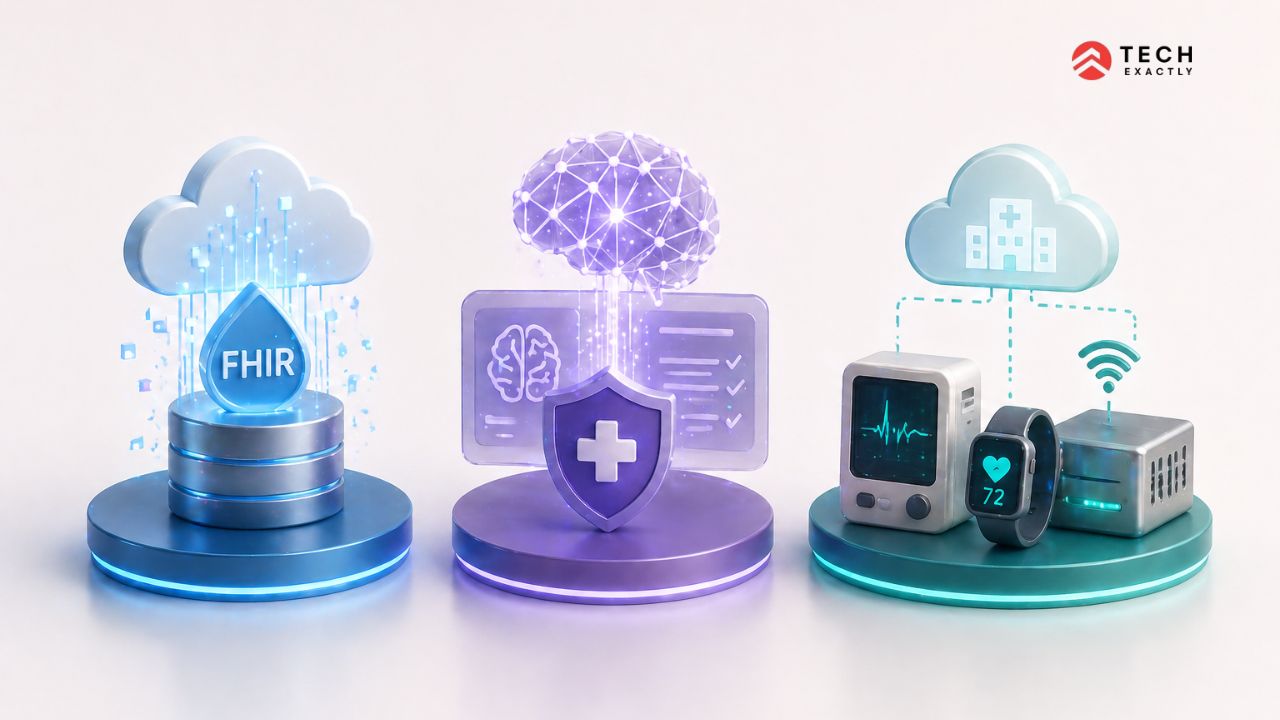
Most “trends” lists are just noise. These three are actually changing how decisions in cloud healthcare are being made right now.
FHIR-native data platforms are becoming table stakes: AWS HealthLake, Azure Health Data Services, and Google Cloud Healthcare API all mature in 2026. Building your own FHIR server in 2026 outside a very narrow set of reasons is nothing but wasted engineering. Use the managed FHIR store and instead invest your effort at the application layer.
Generative AI with clinical-grade governance: Bedrock, Azure OpenAI, and Vertex AI Med-PaLM now provide PHI-eligible endpoints with audit and evaluation tooling. We have moved past asking if generative AI fits in healthcare. Now the real question is whether every output can be trusted, tracked, and explained. If you are planning AI-generated notes or patient communication, you should focus on the governance layer.
Edge and hybrid for device data: Medical devices generating streaming data, such as continuous monitors, imaging at the bedside, and wearables with clinical claims, increasingly need local preprocessing. This includes latency, intermittent connectivity, or data-volume reasons. AWS Outposts, Azure Stack, and Anthos for healthcare edge are maturing. For integration-heavy stacks, this is the architecture shift worth planning.
How Tech Exactly Approaches Cloud Healthcare Computing
We’ve built and migrated healthcare workloads across all three major clouds for US digital health startups, telehealth platforms, and medical device vendors. A few principles follow, regardless of the cloud:
- Design the compliance posture before the cloud choice. BAA scope, data residency, and audit requirements. All of these drive the architecture, not the other way around.
- Single primary cloud; multi-cloud only when the advantage is concrete. Doubling the compliance surface area is a real cost most teams discount.
- Managed services where they exist; roll your own only where the managed option genuinely doesn’t fit. A self-hosted FHIR server in 2026 usually isn’t engineering. It is just a maintenance tax on your future roadmap.
- Cost observability from day one, not day 300. Tag every resource, alert on spend anomalies, right-size quarterly.
Our team handles HIPAA architecture, cloud migration, FHIR integration, and post-migration optimization as part of healthcare app development projects for startups and established platforms across the USA and UK.
Frequently Asked Questions
All three can be HIPAA-compliant. Compliance comes from the architecture you build on top and not just the cloud itself. You need to choose based on workload fit, EHR alignment, and existing tech stack, and not the compliance checkbox, which all three pass.
No, you do not. For most mid-size healthcare products, a single primary cloud with a disciplined disaster recovery plan beats multi-cloud every time. Multi-cloud doubles your compliance and operations surface area. Thus, the benefit has to be well defined to justify it.
For a mid-size healthcare organization with a meaningful on-prem footprint, it takes around 9 to 18 months across six phases. Greenfield MedTech startups can be cloud native from day one and skip migration entirely.
Putting PHI into a service not on the BAA's HIPAA-eligible services list. It's usually an analytics SDK, feature flag tool, or third-party AI service that looks harmless. Maintain a strict allowlist and gate it in CI.
Yes, it can be used via the PHI-eligible endpoints in Bedrock, Azure OpenAI, and Vertex AI. All of this works out provided you have signed the BAA and the specific SKU you are calling is covered. The harder problem is governance, having evaluation, audit trails, and safety guarantees for model outputs.

Manas Das, Mobile App Architect at Tech Exactly, has over 9 years of experience leading teams in iOS, Android, and cross-platform development. He specialises in scalable app architecture and GenAI-driven mobile innovation.