

Generative AI in Healthcare Development: Use Cases, Benefits, and What Forward-Thinking Founders Need to Know in 2026

“Organizations that embrace AI will develop a competitive edge over those who do not.” — McKinsey & Company, Healthcare Gen AI Survey, Q4 2024
The inflection point is here, and it’s moving fast. Generative AI in the healthcare market stands at $2.64 billion in 2025 and is projected to reach $39.70 billion by 2034 (Precedence Research). McKinsey’s Q4 2024 survey confirms that 85% of healthcare leaders are already implementing (not just piloting) generative AI. The proof-of-concept phase is over.
For founders and CTOs at a healthcare app development company in USA or UK, the strategic question has changed. It is no longer a question of whether we build with generative AI; it is where we build first and how we build it right.
This article will mainly cover:
- where generative AI creates the most defensible value in healthcare development
- and how product and technology leaders can operationalise it responsibly and profitably.
Understanding the Role of Generative AI in Healthcare
Most healthcare organisations have used AI for years in flagging deteriorating patients, auto-coding clinical records, routing prior authorisations, etc. That AI recognises patterns in structured data and returns a predefined output. It answers: does this match a known rule?
Generative AI does something categorically different. It reads unstructured information: a clinical note, a patient message, a scan report, and produces new content: a summary, a care plan, a personalised reminder, a draft appeal letter. It answers: what should come next?
That distinction unlocks an entirely new tier of healthcare applications. Accenture estimates that language-based AI has the potential to assist or enhance 40% of all healthcare worker hours, not by replacing clinical judgment, but by eliminating the low-value work surrounding it. For healthcare management administrators and product leaders, that is the foundational opportunity.
How Generative AI Is Reshaping Healthcare Mobile App Development
This is where competitive advantage is actually built and where most tech leaders underinvest in strategic clarity.
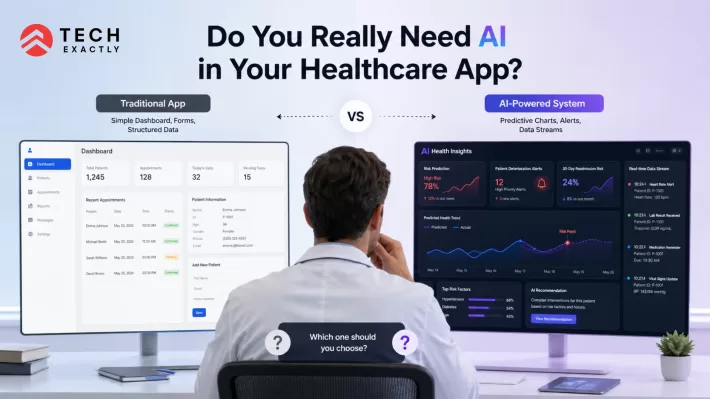
Gen-AI changes what your app can do in real time. Traditional mobile health apps display data, steps, schedules, and reminders. Generative AI enables apps to respond intelligently to that data: surfacing a health insight, adapting a care plan, or escalating a concern based on a user’s check-in response. For teams in mHealth application development, this is the shift from a dashboard to a dynamic care companion.
It raises the bar on what “custom healthcare app development” actually means.
This is also the approach we follow at Tech Exactly, where we develop healthcare mobile apps with generative AI embedded into the core architecture rather than as a feature layer.
This also opens a new product tier in Fitness application development and wearable device app development. To deliver something consumer health apps never could: a coherent health narrative connecting workouts, sleep, biometric trends, and symptoms into one readable picture.
You might like reading how we developed a smart fitness workout app that acts like your personal trainer
Use Case 1: Clinical Documentation
35% of healthcare professionals spend more time on paperwork than with patients, and 68% of physicians in 2025 report increased use of AI for clinical documentation. This is the highest-adoption generative AI application in healthcare today and the clearest entry point for any Healthcare App Development Company in USA building enterprise clinical tools.
What does it do in a product? It listens to a clinical encounter, generates a structured note from the conversation, populates the relevant fields in the health record, and surfaces a summary for the next clinician seeing that patient.
Documented time savings in deployed systems range from 40–60% per shift. Clinicians review and approve; the AI handles the drafting.
- AWS HealthScribe, integrated with Amazon One Medical, embedded generative AI into physician workflows – a live reference model for how to build compliant clinical documentation at scale.
- Cedars-Sinai’s Aiva Nurse Assistant piloted a mobile AI tool, reducing administrative load on nurses, validating demand for AI within mHealth application development for frontline clinical staff.
In our own healthcare builds at Tech Exactly, we see the strongest adoption when clinical documentation AI is tightly integrated into existing mobile workflows rather than introduced as a standalone tool.
Use Case 2: Patient Engagement
The problem with most medical reminder apps is not that they remind, but that they remind everyone the same way.
Generative AI changes the intervention entirely. Instead of a scheduled push, it produces a personalised message informed by that patient’s history, communication preferences, and early signals of disengagement, before the missed appointment, not after.
For custom healthcare app development teams building chronic disease or post-discharge platforms, this is the use case that separates a utility app from a clinically meaningful product.
From an AI in healthcare marketing standpoint, this repositions the product from a reminder tool to a proactive care companion.
Use Case 3: Wearables and Remote Monitoring
Wearable device app development sits on top of a problem in healthcare mobile app development services that generative AI is uniquely positioned to solve. Continuous monitoring generates enormous volumes of biosignal data, like heart rate, blood oxygen, glucose, sleep, and ECG, that clinical teams cannot interpret in real time at scale.
Generative AI sits between the raw signal and the clinician or patient, synthesising trends into readable health narratives, flagging what warrants attention. For fitness application development, it means translating performance data into personalised guidance that accounts for a user’s full health history.
- PieX AI launched an AI pendant for mental health monitoring using multi-sensor data, expanding the MedTech wearable category.
Learn about how we delivered a HIPAA-compliant app that offers online therapy sessions.
Use Case 4: Healthcare Operations
Administrative costs account for approximately 30% of total US healthcare expenditure, and 60% of all healthcare AI investment in 2024 targeted administrative automation. This is where enterprise buyers are signing the largest contracts, and where ROI is most measurable.
Medical courier apps and healthcare logistics platforms represent a specific underserved category. Generative AI adds real-time intelligence to specimen routing, automates chain-of-custody documentation, flags handling deviations, and surfaces exception reports when SLA thresholds are breached.
Revenue cycle management follows the same logic: generative AI drafts prior authorisation requests with clinical supporting context, predicts which claims are likely to be denied before submission, and generates appeal letters tailored to specific payer criteria.

Risks That Derail Adoption And How to Get Ahead of Them
- Confident but incorrect outputs.
Generative AI can produce plausible and wrong answers, unacceptable in clinical contexts. The mitigation is anchoring AI outputs to verified clinical knowledge sources and building mandatory human review into any workflow where the output affects a patient decision. - Bias is baked into training data.
Models trained on historical healthcare data will reflect historical disparities in diagnosis, treatment, and access. Any healthcare app development company in UK or USA deploying AI at a population scale should require demographic performance audits as a contractual deliverable, with stratified monitoring post-launch. - Compliance as an architecture decision.
HIPAA in the USA and GDPR in the UK are not legal overlays; they determine how patient data can flow through an AI system. This must be designed in from the first sprint, not addressed before launch.
This compliance-first architecture is central to how Tech Exactly approaches healthcare application development. You can read how we developed an IEC 62304-compliant mobile app for accurate test interpretation.
Key Takeaways:
- Invest in data quality before AI features.
Generative AI performs in proportion to the quality of data it works with. Consolidate patient data, clean up interoperability between systems, and put consent management in place before writing AI feature code. - Build for workflow integration, not feature demonstration.
The most common failure mode is building AI that clinicians and administrators do not use because it adds steps rather than eliminating them. - Establish governance before the first enterprise contract.
Health system procurement teams will ask how the AI is monitored. Having documented answers before the first negotiation signals clinical maturity.
Conclusion
Generative AI is not an upgrade to the healthcare tech stack. But a new category of capability. Whether you are building custom healthcare app development solutions, delivering healthcare mobile app development services, developing wearable device app development platforms, or building fitness application development tools with clinical-grade intelligence, the product decisions made in the next 12 months will define competitive positioning for the next five years.
At Tech Exactly, we work with healthcare founders and product teams to turn these decisions into compliant, scalable healthcare mobile apps that integrate generative AI responsibly from day one.
If you are evaluating how generative AI fits into your healthcare product roadmap or have questions about building AI-enabled healthcare applications, you can contact us or write to us at [email protected].
This article was written for strategic and informational purposes only. It does not constitute clinical, regulatory, or legal advice.
FAQ
What are the most production-ready generative AI examples in healthcare today?
Clinical documentation automation, AI-powered prior authorisation, personalised medical reminder apps, post-discharge follow-up tools, and wearable health narrative generation are the most widely deployed categories in 2026.
How should a healthcare app development company in the USA handle compliance for generative AI?
Compliance is an architecture decision. Patient data must flow through an approved, auditable infrastructure with the right agreements in place, built in from sprint one, not added before launch.
RAG over de-identified clinical knowledge bases, on HIPAA-eligible cloud infrastructure (AWS, Azure, GCP). It is the lowest-risk, fastest-to-market architecture for most healthcare mobile app development services use cases.
What does the process of building a healthcare app with generative AI actually look like?
It runs alongside standard mobile development, but clinical input is required at every stage:
- Discovery: Defining the workflow, the data source, and the output the AI needs to produce.
- Model selection: A suitable AI model is picked and connected to the app via an API.
- Prompt engineering: We set the rules for how the AI responds within a clinical context.
- Data integration: Link it securely to patient records, wearables, or scheduling systems.
- Validation & monitoring: Test for accuracy and bias before launch, then track performance continuously.
What is the timeline for developing a Gen AI-integrated healthcare App?
A focused Gen-AI integrated custom healthcare app development can take anywhere between four and six months. What extends timelines is rarely the AI. Ideally, as we saw in several projects at Tech Exactly, it is data readiness, integration complexity with existing health record systems, and regulatory validation for clinical or patient-facing features.