

How to Evaluate Infrastructure Vendors Before Signing a BAA | HIPAA Compliance Guide

Let me explain this concept with a scenario that plays out more often than the healthcare industry likes to admit:
A healthcare startup spends months building a promising patient-facing app. They picked an infrastructure vendor, a well-known name with a slick website, because the pricing was competitive and the sales pitch was convincing. They sign the Business Associate Agreement without much scrutiny. Fast forward nine months, and they’re staring down a breach notification, a federal investigation, and fines that could shut them down entirely.
The vendor? They had a BAA on paper. But on the ground, their security controls were paper-thin.
This isn’t a scary story but a pattern. And it’s exactly why knowing what is a BAA agreement and how to evaluate the vendor behind it is one of the most critical decisions in HIPAA compliant app development.
According to the HIPAA Journal, vendor-side breaches were significantly higher, 93M+ records due to business associates. And the average cost of a healthcare data breach hit $10.93 million in 2023, the highest of any industry for the 13th year in a row (IBM Cost of a Data Breach Report).
So before you hand over your trust and your patients’ data to a vendor, you need a rigorous evaluation process. This blog gives you exactly that.
What Is a BAA Agreement and Why Is It Important?
Let’s start with the basics, because a surprising number of teams treat the BAA as a box-ticking exercise.
A Business Associate Agreement (BAA) is a legally binding contract required under HIPAA between a Covered Entity (like a hospital, clinic, or health plan) and any Business Associate, meaning any vendor, contractor, or third-party that touches Protected Health Information (PHI). A BAA HIPAA obligation exists the moment your vendor handles, processes, stores, or transmits PHI on your behalf.
What the BAA contract must cover:
- The permitted uses and disclosures of PHI by the vendor
- The vendor’s obligation to implement appropriate safeguards
- Breach notification requirements and timelines
- The right to audit the vendor’s compliance
- Termination conditions and PHI disposal procedures
Here’s the part many teams miss: signing a BAA doesn’t make your vendor HIPAA-compliant. It only documents that they’ve agreed to be. Whether they actually are compliant is an entirely different question, and the answer is your responsibility to verify.
This is the gap that most vendor evaluations fail to close.
Why Vendor Evaluation Is Non-Negotiable
When you’re navigating HIPAA compliance software development, the regulatory environment doesn’t give you the luxury of assuming good faith.
Consider this: the HHS Office for Civil Rights (OCR) has levied penalties ranging from $145 to $2,190,294 per violation category. And if willful neglect is involved, those penalties don’t go away just because you didn’t know your vendor was non-compliant.
Even more sobering: a 2023 Verizon Data Breach Investigations Report found that third-party involvement featured in 15% of all data breaches globally, with healthcare being a disproportionately targeted sector.
When you’re building in healthcare, whether it’s a clinical platform, a telehealth solution, or a HIPAA-compliant mobile app development project, your vendor’s security posture is your security posture. Period.
Understanding Regulatory Requirements in Outsourcing Healthcare IT
Before you even open a vendor proposal, it helps to understand the regulatory requirements in outsourcing healthcare IT at a foundational level.
HIPAA’s Security Rule mandates three categories of safeguards that your vendors must comply with:
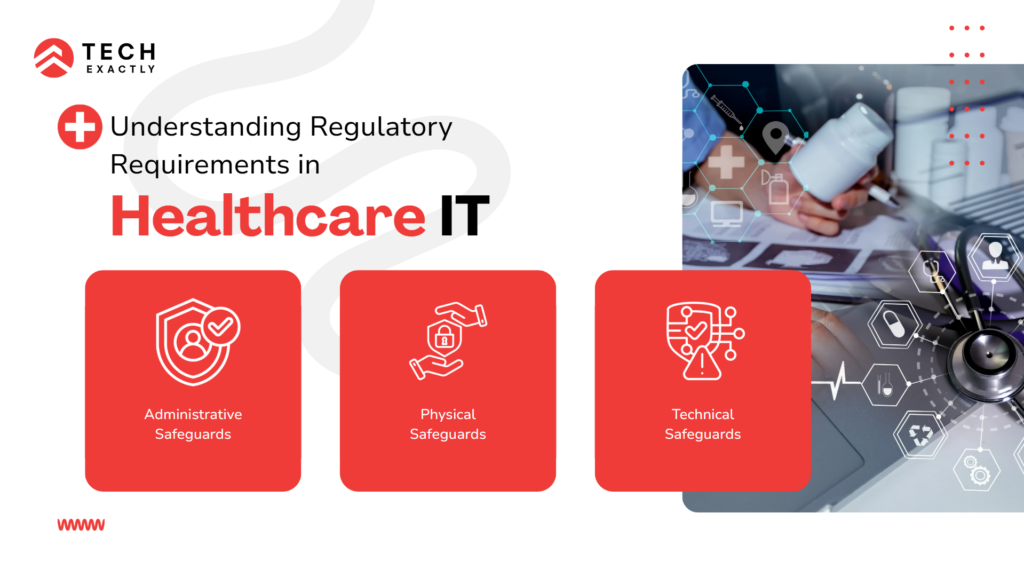
Administrative Safeguards
These govern policies and procedures: risk analysis programs, workforce training, access management policies, and contingency planning. A vendor who can’t show you a formal risk management program is a vendor you shouldn’t trust with PHI.
Physical Safeguards
These govern who can physically access systems where PHI lives, including facility access controls, workstation use policies, and device/media controls.
Technical Safeguards
These are the controls most people think of first: encryption, access controls, audit logs, and automatic logoff. But technical safeguards alone don’t make a vendor HIPAA-compliant. All three layers must be present.
If you’re outsourcing to HIPAA-compliant development agencies, you need to verify all three layers, not just ask whether they use encryption.
Pro Tip: Check out our deep dive on healthcare software development outsourcing to understand what a responsible outsourcing engagement looks like end-to-end.
The Vendor Evaluation Framework: 7 Steps Before You Sign
Here’s the evaluation process we recommend at Tech Exactly, built from real-world experience working with healthcare clients on HIPAA compliance software development projects.
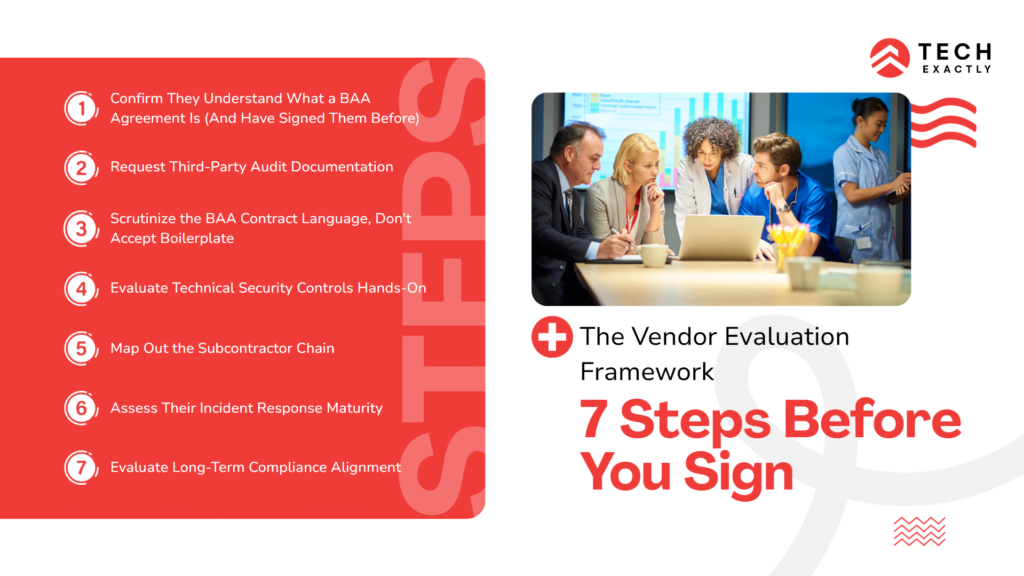
Step 1: Confirm They Understand What a BAA Agreement Is (And Have Signed Them Before)
This sounds obvious, but you’d be surprised how many vendors, especially smaller cloud providers and dev shops, treat the BAA contract as a legal formality their lawyers handle. A vendor who deeply understands the BAA HIPAA framework will:
- Have a standard BAA template ready to share
- Be willing to negotiate specific clauses
- Know exactly which of their subcontractors also have BAAs in place
What to ask: “Can you share your standard BAA contract? Which of your subprocessors are also covered under BAAs?”
If they hesitate, that’s your first red flag.
Step 2: Request Third-Party Audit Documentation
Any legitimate HIPAA compliance software vendor will have undergone third-party audits. The gold standards to look for:
- SOC 2 Type II Report — not just Type I. Type II covers a period of time (usually 6–12 months), proving sustained controls, not just a point-in-time snapshot.
- HITRUST CSF Certification — the most rigorous healthcare-specific framework.
- ISO 27001 Certification — a strong signal of mature information security management.
Example: Imagine you’re evaluating two cloud vendors for your HIPAA compliant mobile app development infrastructure. Vendor A has a SOC 2 Type I from 18 months ago. Vendor B has a current SOC 2 Type II and HITRUST CSF certification. Vendor B isn’t just more compliant on paper; they’ve demonstrated it continuously. That’s the vendor you want.
What to ask: “Can you provide your most recent SOC 2 Type II report? When does your HITRUST certification expire?”
Step 3: Scrutinize the BAA Contract Language, Don’t Accept Boilerplate
Not all BAA contracts are created equal. The language in a BAA directly determines your legal exposure in the event of a breach. Watch for these specific areas:
Breach Notification Timelines: HIPAA requires notification within 60 days of discovering a breach. But your internal response and your own notification to regulators depend on how fast your vendor tells you. Push for contractual SLAs of 24–72 hours for initial vendor notification.
Subcontractor Coverage: Your vendor’s BAA should explicitly state that all downstream subcontractors who touch PHI are also covered under BAAs. If the language is vague here, your chain of compliance has a hole in it.
Audit Rights: The BAA should give you the right to audit or request audit results from the vendor. Vendors who resist this clause are hiding something.
Indemnification Clauses: Who bears liability if the breach originates from the vendor’s systems? This needs to be explicit. Don’t let “mutual indemnification” language paper over a situation where your vendor’s negligence exposes you.
Related reading: Our HIPAA audit checklist for healthcare apps breaks down exactly what you need to test and how to fix what fails.
Step 4: Evaluate Technical Security Controls Hands-On
Marketing pages and sales decks will tell you every vendor is HIPAA-compliant. What separates good HIPAA compliance services from lip service is the technical detail behind the claims. During your evaluation, press for specifics:
Encryption
- Is data encrypted at rest? With what algorithm? (AES-256 is the standard.)
- Is data encrypted in transit? (TLS 1.2 or 1.3 minimum.)
- Who holds the encryption keys? Can you manage your own keys?
Access Controls
- Do they support Role-Based Access Control (RBAC)?
- Is Multi-Factor Authentication (MFA) enforced, not just offered?
- How are privileged access and admin accounts monitored?
Audit Logging
- Are all PHI access events logged with timestamps and user IDs?
- How long are logs retained? (HIPAA requires 6 years for documentation.)
- Are logs tamper-evident?
Example: A HIPAA-compliant software developer you’re evaluating says they “support encryption.” Dig deeper: if they can’t tell you whether they use AES-256 at rest and TLS 1.3 in transit, or if customer-managed keys aren’t an option, that’s a knowledge gap that signals maturity issues in their HIPAA compliance services.
Step 5: Map Out the Subcontractor Chain
Here’s something most evaluation guides skip: your vendor’s vendors matter too.
Under HIPAA, the obligation to protect PHI flows downstream. If your vendor uses a subcontracted data center, a third-party analytics platform, or even an outsourced customer support tool that might access PHI, all of those entities need to be covered under BAAs.
What to ask: “Please provide a list of all subprocessors that may have access to PHI, and confirm that each one has a signed BAA with you.”
This is especially critical when evaluating regulatory requirements in outsourcing healthcare IT; the chain of accountability must be unbroken from you all the way down.
Step 6: Assess Their Incident Response Maturity
A vendor who’s never had a security incident isn’t necessarily more trustworthy than one who has; what matters is how they responded. Ask for their incident response plan (IRP) and look for:
- Defined roles and escalation paths during a breach
- Documented tabletop exercises or real incident post-mortems
- A dedicated security team (not just a dev who “handles security”)
- Clear breach notification workflow that integrates with their BAA HIPAA obligations
What to ask: “Can you walk me through how you handled your last security incident? What was your notification timeline?”
Their comfort or discomfort answering this question will tell you a lot.
Step 7: Evaluate Long-Term Compliance Alignment
Compliance isn’t a one-time event. Before you sign, ask how your vendor supports your ongoing compliance:
- Do they provide compliance reports on a regular cadence?
- How do they communicate policy or infrastructure changes that could affect your PHI environment?
- Do they have a dedicated customer success or compliance liaison for healthcare clients?
HIPAA-compliant development agencies and infrastructure vendors who take long-term compliance seriously will have proactive communication processes, not just reactive ones when something goes wrong.
Red Flags: When to Walk Away
Sometimes the evaluation process reveals that a vendor simply isn’t ready for healthcare workloads. Here are clear signals to exit the conversation:
- They can’t produce a signed BAA quickly. If it takes weeks and multiple legal escalations, their process isn’t built for healthcare.
- Their BAA contract has no breach notification timeline. Vague language here is a liability, not a technicality.
- They conflate “secure” with “HIPAA-compliant.” Security and compliance overlap, but they’re not synonymous. A vendor who doesn’t know the difference doesn’t understand HIPAA compliance services.
- No third-party audit reports available. Self-attestation is not sufficient.
- Resistance to audit rights. A compliant vendor has nothing to hide.
- PHI stored in non-US regions without your knowledge. International data residency creates additional compliance complexity.
A Real-World Example: What Good Vendor Evaluation Looks Like
Let’s say your team is building a HIPAA compliant mobile app for remote patient monitoring. You’ve shortlisted two infrastructure vendors.
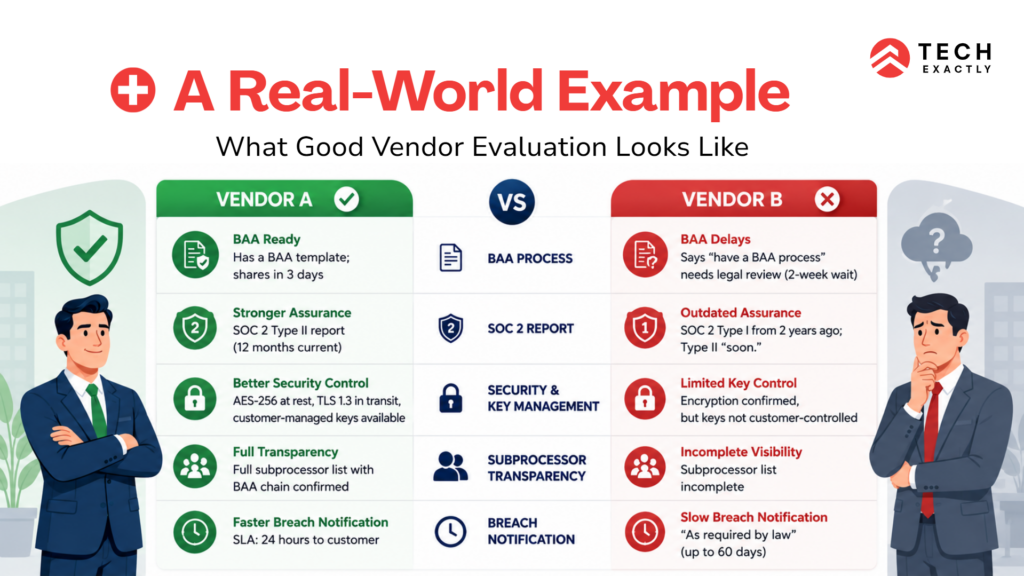
Vendor A is the clear choice, even if Vendor B is cheaper. The cost of HIPAA compliance software development done right is always less than the cost of a breach.
For teams navigating the build-vs-integrate decision in healthcare apps, see our guide: Build vs. Integrate AI in Healthcare Apps.
Choosing the Right HIPAA-Compliant Development Partners
Evaluating infrastructure vendors is only part of the picture. If you’re working with external HIPAA-compliant development agencies to build the application itself, the same rigor applies. Your HIPAA app developer, whether an agency or a freelance team, is a Business Associate the moment they access PHI in a development or testing environment.
HIPAA-compliant software developers who operate at a high standard will:
- Use de-identified or synthetic data in dev/test environments (never real PHI)
- Maintain their own access logs and security policies
- Sign a BAA with you before the first line of code is written
- Follow secure SDLC (Software Development Life Cycle) practices
- Have internal policies governing code repositories, secret management, and endpoint security
When vetting a HIPAA app developer, treat them through the same lens as your infrastructure vendor, because from a regulatory standpoint, they are one.
If you’re building or scaling a healthcare application, our guide on HIPAA compliant mobile app development is a good place to start before you bring in any development partner.
A Note on AI-Powered Healthcare Infrastructure
As more healthcare applications integrate AI, the question of whether to process data on-device or via cloud APIs becomes a compliance consideration, not just a technical one. HIPAA compliant app development in an AI context adds another layer to your vendor evaluation: where does inference happen, and does PHI travel to an external model provider?
If it does, that provider needs a BAA too.
Explore the tradeoffs in our breakdown: On-Device AI vs. Cloud-Based APIs.
Vendor Evaluation Checklist at a Glance
Use this before any BAA signing:
BAA Contract Review
- Standard BAA template available and shareable
- Breach notification SLA defined (ideally ≤72 hours to customer)
- Subcontractor BAA chain documented
- Audit rights clause included
- Indemnification language reviewed by your legal team
Compliance Documentation
- SOC 2 Type II report (current, within 12 months)
- HITRUST or ISO 27001 certification (if applicable)
- Most recent internal risk assessment shared
Technical Controls
- Encryption at rest (AES-256) and in transit (TLS 1.2+) confirmed
- Customer-managed key option available
- MFA enforced for all access
- Audit logs retained for ≥6 years
- RBAC implemented
Operational Readiness
- Dedicated security/compliance team confirmed
- Incident response plan reviewed
- Subprocessor list complete and BAA-covered
- Ongoing compliance reporting cadence defined
Conclusion: Evaluate First, Sign Second
The BAA is where legal obligation begins, but your job as a responsible healthcare product team starts long before the ink dries. Whether you’re working with cloud infrastructure providers, HIPAA-compliant development agencies, or specialized HIPAA compliance software vendors, the evaluation process is your primary line of defense.
The vendors worth trusting are the ones who welcome your scrutiny. They’ll have audit reports ready, BAA templates available, subprocessor lists on hand, and a security team you can actually talk to. If a vendor gets defensive when you ask hard questions, that defensiveness is itself a data point.
In an industry where the cost of a breach can reach nearly $11 million and where patients trust you with their most sensitive information, no pricing advantage from a poorly vetted vendor is worth the risk.
Here at Tech Exactly, we believe the process is simple: evaluate thoroughly. Sign confidently.