

How to Choose the Right Software Development Partner in 2026


As per BCG, nearly 70% of digital transformations fail to meet their original timeline, budget, or scope and in the majority of cases, the root cause isn’t technical. It’s the wrong partner. A team that overpromised in the sales process, underdelivered in execution, and left the client holding a codebase they don’t fully own and can’t easily maintain.
The software development outsourcing market is valued at $618 billion in 2026 and is on track to reach nearly $977 billion by 2031. That growth means more options than ever, but it has also flooded the market with vendors who look identical on paper. Whether you’re looking for a custom mobile app development company or a long-term engineering partner, the gap between the best and the rest has never been wider or harder to spot before you sign a contract.
The stakes in 2026 are higher than they’ve ever been:
- AI has raised the baseline of what software is expected to do, and a partner not building with AI-native practices is already behind.
- Product timelines have compressed, and the window between idea and market is narrower than it has ever been.
- The cost of the wrong choice: delayed go-to-market, compounding technical debt, and a product that never ships is a mistake that startups and enterprises alike cannot afford to make twice.
To understand why the stakes are this high, you need to understand what has fundamentally changed in the market.
The State of Software Development Partnerships in 2026
Three forces are reshaping how companies should evaluate development partners, and all three have accelerated significantly in the past 24 months.
- AI is now a baseline expectation, not a differentiator. Gartner projects that 80% of the development lifecycle will involve generative AI touchpoints by year-end. A partner who isn’t using AI-assisted development, testing automation, and LLM-powered tooling is already operating at a structural disadvantage and so is any client who hires them.
- The talent shortage is driving outsourcing decisions. Companies face a 44% gap in IT skills associated with AI, machine learning, and data science. This isn’t a temporary spike; it is a structural imbalance between the demand for specialized engineering talent and its supply in developed markets.
- Buyers have moved from lowest cost to best outcome. Buyers now sign shorter contracts but expand scope with outcome-based pricing increasingly linked to KPIs like cloud cost per unit or defect escape rates. The era of the long, vague, time-and-materials engagement is ending.
These three shifts change who you should hire and how you should evaluate them.
In-House vs. Outsourcing: The Real Decision Framework
Before you evaluate any partner, you need to answer a more fundamental question: should this be built in-house at all? The answer is rarely black and white, but the framework below makes it clearer.
| Dimension | In-House Team | Outsourced Partner |
| Upfront cost | High (hiring, onboarding, benefits) | Lower (project or retainer-based) |
| Time to start | 3–6 months to hire and onboard | 2–4 weeks to kick off |
| AI & specialist skills | Hard to hire, high attrition | Access to pre-built specialist teams |
| Long-term cost | Lower at scale if retained | Flexible, scales with need |
| IP control | Full | Contractually protected |
| Best for | Core product, long-term roadmap | MVPs, new capabilities, scale-up |
If you’re building infrastructure, integrations, or a new vertical capability, a specialist software development partner 2026 is almost always faster and cheaper than building the internal competency from scratch.

The decision you make here sets the context for everything that follows, including which type of partner you should be looking for. Whether you’re a US-based product company or a founder seeking custom software development services, a specialist software development partner is almost always faster and cheaper than building the internal competency from scratch.
For a deeper breakdown: In-House vs Outsourcing Software Development
The Step-by-Step Checklist: How to Choose a Software Development Company
The sections above give you the framework. This checklist turns it into action. Use it when evaluating any development partner; a strong partner clears every item. Gaps are negotiating points, not dealbreakers, but undisclosed gaps become project risks.
Step 1: Define your requirements before outreach
☐ Do you have a clear product brief or technical specification?
☐ Have you defined success metrics: launch date, performance benchmarks, budget ceiling?
☐ Do you know whether you need a fixed-price engagement or an ongoing team?
Step 2: Evaluate technical capability
☐ Do they have demonstrable experience in your tech stack?
☐ Have they built in your industry or a closely adjacent one?
☐ Do they use AI-assisted development tools as standard practice?
☐ Can they walk you through a relevant architecture decision from a past project?
Step 3: Assess communication and project management
☐ What project management methodology do they follow?
☐ What tools do they use: Jira, Linear, Notion, Confluence, Slack?
☐ What is their timezone overlap with your team?
☐ Who is your dedicated point of contact: a PM, a developer, or an account manager?
Step 4: Validate their track record
☐ Can they provide references from clients in similar industries?
☐ Do their case studies show measurable outcomes, not just screenshots?
☐ How do they handle projects that go off-track, do they have a documented recovery process?
Step 5: Review the commercial terms
☐ Is the pricing model aligned with your risk appetite?
☐ Are IP ownership terms clearly defined in the contract?
Step 6: Run a paid discovery or trial sprint
☐ Have you run a short paid engagement before committing to the full project?
☐ Did the quality of their output match what was promised in the sales process?
The checklist tells you what a strong partner looks like. The next section tells you when to walk away entirely.
Related reading: Key Factors to Consider for App Development for Startups
The 5 Biggest Mistakes Companies Make When Choosing a Partner
Once you’ve decided to work with an external partner, the selection process itself becomes the highest-risk phase. Most failed outsourcing engagements fail during selection, because the wrong signals were evaluated and the right questions were never asked. These five mistakes follow a predictable pattern, roughly in the order they occur during the evaluation process.
Choosing based on price alone
Hourly rates range from $25–$50/hr in Asia to $80–$150/hr in North America, but hourly rate and total project cost are entirely different numbers. A slower, cheaper team that requires more rework will consistently cost more. Price is an input to the decision, not the decision itself.
Skipping the architecture conversation
Most companies evaluate partners on portfolio and price. Few ask how the partner would architect the specific system being built.
Ignoring the communication infrastructure
Timezone gaps, language barriers, and poor tooling compound into weeks of delay. Ask specifically how they handle async communication, sprint reviews, and escalations before you sign anything.
Not defining success metrics upfront
TeamStage’s 2024 research found that 37% of projects fail due to a lack of clear goals and objectives. A partner who agrees to everything in the sales process without pushing back is a red flag, not a green one. Good partners challenge unclear requirements because vague requirements produce poor outcomes.
Treating the contract as the relationship
The contract establishes baseline protection. The relationship determines whether the product gets built well. How a partner behaves in the first two weeks – their questions, their proactivity, their documentation tells you more than any legal agreement ever will.
Knowing what to avoid is half the picture. The other half is knowing what to actively look for.
What the Best Development Partners Look Like in 2026
The profile of an excellent software development company has shifted. Technical competence is table stakes. What separates the best from the rest in 2026 is a combination of AI-augmented delivery, domain depth, and outcome accountability.
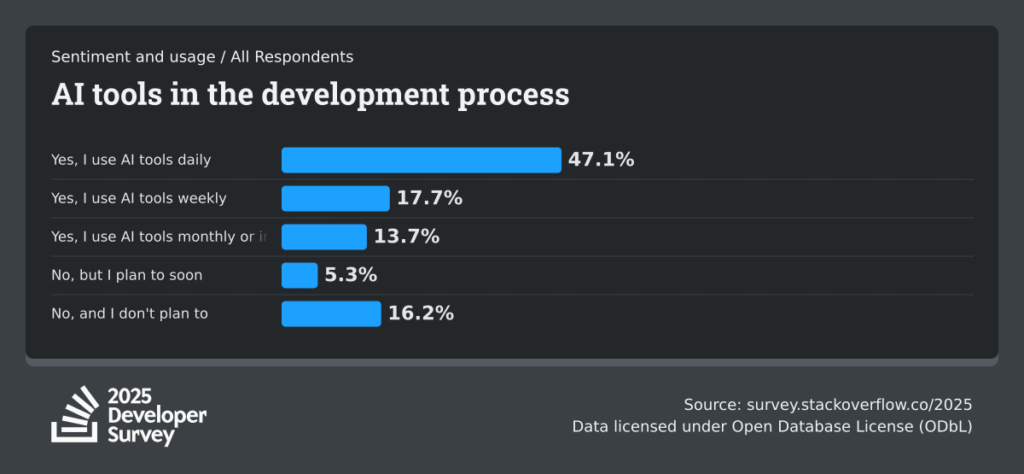
- AI-native development practice: The majority of teams using AI-assisted workflows report noticeable time savings, with many developers saving several hours per week. A partner using GitHub Copilot, AI-assisted testing, and LLM-powered code review as standard is catching bugs earlier and shipping more predictably.
- Vertical domain experience: A partner who has built in your industry: healthcare, FinTech, logistics, SaaS, brings regulatory knowledge, UX patterns, and integration experience that a generalist team will spend your budget acquiring from scratch.
- Transparent project management: Agile delivery with weekly demos, shared sprint boards, documented velocity, and honest retrospectives. You should never have to chase a status update.
Over 85% of companies report that their outsourcing partnerships meet or exceed expectations, but that figure is an average across all engagements, and the distribution is wide. The partners at the top of that distribution share the traits above. The ones at the bottom share the five failure patterns from the previous section.
▶️Related reading: How to Choose the Right Mobile App Development Partner
Types of Software Development Engagement Models and What They Cost
Knowing what a good partner looks like is necessary, but you also need to structure the commercial relationship correctly. The software development engagement models you choose allocate risk between you and your partner, and getting it wrong creates misaligned incentives from day one.
| Model | How It Works | Best For | Risk |
| Fixed Price | Agreed scope, fixed budget | Well-defined MVPs, short projects | Scope creep leads to change orders |
| Time & Materials | Billed by hours worked | Evolving scope, long-term builds | Budget can drift without governance |
| Dedicated Team | Monthly retainer per team member | Product companies, ongoing development | Higher commitment, highest flexibility |
| Outcome-Based | Priced against delivered KPIs | Mature buyers, complex programs | Requires a strong metrics definition |
The industry is moving toward outcome-based and dedicated team models as buyers demand accountability over activity. For most product companies building in the $50k–$300k range, a fixed-price MVP followed by a dedicated team retainer is the combination that minimizes risk at early stages while preserving flexibility as the product matures.
If a partner pushes back on outcome-based KPIs or can’t articulate what success looks like in measurable terms: sprint velocity, defect escape rate, time-to-feature, that tells you something important about where their incentives actually sit.
Explore further: Software Development Outsourcing: A Complete Guide
How to Verify a Partner’s Project Management Skills Before You Sign
Technical capability gets a partnership started. Project management determines whether it finishes on time and on budget. This is the dimension most companies evaluate least rigorously during selection and suffer the most during execution.
Scope creep and shifting requirements affect the majority of projects and are strongly associated with cost overruns, yet most clients only discover a partner’s project management weaknesses after work has already begun. Only 1 in 14 software projects is delivered on time and within budget. The differentiator between that statistic and a well-run engagement almost always comes down to process, not talent.
What good project management from a development partner looks like:
- Dedicated project manager: Not a developer doubling as PM. They should run a live Jira board, a Confluence or Notion doc space, and time-tracking via WebWork. Can’t show you their board on a sales call? That’s a signal.
- Fortnightly demos, not slide decks: Working software every two weeks. Strong partners use Loom for async sprint walkthroughs, especially useful across time zones.
- Shared risk register: A live doc in Notion or Confluence tracking technical and timeline risks with mitigation plans, accessible to both teams at any time, not just on scheduled calls.
- Documented change management: Scope changes are inevitable. A mature partner logs every change in Jira or a Google Sheets change log with clear cost and timeline impact. Vague verbal adjustments are a red flag.
Venkatesh, Business Analyst, Tech Exactly: “The clearest sign of a mature development partner isn’t their portfolio, it’s how they run their Jira board. When we onboard a new project at Tech Exactly, the first thing we set up is a shared workspace with the client: epics mapped to business outcomes, not just feature lists. A sprint board that only the dev team can see is a red flag we actively look for when auditing failed projects that come to us for recovery work.”
Case Study: How the Right Software Development Partner Built the UK’s #1 High-Protein Recipe App
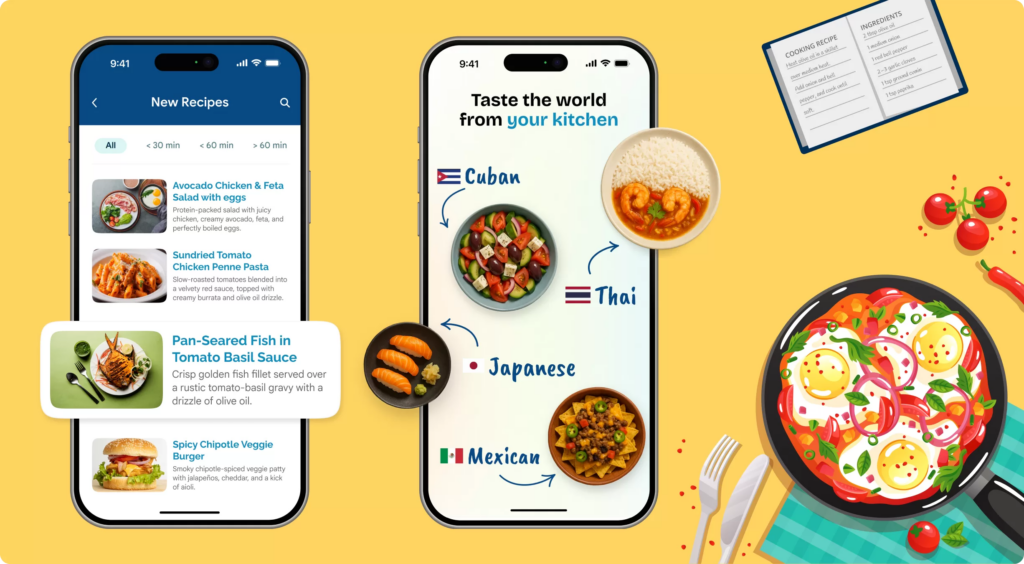
A UK-based nutrition brand had already launched a recipe app on a no-code platform. It got them to market fast, but as the community scaled, the cracks started showing. The founder made the call to scrap it, rebuild custom, and bring in Tech Exactly as their right software development partner.
The Problem
The no-code platform had done its job as an MVP. But it was actively holding the business back:
- Content was fragmented across YouTube, social media, and PDFs, no central hub
- Load times were degrading as the recipe library crossed 100+ entries
- There was no native subscription system, so premium revenue potential was going untapped
The Solution
Tech Exactly rebuilt from scratch as a fully custom cross-platform mobile app: React Native on iOS and Android, backed by Laravel and AWS. A dedicated team of React Native developers, UX designers, QA analysts, and a project manager handled the full build.
- Smart search and filters across 300+ recipes by keyword, meal type, and cooking time
- Rich recipe pages with nutritional breakdowns, ingredient lists, and embedded YouTube videos
- RevenueCat-powered subscriptions with monthly/annual plans and a 3-day free trial to drive conversions
The Outcome
- 360,000+ followers and the UK’s #1 High-Protein Recipe App
- 4.9/5 App Store rating with 1,000+ five-star reviews
- A fully monetized premium content engine, something the original no-code build never could have supported
As the founder put it: “Tech Exactly has delivered excellent work on time. The standard of work and the cost of the engagement have been outstanding.”
▶️Read the full case study here.
The Cost of Not Knowing How to Find a Software Development Partner
A failed or under-delivered software development engagement doesn’t just mean a wasted budget. It means delayed go-to-market, lost competitive position, technical debt that takes years to unwind, and in some cases, a product that never ships at all. The average cost of a failed software project runs to $66 million for large enterprises (McKinsey) and proportionally devastating amounts for startups, where runway is finite and second chances are rare.
The time spent rigorously evaluating a development partner upfront, running the checklist above, asking the hard questions, doing a trial sprint is the highest-ROI activity in the entire project lifecycle. It is also consistently the one that companies skip when they’re excited about building.
Don’t skip it. Read more on Benefits of Custom Software Development Company to understand what a well-executed engagement actually delivers.
So, Are You Choosing a Vendor or a Partner?
That’s the question worth sitting with before you shortlist anyone.
A vendor delivers what you ask for. A true software development partner in 2026 and a mobile app development company worth working with challenges your assumptions, flags risks you haven’t thought of, documents every decision, and treats your product’s success as their own accountability. The technical skills are table stakes. The process, the communication culture, and the engineering values are what actually determine whether the product ships and whether it’s something you’re proud of when it does.
Everything this guide has covered, the evaluation framework, the engagement models, the checklist, the red flags comes down to one practical filter: does this partner behave like they have skin in the game, or like they’re managing a ticket queue?
At Tech Exactly, a software development company that has shipped products across healthcare, FinTech, fitness, and field operations, we believe the best partnerships start before a single line of code is written with the right questions, the right documentation, and a shared definition of what success actually looks like. If you’re currently evaluating development partners and want a team that treats your product with the same rigor we apply to our own, let’s start the conversation. We’d love to hear what you’re building.