

How SMBs Can Integrate AI into Existing Software Systems: A Complete 2026 Guide

Key Takeaways
- AI integration is an infrastructure decision, not a feature addition. SMBs that treat it as a bolt-on consistently underdeliver and overspend.
- Data quality determines AI quality. Before evaluating any tool or vendor, audit what you have. Dirty data often produces confident, wrong outputs.
- Start narrow, prove ROI, then expand. One well-integrated AI use case delivers more value than five half-built ones running simultaneously.
- Integration is 60% data engineering and 40% architecture decisions before a model is even selected.
- AI automation for small businesses compounds over time. The SMBs pulling ahead aren’t the ones with the most AI tools; they’re the ones whose AI gets measurably smarter every quarter.
Most articles about AI integration read like they were written by someone who has never actually had to integrate anything. They talk about “leveraging AI capabilities” and “unlocking transformative potential” and then leave you with a five-step framework that assumes you’re starting from a clean slate with a generous budget and a team of ML engineers on standby.
That’s not what we see at Tech Exactly. Small and mid-sized businesses are no longer asking whether to integrate AI; they’re asking how fast they can do it without breaking what already works. According to McKinsey’s 2025 State of AI report, 88% of organizations are now using AI in at least one business function, up from 78% just a year prior.
But most SMBs don’t start with a blank slate. They start with a CRM from 2017, an ERP that the IT team is afraid to touch, a customer support stack held together with Zapier automations, and a development budget that doesn’t stretch to a full rebuild. Integrating AI into software systems that were never designed for it is the real challenge.
That gap between the AI opportunity and the legacy reality is precisely where most SMB integration projects stall, overspend, or quietly fail. Partnering with an experienced AI-powered mobile app development company is no longer reserved for enterprise budgets. It’s the fastest path for SMBs to close that gap without burning existing infrastructure.
Why SMBs Are Prioritizing AI Integration in 2026
This urgency is no longer theoretical. Three forces have converged to make AI solutions for business a board-level priority for SMBs.
Competitive pressure from AI-native competitors.
Startups entering traditional SMB markets are building AI-first from day one: lower operational costs, faster customer response, and personalized experiences at scale. An SMB without AI is now competing against organizations that are structurally cheaper to run.
Salesforce found that 72% of customers expect companies to understand their needs and expectations. Businesses still relying on manual workflows are losing in measurable ways: higher churn, slower resolution times, and lower satisfaction scores.
AI has become genuinely accessible.
The proliferation of API-first AI tools – OpenAI, Anthropic, Google Gemini, HuggingFace, etc. means that AI solutions for business no longer require a dedicated data science team or a seven-figure infrastructure budget. The barrier is no longer cost or access, but integration strategy.
Related reading → How to Integrate AI into Your App: Full Guide
Key Points:
AI automation for small businesses is an operational necessity in 2026.
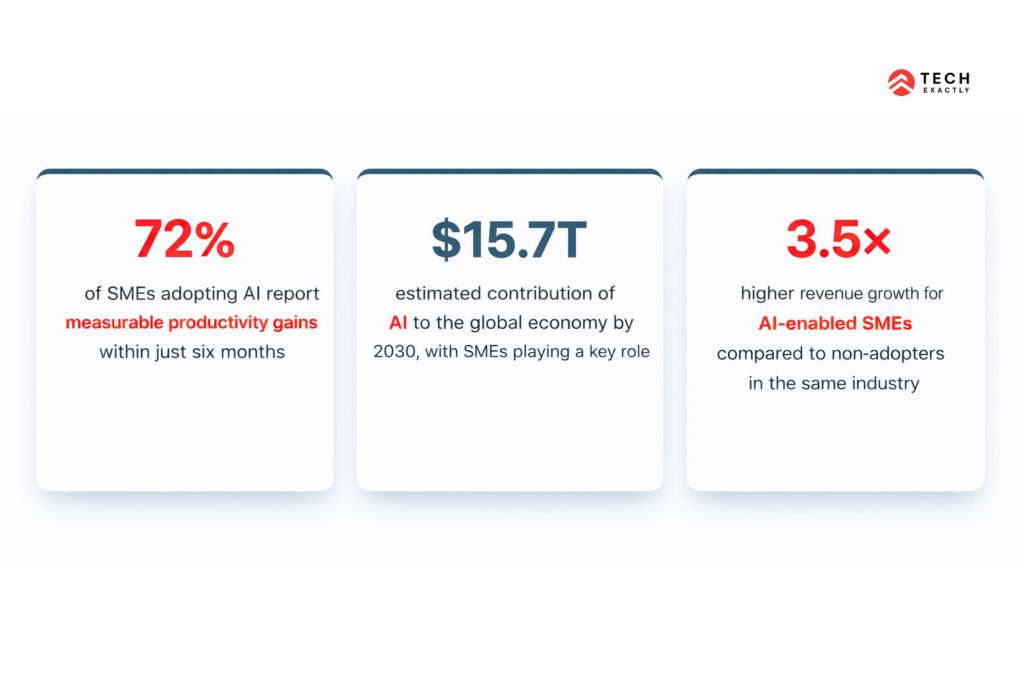
- The global AI market for SMBs is projected to reach $ 521.3 billion by 2028.
- SMBs using AI-powered tools report an average 40% reduction in time spent on repetitive tasks. (Source)
- 60% of SMB owners say AI has already improved their ability to focus on core business functions, per the US Chamber of Commerce.
- Companies that invest in AI tech consulting integration with existing systems are 3x more likely to report successful AI outcomes than those who self-implement without specialist guidance.
Key Challenges in Overcoming Legacy System Hurdles
Understanding why you should integrate AI is the easy part. Understanding what stands in your way is where the real work begins. Legacy systems: the operational backbone of most SMBs presents a specific set of integration challenges that generic AI adoption advice rarely addresses.
Data fragmentation and poor data quality. AI models are only as good as the data they access. Most SMBs have customer data spread across a CRM, a billing system, spreadsheets, and email threads, with no unified schema, inconsistent formatting, and years of duplicates. Before AI can add value, data pipelines need to be cleaned, normalized, and centralized.
API gaps in older software. Systems built before 2015 were rarely designed with API-first architecture. Integrating templates with existing software systems in USA often means building middleware. A translation layer between legacy systems and new AI services.
Change resistance inside the organization. This is the challenge no vendor mentions in their sales deck. Teams that have built workflows around existing systems resist AI integration, not because of technical reasons but because of fear: of job displacement, of learning new tools, of being held accountable to metrics they didn’t previously have.
- Legacy system incompatibility is the #1 barrier to AI adoption by SMBs, ahead of cost and skills gaps.
- The average SMB runs 8–12 separate software tools, making integration complexity a genuine architectural challenge, not just a vendor selection problem.
- Only 23% of SMBs have a documented data governance policy, which is a critical prerequisite for any AI integration that touches customer data.
💡A lesson we learned at Tech Exactly: Early in our AI integration practice, we took on an SMB client with a legacy inventory management system and immediately began scoping the AI layer without auditing the data quality first. Three weeks in, we discovered the product database had 40% duplicate entries and inconsistent category naming across four years of manual imports. The AI recommendations were confidently wrong because the data feeding them was a mess. We now make data auditing the mandatory first phase of every consulting for AI integration in existing systems, before a single line of AI code is written. It added two weeks to the timeline and saved the entire project.
Step-by-Step Strategy: Consulting for AI Integration in Existing Systems
The difference between an AI integration that delivers ROI and one that becomes a sunk cost is almost always the strategy phase, specifically, whether it happened at all. Here is the framework Tech Exactly uses when integrating AI into an SMB’s existing software stack.
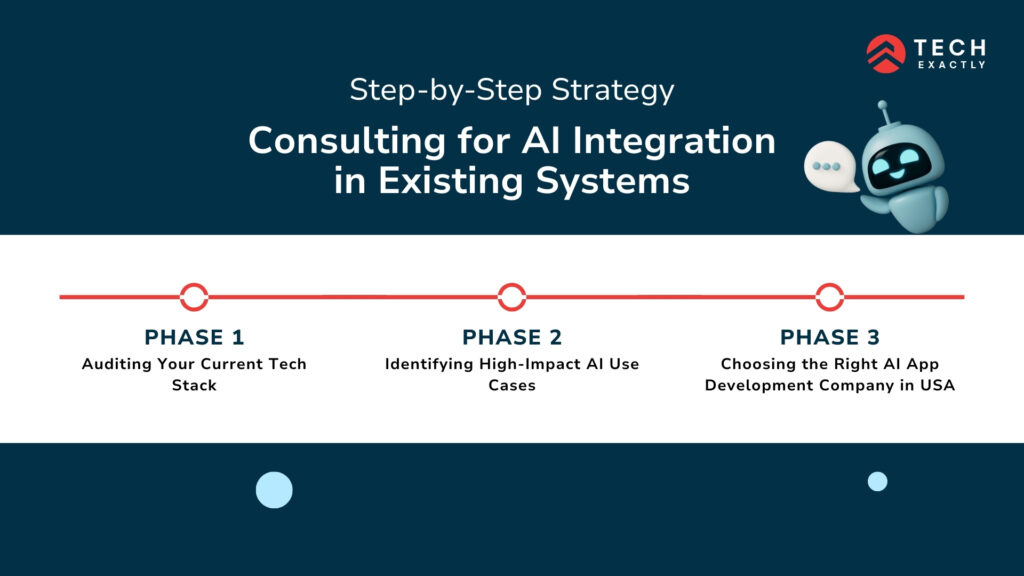
Phase 1: Auditing Your Current Tech Stack
Before evaluating any AI tool or vendor, you need a complete, honest picture of what you’re working with. This means documenting every software system in use, its API availability, its data outputs, and its integration history.
- Map every tool in your stack: CRM, ERP, helpdesk, billing, communication, analytics.
- Identify which systems have modern REST or GraphQL APIs and which require custom middleware.
- Assess data quality per system: volume, completeness, consistency, and recency.
- Document where manual human effort is filling gaps that software should be handling.
The output of this phase is not a technology recommendation but a clear-eyed picture of your integration constraints. Any AI tech consulting integration with existing systems partner who skips this phase and jumps straight to tool recommendations is selling you a solution before they understand your problem.
Phase 2: Identifying High-Impact AI Use Cases
Not every business process is a good candidate for AI integration. The highest-ROI use cases share three characteristics: they are repetitive, data-rich, and currently consuming disproportionate human time.
AI Use Case | Business Function | Typical SMB ROI |
AI-powered lead scoring | Sales & CRM | 30–45% improvement in conversion rate |
Automated customer support | Helpdesk / Service | 60–70% reduction in first-response time |
Invoice & document processing | Finance / Operations | 80% reduction in manual processing time |
Inventory demand forecasting | Supply Chain | 25–35% reduction in overstock costs |
AI content & copy generation | Marketing | 50% reduction in content production time |
Predictive churn analysis | Customer Success | 20–30% improvement in retention |
Prioritize use cases where the data already exists, the workflow is well-defined, and the business impact is directly measurable. Start with one. Prove ROI. Then expand.
Phase 3: Choosing the Right AI App Development Company in USA
This is the decision that determines whether your integration succeeds or stalls. The right AI app development company in USA for an SMB integration engagement is not the same as the right partner for a greenfield AI product build. You need a team with specific experience in integrating templates with existing software systems in USA, middleware development, and the legacy architecture patterns common in SMB tech stacks.
- Ask for integration-specific case studies: Not AI product builds, examples of AI being integrated into existing operational software with measurable before-and-after outcomes.
- Verify their data engineering capability: AI integration is 60% data work. A partner without a strong data pipeline and ETL experience will hit a wall in Phase 1.
- Check their consulting approach: The best partners spend the first engagement phase listening and auditing, not pitching tools. If a vendor recommends a specific AI solution before they’ve seen your data, walk away.
Best Practices for Integrating AI into Legacy Systems
The best practices for integrating AI into legacy systems are less about technology selection and more about how you manage the integration process itself. These are the principles that separate clean, maintainable AI integrations from technical debt disasters.
Build an API abstraction layer first. Never connect an AI service directly to a legacy system. Build a middleware layer that translates between your old system’s data format and the AI service’s expected input. This protects you from vendor lock-in and makes future AI provider swaps significantly cheaper.
Adopt a phased rollout, not a big bang deployment. Run your AI integration in parallel with existing workflows for the first 4–6 weeks. Compare AI outputs against human outputs before switching over fully. This catches edge cases, builds team confidence, and provides a safety net if something goes wrong.
Build a feedback loop from day one. AI models in production drift over time as real-world data diverges from training data. Build mechanisms for users to flag incorrect outputs and a process for using that feedback to retrain or fine-tune the model on a regular cadence.
💡Personal Insight from Tech Exactly Content Team: “We integrated an AI copywriting layer into our own WordPress CMS workflow. The mistake we made initially was giving the AI too much autonomy: publishing content with minimal human review. Within three weeks, we had blog posts with factual inaccuracies that got flagged publicly. We immediately implemented a mandatory human review gate before any AI-generated content goes live. The lesson: AI in production workflows needs guardrails, not just guidelines, and those guardrails need to be built into the architecture, not left to individual judgment.”
Related reading → Generative AI in Healthcare: Use Cases, Benefits & What Founders Need to Know
Integrating Generative AI Software in Existing Design Workflows
Generative AI has moved fastest in creative and design functions, and for SMBs with small marketing or product design teams, this is one of the highest-ROI integration opportunities available right now. The tips for integrating generative AI software in existing design workflows aren’t about replacing designers; they’re about eliminating the low-value production work that consumes their time and slowing down no one’s creativity.
The most practical integration points for SMB design and content workflows:
- AI-assisted content generation: Tools like Claude, GPT-4o, and Gemini integrate directly into CMS platforms via API, enabling AI-drafted copy that a human editor refines, compressing content production cycles by 50–70% without sacrificing brand voice.
- Design asset generation: Midjourney, DALL-E 3, and Adobe Firefly integrate into design workflows to generate first-draft visual assets, mood boards, and ad creative variations, dramatically reducing the time between brief and first concept.
- Automated design-to-code pipelines: Tools like Vercel v0 and Anima convert Figma designs into production-ready React components, reducing front-end development handoff time and the back-and-forth between design and engineering teams.
The key principle for integrating AI into creative workflows is to treat it as an accelerant, not a replacement. The most successful SMB teams treat AI as a junior team member who produces fast first drafts and a senior human who makes every final call.
The Role of AI Chatbots in Scaling Small Business Operations
For SMBs, the most immediately deployable and highest-impact AI automation for small businesses is conversational AI. An AI chatbot integrated into your customer-facing touchpoints: website, WhatsApp, email, or in-app, can handle the majority of tier-1 customer interactions without human intervention, around the clock.
But working with a specialist AI chatbot app development company matters here far more than most SMBs realize. A production chatbot integrated into your existing CRM, helpdesk, and order management system is architecturally complex. It needs context management, conversation memory, fallback routing to human agents, and live data integration. None of that comes out of the box with generic chatbot platforms.
What AI chatbot integration delivers for an SMB in practice:
- Tier-1 support automation: The chatbot handles FAQs, order status, returns, and account queries like routing only complex or escalated cases to human agents. Typical reduction in human support volume: 55–65%.
- Lead qualification at scale: The chatbot qualifies inbound website leads against your ICP criteria, books discovery calls directly into your sales team’s calendar, and logs every interaction to your CRM, without human involvement.
- Proactive customer engagement: AI-triggered outbound messages based on user behavior: abandoned cart reminders, renewal nudges, and onboarding prompts personalized at scale using your live CRM data.
An AI powered mobile app development company with chatbot integration experience will build these systems with production-grade reliability and scale without requiring a proportional increase in your support headcount.
Related reading → Agentic AI in Healthcare: How Autonomous Systems Are Transforming Patient Care
Final Thoughts
AI integration for SMBs in 2026 is more of a business transformation project that happens to involve technology.
The companies that get it right start with a clear-eyed audit of what they have, identify the specific workflows where AI delivers measurable ROI, and choose integration partners who treat data quality and process rigor as seriously as the model itself. The ones that get it wrong skip the audit, underestimate the data work, and discover six months in that they’ve built an AI layer on top of a foundation that was never ready to support it.
The AI solutions for business landscape have become more accessible than ever before, but accessibility doesn’t remove the need for strategy. A poorly integrated AI system creates more operational debt than no AI at all.
At Tech Exactly, we work with SMBs at every stage of this journey, from initial consulting for AI integration in existing systems and tech stack auditing, through to production deployment, model maintenance, and ongoing optimization. We have helped businesses integrate AI into software systems that were built long before AI was a consideration, and we know exactly where the landmines are.
If you’re trying to figure out where AI fits in your current stack, what it will actually cost, and how to avoid the mistakes that derail most SMB integration projects, let’s have that conversation.