

Top 10 Benefits of Custom Software Development for SMBs and Entrepreneurs in 2026

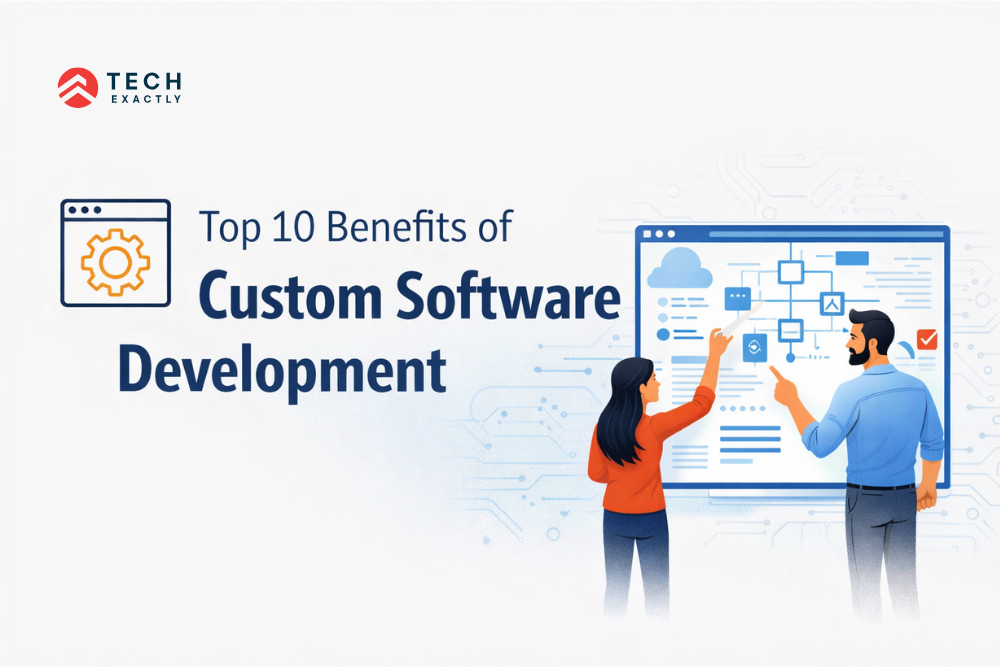
Top 10 Benefits of Custom Software Development for SMBs and Entrepreneurs in 2026
Most small and mid-sized businesses reach a point where their off-the-shelf software starts costing them more than it saves. The spreadsheet workarounds multiply. The third-party integrations break. And somewhere along the way, your team starts working around the software instead of with it.
Here’s the uncomfortable truth nobody in the SaaS industry wants you to hear: the software you’re paying a monthly subscription for might be the single biggest hidden tax on your business growth. That’s not a software problem. That’s a strategy problem. And the businesses pulling ahead in 2026 have already figured this out.
That’s the moment custom software benefits stop being a “nice to have” and become a genuine business decision. Here’s what makes the case:
- Off-the-shelf software is designed for the average business (not yours)
- SaaS licensing costs compound silently as your team and usage grow
- Vendor roadmaps prioritize their largest customers, not your specific needs
- Every workaround your team builds is time and money you’ll never get back
According to Grand View Research, the global custom software development market hit $43.16 billion in 2024 and is projected to grow at a 22.6% CAGR through 2030. If you’re in that camp, here’s everything you need to know about what custom software development actually delivers and whether it’s the right move for your business right now.
What is Custom Software Development?
Custom software development is the process of designing, building, and deploying software that is built specifically for your business: your workflows, your users, your goals. Not a generic product adapted to fit you. Something built from the ground up to work exactly the way you need it to.
| 2024 Market Size | 41.26 (USD Billion) |
| 2035 Market Size | 435.9 (USD Billion) |
| CAGR (2025 – 2035) | 23.9% |
In layman’s language, think of it like building a house. You can buy a ready-made apartment where everything is standardized, or you can design a home where every room, doorway, and layout reflects how you actually live. Both give you a place to stay. Only one is built around your needs.
In practice, custom software development outsourcing can mean a lot of different things depending on what your business needs:
- A mobile app built for your customers or field teams, from scratch, owned entirely by you
- A web platform or dashboard that centralizes your operations in a way no off-the-shelf tool can replicate
- A custom API or backend system that connects your existing tools and automates the manual work sitting between them
The process typically involves a discovery phase to map your requirements, a design and architecture phase, agile development in sprints with regular checkpoints, QA and testing, and then launch, followed by ongoing support and iteration as your product evolves.
What it is not is a quick fix or a shortcut. Custom software is a strategic investment, one that pays back in efficiency, ownership, and competitive capability over the long term.
Understanding the advantage of Custom Software vs Off-the-Shelf
Before getting into the benefits, it’s worth being clear-eyed about what you’re actually choosing between.
| Factor | Advantage of Custom Software | Off-the-Shelf |
| Upfront Cost | Higher initial investment | Lower to start |
| Long-term Cost | Lower total ownership cost | Recurring licensing + add-ons |
| Fit to Your Business | Built exactly for your workflows | You adapt to the software |
| Scalability | Grows with you, no vendor limits | Often hits a ceiling |
| Integrations | Seamless by design | Workarounds often required |
| Security | Custom architecture, harder to target | Generic, same vulnerabilities as thousands of others |
| IP Ownership | You own the code | You’re licensing someone else’s |
| Competitive Edge | Unique capabilities | Same tools as your competitors |
| Feature Control | You decide what gets built | You wait on a vendor roadmap |
The hidden costs of off-the-shelf software – training, integration, lost productivity, and workarounds- rarely show up on the initial invoice. But they accumulate fast. Over a 3–5 year horizon, the advantages of customized software frequently win on total cost, not just capability.
Top 10 Benefits of Custom Software Development
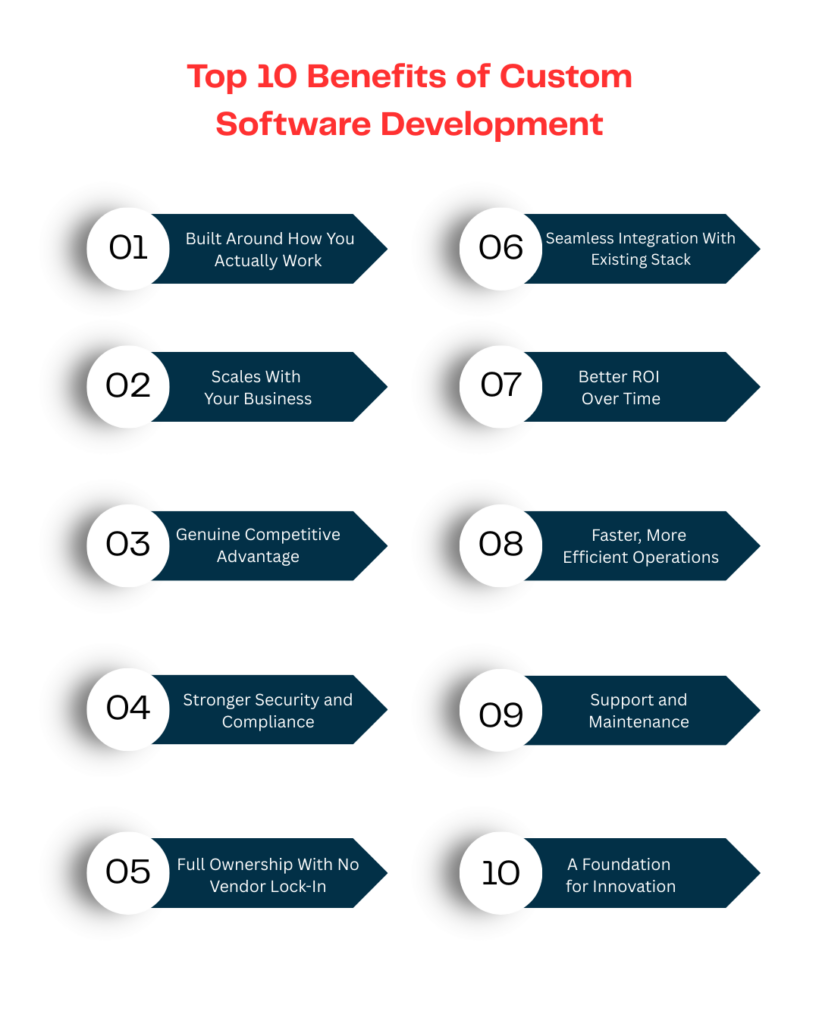
1. It’s Built Around How You Actually Work
Off-the-shelf software is designed for the average business. Yours isn’t average; it has its own processes, terminology, client management style, and operational quirks that make it work. Custom software development means the tool adapts to you, not the other way around.
For SMBs especially, you don’t have a 50-person ops team to retrain every time a vendor pushes an update that reorganizes the interface. You need software that fits how your team already thinks and works from day one.
2. Scales With Your Business, Not Against It
Growth breaks off-the-shelf software. You start with a tool that works perfectly for 10 clients, and by the time you’re at 100, you’re hitting user limits, feature paywalls, and performance degradation that forces a painful migration at exactly the wrong moment.
Custom software is architected to scale alongside your business. Whether you’re adding users, expanding to new markets, or handling ten times the transaction volume. Tech Exactly’s case study on building a recipe app that scaled to 360K+ users is a direct example of what happens when you build for scale from day one rather than scrambling to retrofit it later.
- No per-seat pricing surprises
- Architecture designed for volume
- New markets, new features, same foundation
3. Genuine Competitive Advantage
If your competitors are using the same CRM, the same project management tool, and the same customer portal as you, what exactly are you differentiating on? Custom software development gives you capabilities they simply don’t have.
Example: A custom-built client onboarding flow. A proprietary analytics dashboard that spots trends in your specific data. A mobile app that makes ordering or booking so frictionless that customers prefer you over alternatives.
4. Stronger Security and Compliance
Research shows that 75% of third-party breaches target widely-used commercial software platforms, because that’s where the return on a hacker’s effort is highest. When you’re running the same platform as thousands of other businesses, you’re sharing the same attack surface.
Whether that’s GDPR for UK-based businesses, HIPAA for healthcare-adjacent products, or PCI-DSS for anything touching payments.
- Unique codebase = harder target
- Compliance built in, not bolted on: GDPR, HIPAA, or PCI-DSS requirements are designed into the architecture from day one
- You control the data. No third-party vendor storing your sensitive client information on infrastructure you can’t audit
5. Full Ownership With No Vendor Lock-In
One of the most underrated benefits of custom software development is deceptively simple: you own it. The code, the IP, the data architecture, all of it is yours.
With off-the-shelf software, you’re a licensee. The vendor can raise prices, sunset features, change their terms, or shut down entirely, and you have no recourse except to scramble for an alternative.
6. Seamless Integration With Your Existing Stack
Most SMBs don’t start from zero; you have existing tools, databases, and workflows that a new solution needs to play nicely with. Off-the-shelf software comes with its own integration logic, which often means expensive middleware, brittle API connections, or just manually moving data between systems.
Custom software development means integrations are designed into the product from the start, not bolted on after.
💡 Expert Tip — Mobile App Developer, Tech Exactly: “One of the biggest mistakes SMBs make is treating integrations as an afterthought. When we’re scoping a custom build, we always map every system the client currently uses in week one of discovery, because integration architecture shapes the entire technical foundation. Get that wrong upfront and you’ll pay for it in every sprint after.”
7. Better ROI Over Time
The upfront cost of custom software development is real, and there’s no point pretending otherwise. But the comparison that matters isn’t upfront cost, it’s total cost of ownership over three to five years.
Off-the-shelf software compounds costs: monthly licensing, per-seat fees as you grow, upgrade costs, integration tools, and the productivity drag of working around limitations. Custom software front-loads the investment and then delivers compounding returns – no per-seat pricing, no forced upgrades, no paying for features you don’t use. For growing SMBs, the math typically flips in favour of custom between years two and three.
Learn how Tech Exactly built an IEC 62304-compliant mobile app for an Australian biotech company.
8. Faster, More Efficient Operations
Generic software forces your team to adapt its workflows to match the tool’s logic. That means extra clicks, manual steps, and workarounds that quietly drain hours from every working week. Custom software is built around your actual operational flow, which means less friction, fewer errors, and more time spent on work that actually moves the business forward.
See how Tech Exactly, custom offshore software development services, helped a field operations business streamline workforce management for 1,500+ workers in this case study.
9. Support and Maintenance on Your Terms
When something breaks in an off-the-shelf product, you raise a support ticket and wait. You’re one of thousands of users in the queue, and the fix timeline is entirely outside your control.
With custom software, your development partner knows your codebase, understands your business context, and can diagnose and fix issues faster than any generic support desk. Maintenance is on your schedule, updates are on your terms, and nothing changes in your product without your input.
10. A Foundation for Innovation
Perhaps the most forward-looking benefit of custom software development is what it enables next. When you own the codebase and the architecture, you can extend it – add AI capabilities, build new product features, integrate emerging technologies, without waiting on a vendor’s roadmap or paying for a platform upgrade.
Read how Tech Exactly helped a fitness startup build a smart workout app that scaled as a platform, not just a product in this case study.
How to Choose the Right Custom Software Development Partner
This is where most SMBs get burned. Not in the build itself, but in picking the wrong team to do it. A bad development partner doesn’t just waste your budget. They waste your time, your momentum, and in some cases leave you with a codebase so messy that the next team charges you more to fix it than it would have cost to build it properly the first time.
Here’s what actually separates a partner worth hiring from one worth avoiding:
They Ask More Questions Than They Answer Early On
A good custom software development partner doesn’t open with a tech stack recommendation. They open with questions, about your users, your existing systems, your compliance environment, your growth plans, and your definition of success. If a vendor sends you a proposal within 48 hours of a first call without a thorough discovery process, that’s not efficiency. That’s a template with your name on it.
- Do they map your existing workflows before proposing a solution?
- Are they asking about integrations, user roles, and edge cases or just features?
- Do they push back when your requirements have gaps or contradictions?
Their Case Studies Match Your Problem
Any development agency can claim experience in your sector. What you want to see is proof that they’ve solved a problem like yours at a similar scale, with similar constraints. Ask for case studies that show the problem, the approach, and the measurable outcome. Vague testimonials don’t count.
Ask:
- Do they have case studies with concrete outcomes?
- Have they worked with businesses at your stage: startup, growth, or scaling?
- Can they connect you with a past client for a direct reference?
They’re Honest About What You Actually Need
The right partner will sometimes tell you that you don’t need a fully custom build yet or that a specific feature you’ve asked for will add cost without adding real value. That kind of honesty is rare, and it’s the clearest signal that a team is looking out for your outcome rather than their invoice.
They Own the Full Build Not Just One Layer
Custom software development typically requires more than just developers. You need UX thinking, QA rigour, project management, and often mobile expertise alongside custom web software development. A partner who only handles one layer of that stack will hand you off to sub-contractors or leave gaps that quietly become your problem later.
Ask specifically: who is on the team assigned to your project? What is their experience? Is there a dedicated project manager or are you self-managing communication across a distributed group of freelancers?
Contracts to Protect Both Parties
Before signing anything, get clarity on three things: IP ownership (you should own all code produced), what happens at handoff (documentation, access, transition support), and how disputes are handled. A trustworthy software development partner won’t hesitate on any of these. If there’s resistance or vague language around code ownership, that’s a red flag worth taking seriously.
Read: Software Development Outsourcing: A Complete Guide for 2026
Is Custom Software Development Right for Your Business?
Not every business needs a fully custom built software from day one, and a good software development partner will tell you that honestly. Here’s a quick way to think about it:
Custom software is likely the right move if:
- Your off-the-shelf tools require significant workarounds to match your workflows
- You’re hitting scaling limits or integration walls that are slowing growth
- Your business handles sensitive data that demands a specific security or compliance architecture
- You have a unique process or product that off-the-shelf software simply can’t replicate
Off-the-shelf may still make sense if:
- You’re pre-revenue and validating a concept with minimal overhead
- Your workflows are genuinely standard and fit existing tools well
- Budget constraints make the upfront investment untenable right now
How Tech Exactly Helps SMBs Get Custom Software Right
At Tech Exactly, custom offshore software development services, we work with SMBs and entrepreneurs who know their off-the-shelf tools aren’t cutting it anymore and want to build something that actually fits their business. We don’t start with a framework recommendation or a tech stack debate. We start with your operations, your users, and your growth goals.
You might like reading: How to Choose the Right Mobile App Development Partner for Your Business
From there, we scope, design, and develop custom-built software that’s practical to maintain, designed to scale, and delivered without the bloat that makes custom builds expensive to run long-term. Whether you need a mobile app, a web platform, or a full-stack custom system, we’ve built it before, across industries from healthcare and fintech to fitness and field operations.
👉 Book a Free Discovery Call with Tech Exactly
FAQ
Q1. What is custom software development?
Custom software development is the process of designing and building software specifically for your business: its workflows, users, and goals, rather than buying a generic off-the-shelf product that tries to serve everyone.
Q2. How much does custom software development cost?
Costs vary significantly based on scope, complexity, and the development team’s location. A focused mobile app or custom web software development platform typically starts from $15,000–$50,000. The more relevant number for most SMBs is total cost of ownership over 3–5 years, where the advantages of custom software development frequently outperforms recurring SaaS licensing.
Q3. How long does it take to build custom software?
A focused MVP with core features typically takes 8–16 weeks. More complex platforms with multiple integrations and user roles can take 4–9 months. A good development partner will be upfront about timelines based on your specific scope.
Q4. What are the main benefits of custom software development for small businesses?
The biggest benefits for SMBs are software that actually fits your workflows, no per-seat licensing costs as you grow, full ownership of your IP, better security than generic platforms, and a technical foundation you can extend as the business evolves.
Q5. Can I start with a small custom build and expand later?
Absolutely and this is often the smartest approach. Build the highest-impact module first, validate it with real users, then layer on additional features. A good architecture makes this expansion straightforward rather than requiring a full rebuild.
Q6. How do I choose the right custom software development company?
Look for a partner with proven case studies in your industry, transparent project management, clear IP ownership terms in their contracts, and honest scoping, not just a team that tells you yes to everything before the ink is dry.