


Managing Patient Data in AI Systems: Storage, Access, and Security Layers

Layer 1: Healthcare Data Storage Solutions
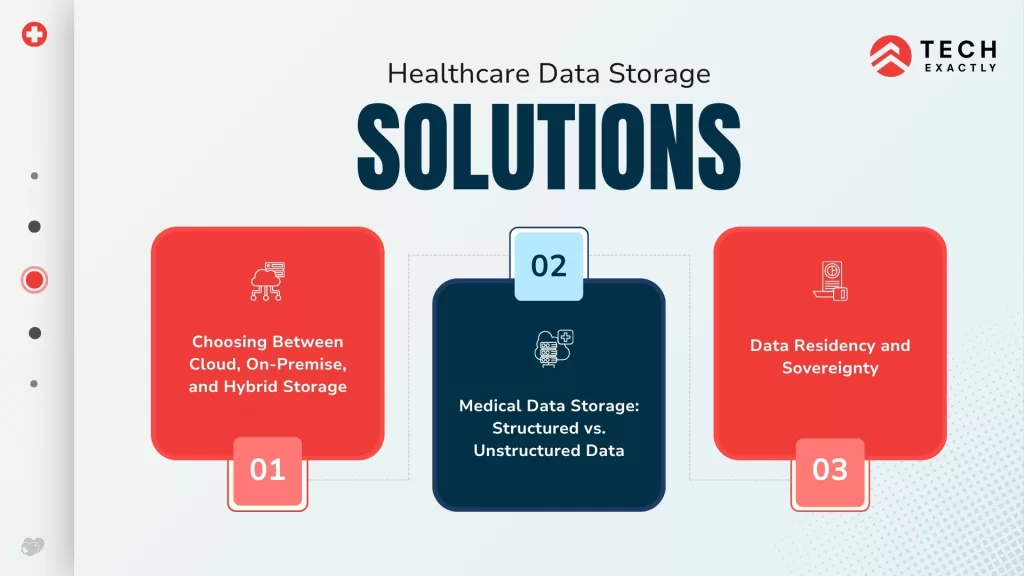
Choosing Between Cloud, On-Premise, and Hybrid Storage
The first architectural decision for any healthcare AI system is where patient data lives. The options are:
- Cloud-based storage: Scalable, cost-effective, and increasingly the standard for modern healthcare apps. Providers like AWS (with HIPAA BAAs), Microsoft Azure Health Data Services, and Google Cloud Healthcare API offer purpose-built HIPAA-compliant cloud storage environments.
- On-premise storage: Preferred by legacy hospital systems and organizations with strict data sovereignty requirements. Offers direct control but requires significant in-house infrastructure investment.
- Hybrid storage: The most common real-world setup. Active clinical data and AI inference endpoints live in the cloud; archival records, backups, or highly sensitive datasets remain on-premise.
A Forbes study found that 83% of healthcare organizations now use cloud infrastructure for at least some clinical workloads, with hybrid cloud being the dominant model in enterprise health systems. This shift has accelerated AI adoption but has also raised new questions about cloud healthcare solutions and data governance.
For AI systems specifically, cloud-first architectures make sense because model training, retraining pipelines, and inference at scale all benefit from elastic compute. The key constraint is that every cloud service touching PHI (Protected Health Information) must be covered by a signed Business Associate Agreement (BAA) with the cloud provider.
For a deeper look at the infrastructure side, read our guide on cloud healthcare computing.
Medical Data Storage: Structured vs. Unstructured Data
Healthcare AI systems typically handle two types of data, each with different storage requirements:
Structured data (lab results, vitals, billing codes):
- Stored in relational databases (PostgreSQL, MySQL) or purpose-built FHIR-compliant data stores
- Queried via HL7 FHIR APIs for interoperability
- Encryption at rest using AES-256 is the baseline standard
Unstructured data (clinical notes, imaging files, audio recordings from remote visits):
- Stored in object storage (Amazon S3, Azure Blob Storage, Google Cloud Storage) with versioning enabled
- Requires additional processing (OCR, NLP pipelines) before AI models can consume it
- Must be de-identified or pseudonymized before being used in model training
Key principle: Separate storage layers for raw PHI and de-identified training data. Merging them creates compliance risk and complicates audit trails.
Data Residency and Sovereignty
For healthcare organizations operating across state lines or internationally, data residency requirements add another layer:
- US Federal: HIPAA applies nationally; some states (California, Texas) have additional health data privacy laws
- European operations: GDPR applies; patient data must stay within the EU unless specific transfer mechanisms are in place
- Regional cloud zones: Most major cloud providers allow you to pin data to specific geographic regions — always enforce this in your storage configurations
Layer 2: Access Control – Who Gets to See What, and When
Controlling who can access patient data in an AI system is as critical as where the data is stored. Breaches frequently occur not because of external attacks, but because of over-permissioned internal access.
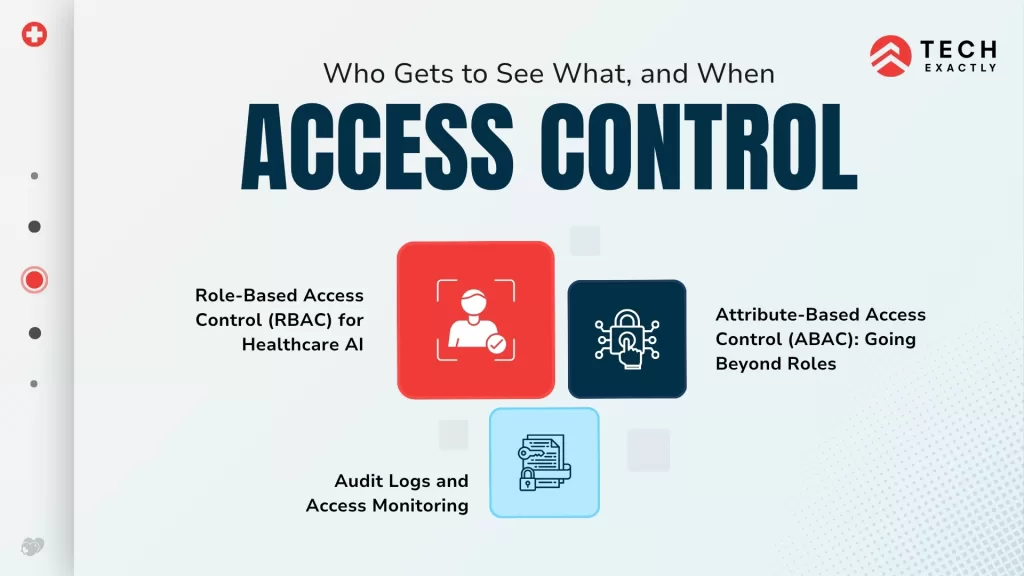
Role-Based Access Control (RBAC) for Healthcare AI
RBAC is the minimum standard for healthcare data access. In practice, it means:
- Clinicians access only the records for their assigned patients
- Data scientists and ML engineers access de-identified datasets for model training, never raw PHI
- Admin and billing teams access demographic and insurance data, not clinical notes
- AI model inference endpoints access only the specific data fields needed for a given prediction task
Attribute-Based Access Control (ABAC): Going Beyond Roles
For AI-powered healthcare platforms with complex workflows, RBAC alone is often insufficient. ABAC allows access decisions based on dynamic attributes:
- User attributes: Role, department, clearance level, employment status
- Resource attributes: Data sensitivity classification, patient consent status, data retention tags
- Environment attributes: Time of access, device type, network location
Example: A radiologist’s AI-assisted diagnostic tool might allow image viewing only from hospital-network devices during clinical hours, not from a personal laptop at 2 AM, even with valid credentials.
Audit Logs and Access Monitoring
Every access event involving PHI must be logged – who accessed it, when, from where, and for what purpose. In AI systems, this extends to:
- Model inference requests (what data was sent to the model, what was returned)
- Data export events from training pipelines
- API calls to FHIR endpoints
- Admin changes to access control policies
Audit logs must be immutable and retained for a minimum of 6 years under HIPAA. In practice, store them in write-once storage with tamper detection enabled.
Layer 3: Security Architecture
No single security control is sufficient. AI healthcare data security systems require a defense-in-depth approach: multiple overlapping layers, so a breach of one layer doesn’t mean a full compromise.
Healthcare organizations take an average of 236 days to identify a breach and 93 days to contain it, one of the longest response timelines across all industries. This makes proactive security architecture non-negotiable.
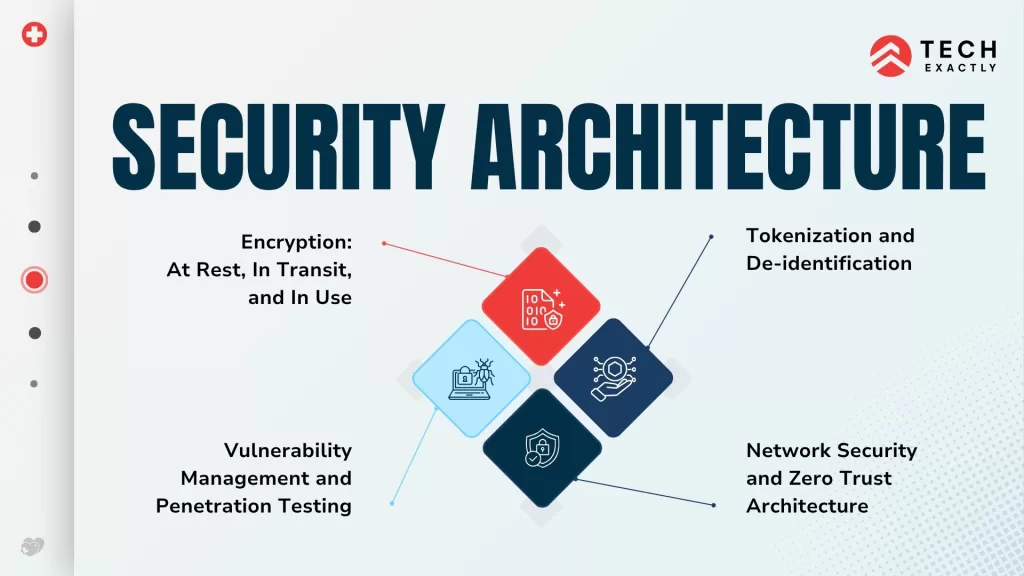
Encryption: At Rest, In Transit, and In Use
- At rest: AES-256 encryption for all stored PHI; encryption keys managed via a dedicated KMS (AWS KMS, Azure Key Vault, Google Cloud KMS), never hardcoded
- In transit: TLS 1.2 or higher for all data in motion; mTLS (mutual TLS) for service-to-service communication within microservices architectures
- In use: For AI model training on sensitive datasets, consider privacy-preserving techniques like federated learning (model trains on decentralized data without centralizing PHI) or differential privacy (adds mathematical noise to training data to prevent individual re-identification)
Tokenization and De-identification
Before patient data enters an AI training pipeline, it should be tokenized or de-identified:
- Tokenization: Replace PHI fields (name, SSN, MRN) with non-sensitive tokens; original mapping stored in a separate, highly restricted vault
- De-identification: Remove or generalize the 18 HIPAA Safe Harbor identifiers; apply to any dataset used for AI model development
- Synthetic data generation: Increasingly used to generate realistic but fully artificial patient datasets for model training (eliminates PHI risk)
For a detailed breakdown of how to architect security for healthcare apps end-to-end, see our security architecture guide for healthcare apps.
Network Security and Zero Trust Architecture
Healthcare AI platforms should operate on a Zero Trust model, no implicit trust for any user, device, or service:
- Micro-segmentation: Isolate AI processing environments from the broader network; model training clusters should have no direct internet access
- API gateway with rate limiting and threat detection: All FHIR API calls are routed through a gateway with anomaly detection
- Web Application Firewall (WAF): Protect AI model serving endpoints from injection attacks, prompt injection (for LLM-based tools), and DDoS
- VPN / Private Link: Use private connectivity (AWS PrivateLink, Azure Private Endpoint) to ensure PHI never traverses the public internet
Vulnerability Management and Penetration Testing
- Run automated SAST/DAST scans on every code deployment touching PHI
- Conduct third-party penetration testing at a minimum annually, and after major feature releases
- Maintain a CVE patching SLA: critical vulnerabilities patched within 24–72 hours
- Include AI-specific attack vectors in security testing: model inversion attacks, membership inference attacks, data poisoning
For a broader look at securing healthcare apps across the full development lifecycle, our guide on how to secure healthcare apps covers practical controls your development team can implement from day one.
Healthcare AI Compliance: The Regulatory Framework You Can’t Ignore
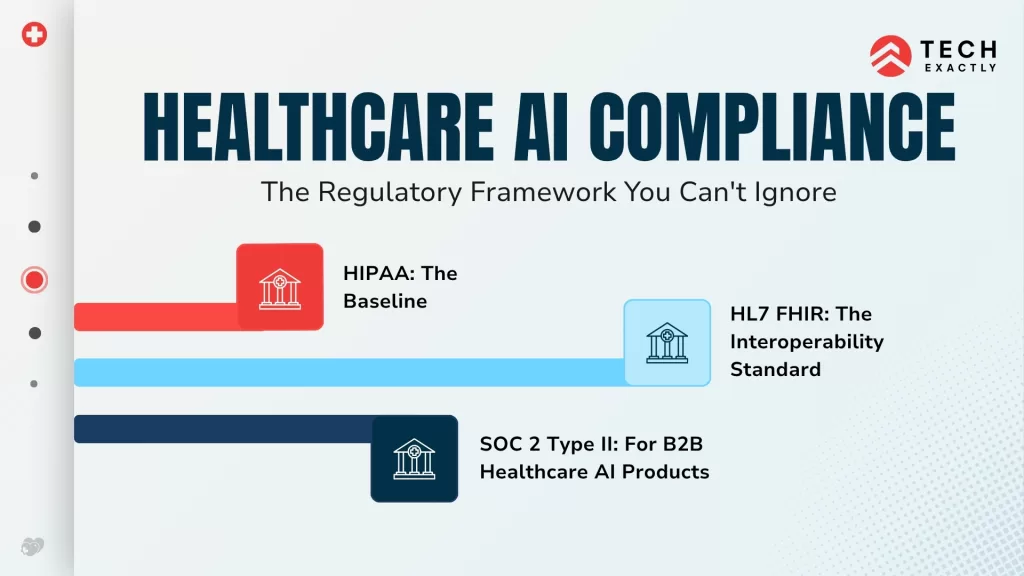
HIPAA: The Baseline
The Health Insurance Portability and Accountability Act defines the floor for US healthcare data security. Key rules for AI systems:
- Privacy Rule: Governs the use and disclosure of PHI; applies to AI systems using patient data for training or inference
- Security Rule: Mandates administrative, physical, and technical safeguards for electronic PHI (ePHI)
- Breach Notification Rule: Requires notification to patients and HHS within 60 days of a breach discovery
For any AI system ingesting PHI, your hipaa compliant cloud storage must cover the entire data supply chain, your cloud provider (via BAA), your data vendors, and any third-party AI APIs (e.g., if you’re calling a foundation model API with patient data, that provider must also sign a BAA).
HL7 FHIR: The Interoperability Standard
FHIR (Fast Healthcare Interoperability Resources) is the modern standard for exchanging healthcare data. For AI systems:
- FHIR APIs enable structured, standardized access to EHR data, critical for training data ingestion
- SMART on FHIR handles OAuth-based authorization for patient and provider access
- CMS has mandated FHIR-based APIs for payer-to-provider data sharing. AI products in this space must be FHIR-compliant
SOC 2 Type II: For B2B Healthcare AI Products
If you’re building a healthcare AI SaaS product sold to hospitals or health systems, SOC 2 Type II certification signals to enterprise buyers that your security controls are independently audited and continuously effective, not just documented.
If you’re evaluating whether to build or integrate AI capabilities within a healthcare app, our build vs. integrate guide breaks down the compliance implications of each path.
Adrija Roy, Project Manager at Tech Exactly, shares from the field:
“One of the most common mistakes we see when healthcare teams start building AI products is treating compliance as a final checklist item rather than a continuous architecture decision. The moment you decide where your data lives, who processes it, and how your AI model accesses it, those are compliance decisions, not just technical ones. We always push our clients to bring their legal and compliance team into the sprint planning process from the first milestone, not the last. It saves weeks of rework and prevents the kind of infrastructure pivots that kill healthcare AI timelines.”
Putting It Together: A Patient Data Architecture Checklist
Before you ship any AI feature that touches patient data, validate against this checklist:
Storage
- All PHI is stored in HIPAA-compliant environments with signed BAAs
- Encryption at rest (AES-256) is enforced on all data stores
- Separate storage layers for raw PHI and de-identified/training data
- Data residency requirements are identified and enforced by the region
Access Control
- RBAC implemented with least-privilege defaults
- ABAC policies for context-sensitive access (device, location, time)
- AI model inference endpoints access only the minimum required data fields
- Immutable audit logs retained for 6+ years
Security
- TLS 1.2+ on all data in transit; mTLS for service-to-service
- Tokenization or de-identification is applied before AI training pipelines
- Zero Trust network architecture enforced
- Penetration testing completed, including AI-specific attack vectors
- SAST/DAST scanning on all PHI-adjacent code
Compliance
- HIPAA Privacy, Security, and Breach Notification Rule compliance verified
- FHIR API compliance for any EHR data exchange
- BAAs signed with all third-party vendors and cloud providers
- SOC 2 Type II audit in scope (for SaaS products)
If you’re also evaluating a behavioral health use case, the behavioral health software build vs. buy guide covers additional compliance nuances specific to mental health data, which carries heightened sensitivity under many state laws.
Final Thought
Building AI systems that touch patient data is one of the most technically demanding and responsibility-heavy challenges in software development today. The margin for error is zero, not because regulators are watching (though they are), but because real patients bear the consequences of every security gap.
The organizations getting this right aren’t just checking compliance boxes. They’re treating patient data architecture as a product discipline: designed thoughtfully, audited continuously, and evolved as the threat landscape and regulatory environment change.
If you’re building in this space, partnering with an experienced AI App Development Company in USA that understands both the clinical context and the engineering constraints isn’t a luxury but a risk management decision. To know more about our project, here are some case studies.
At Tech Exactly, we work with healthcare product teams as an AI-Powered Mobile App Development Company to build systems where data security is an architectural principle from day one, not an afterthought. Whether you’re starting from scratch or securing an existing system, reach out to our team to discuss your specific compliance and data architecture needs.


