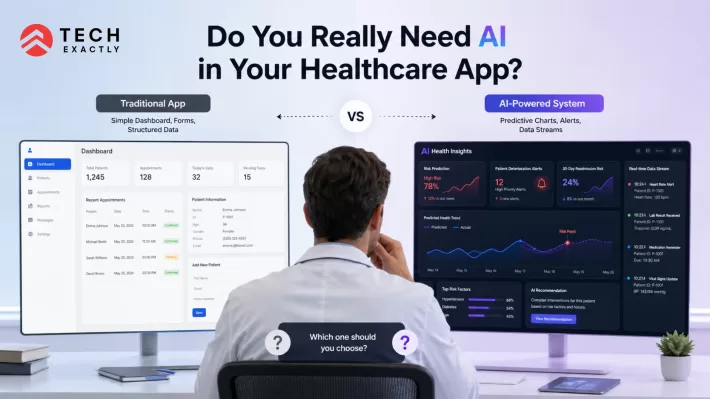


AI Feature Prioritisation for Healthcare Apps: What to Build First

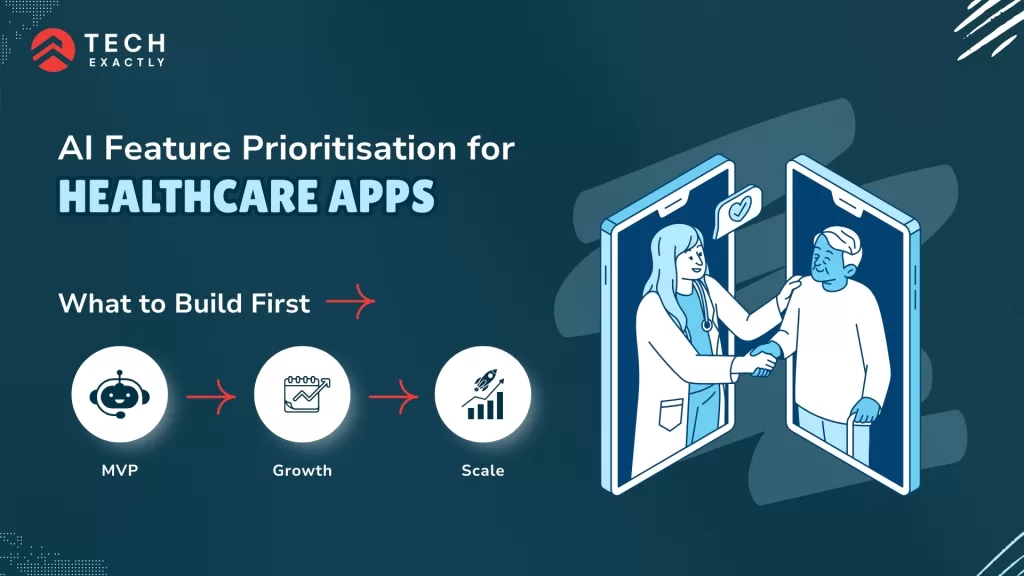
AI has long been considered an experimental part of healthcare software applications. It is now becoming one of the key sources of product differentiation. AI can be applied to improve workflows, engage patients, and perform many other purposes.
As per the McKinsey report, generative AI could play a significant role in unlocking productivity gains across healthcare. Along with this, it can be observed in clinical documentation and decision support.
However, there is an important question that must be answered by any product manager or CTO – not about using AI or not, but what should be done first. Often enough, product owners try to adopt AI technology without proper prioritization planning.
This leads to the usage of overly complicated algorithms, implementation of features only because of their demo value, while ignoring those that would really solve users’ problems.
As a consequence, the cost of development, delay in bringing an application to market, and inefficient ROI become inevitable. Here comes the role of intelligent prioritization.
From what we have seen building healthcare platforms at Tech Exactly, the hard part usually isn’t getting AI to work; it’s deciding which AI-driven features are actually worth doing first because they’ll move the needle clinically and operationally.
An optimized AI development strategy will ensure:
Timely release of MVP
Alignment with actual user needs
Optimal investment and architecture scalability
Minimized risks and expenses
No matter if you are going to develop a product from scratch or enhance your already operating healthcare platform, here you can find out which AI features should be developed in priority.
How is AI useful for Healthcare Apps?
AI in healthcare is not a unified skillset but rather a set of tools that aid decision-making, automate processes, and help extract insights from big data sets.
With strategic implementation, AI can positively influence clinical outcomes and operational efficiencies. Let us discuss its use cases.
Diagnostic and Medical Imaging
The ability of AI to examine X-rays, MRIs, and CT scans is impressive. Machine learning models can detect abnormalities, discover patterns, and help radiologists make fast and precise diagnoses. In healthcare apps, this means:
Faster diagnostic assistance
Minimized human errors
Scalability in radiology services
The research by Stanford shows how AI models are improving diagnostic accuracy in radiology and play a major role in reducing interpretation time. It is, however, usually a feature for scale-stage projects, as it requires high-quality data sets, regulatory clearance, and rigorous validation.
Virtual Assistants and Chatbots
One of the most functional features in healthcare apps is chatbots powered by AI technology. They help deal with patients’ requests, ask questions, and give information about general health problems.
In this case, the solution provided by an AI chatbot app development company proves to be extremely useful. Here are some advantages:
24/7 support for patients
Decreased load on clinical staff
Better patient involvement
The studies by NIH observe that AI-powered chatbots can help improve patient engagement and accessibility in healthcare services.
Predictive Analysis
Machine learning models can predict the likelihood of health problems based on patient data and take necessary preventative measures. Examples of use cases are:
Chronic disease risk scoring
Readmission risk assessment
Detection of deteriorating health status
They can be quite useful in healthcare apps, yet highly dependent on the quality of your data sets.
Administrative Automation
A substantial part of healthcare inefficiencies is associated with administrative overheads, including documentation, scheduling, billing, and compliance management.
AI can automate:
Clinical documentation
Appointment scheduling
Claims processing
This type of feature is the most profitable option, especially at the MVP stage.
High-Priority Features (MVP – Build First)
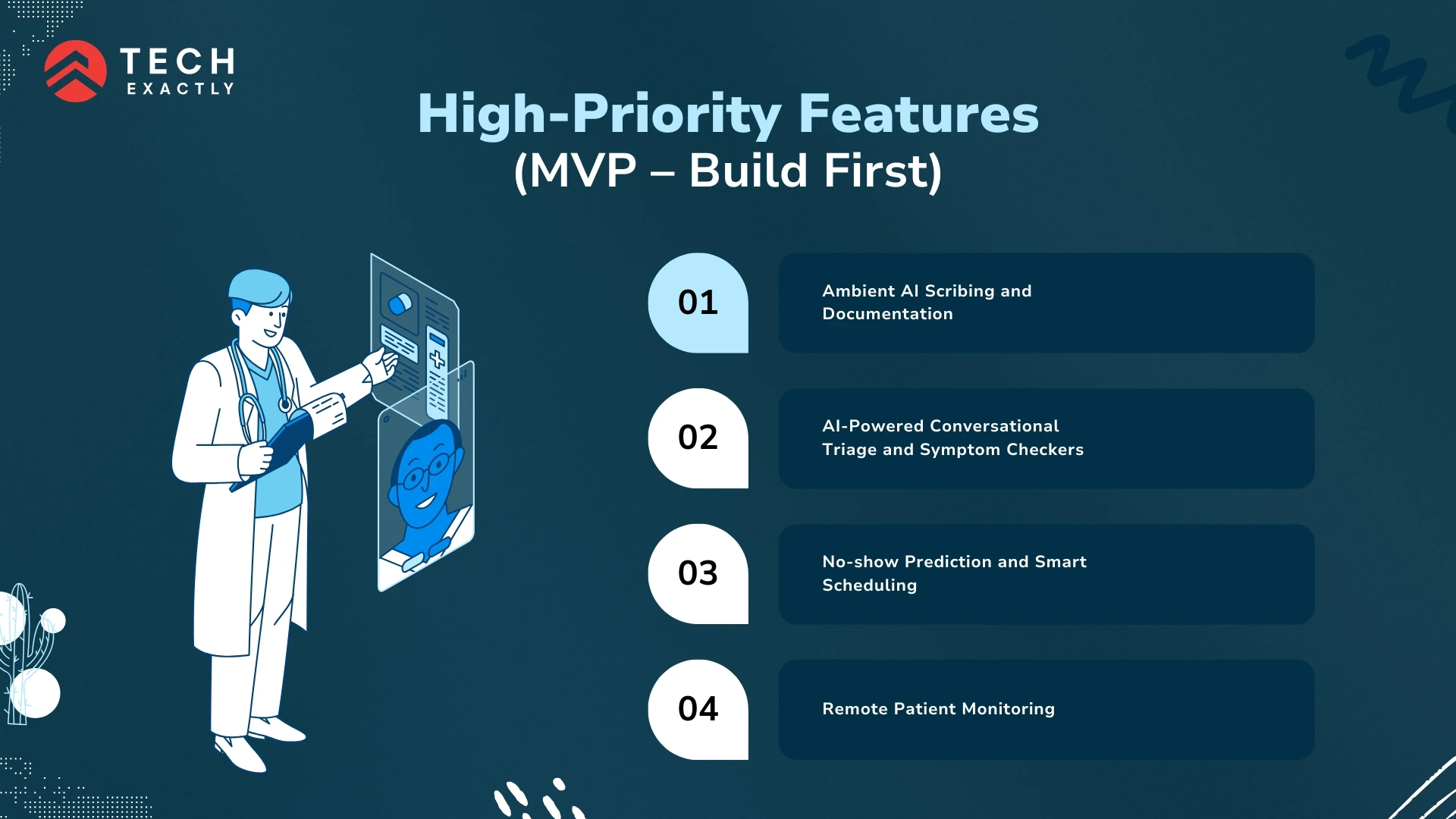
In developing an AI-based application for healthcare purposes, it is necessary to start with MVPs that provide clear benefits, are relatively easy to implement, and integrate into the workflow.
Ambient AI Scribing and Documentation
Clinical documentation is among the most consuming activities performed by healthcare specialists. Ambient AI solutions could listen to doctor-patient interactions and produce structured notes from them automatically. Why start with this:
Very high efficiency gains
Well-defined return on investment (savings on time)
Regulatory complexity is lower than in the case of diagnostics
The functionality itself doesn’t require AI with advanced clinical decision-making skills.
AI-Powered Conversational Triage and Symptom Checkers
Among the best entry points to AI for healthcare applications is conversational symptom checkers powered by AI. They can:
Evaluate patients’ symptoms
Direct them to proper treatment options
Prevent unnecessary hospitalization
Thanks to recent advances in AI chatbot app development services and natural language processing, it is much easier now to develop such apps. Why it fits the MVP idea:
High patient interaction
Immediate patient benefit
Scalability through improvements
In my view, this is one of the most practical places to start. It improves the patient experience right away, and it’s scalable; plus this is easier to iterate on as you learn what works.
No-show Prediction and Smart Scheduling
Appointments being missed are one of the major challenges faced by healthcare organizations. Using AI, you will be able to:
Predict no-show probability
Generate the best time slots
Send smart notifications
This functionality offers great potential when it comes to optimizing operations. This is exactly the kind of feature worth shipping early. If utilization and efficiency are core to your model, small lifts here can translate into outsized wins; higher revenue capture and tighter resource planning.
Remote Patient Monitoring
With the proliferation of wearables and the Internet of Things, remote patient monitoring is a part and parcel of contemporary healthcare. AI can help in:
Health monitoring in real time
Generating alerts when something unusual is detected
Patient monitoring on an ongoing basis
Why it deserves priority:
Aligns with telemedicine trends
Improves chronic disease management
Data pipelines for analysis
The World Health Organization highlights remote patient monitoring as a key component of digital health transformation, especially for chronic disease management.
Secondary-Priority Features (Enhance and Scale)
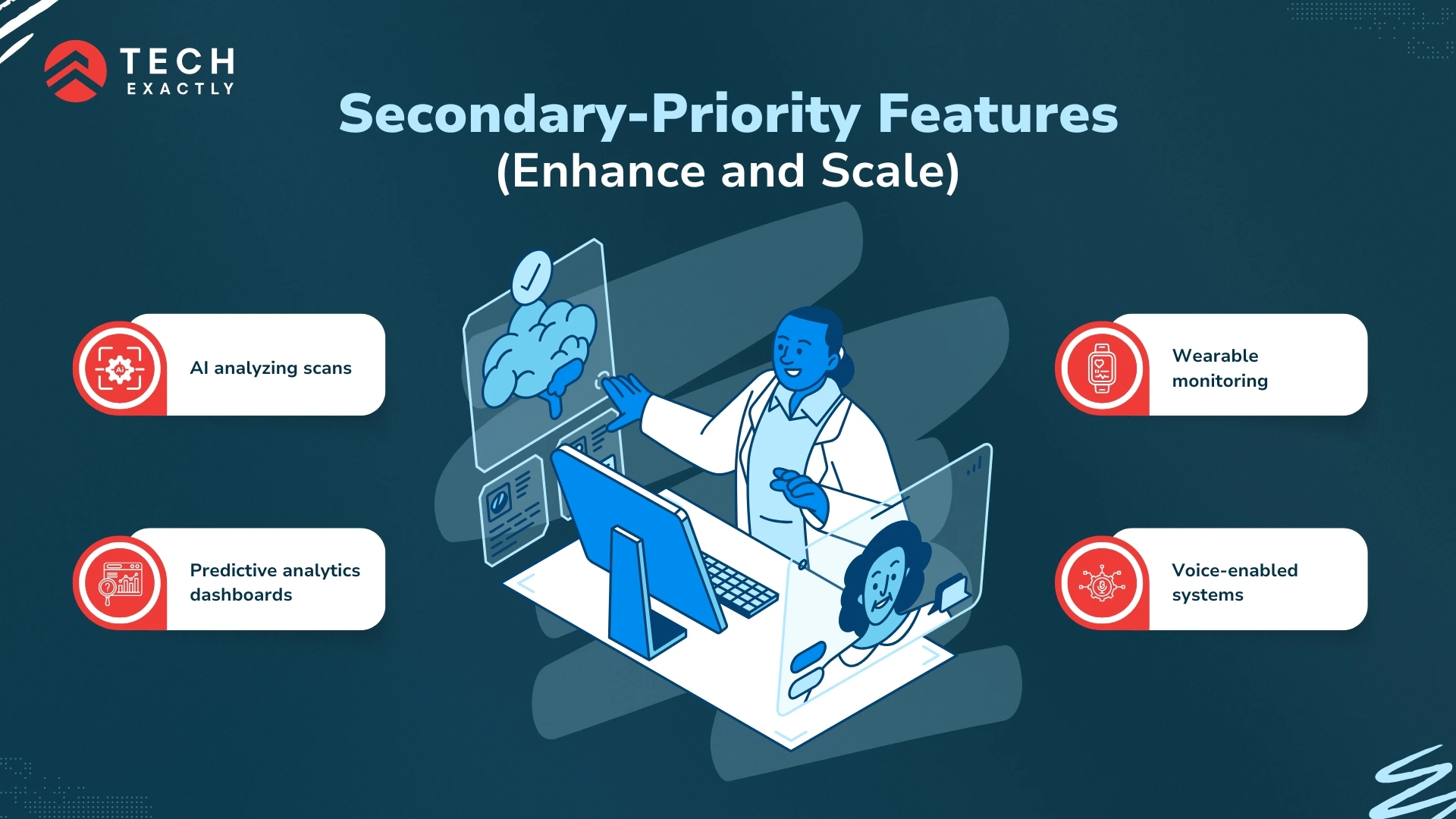
After establishing your core workflow and developing mature data pipelines, you can consider expanding into other AI capabilities.
Personalized GenAI Health Plan
With generative AI, you can generate personalized health plans depending on individual patients’ histories and preferences. Though very useful, this feature is contingent upon:
Good data inputs
Effective validation systems
Management of hallucinations
It should be developed only during the growth stage, but not MVP.
Medical Imaging with AI Assistance
AI can help in improving imaging techniques, facilitating diagnosis, and shortening the time for interpretation of images. Yet:
Needs regulatory compliance
Requires good-quality labeled datasets
Necessitates effective evaluation frameworks
This makes it a late-stage feature for most startups.
EHR System with Voice Interaction
With voice interaction, you can improve the convenience of communication between doctors and medical systems, making processes hands-free. Possible uses include:
Entering voice-based data
Searching for patient information
Navigating through work
As useful as it may be, this feature relies heavily on:
Effective integration with EHR systems
Good medical language processing
Critical Infrastructure (Must Precede All AI)
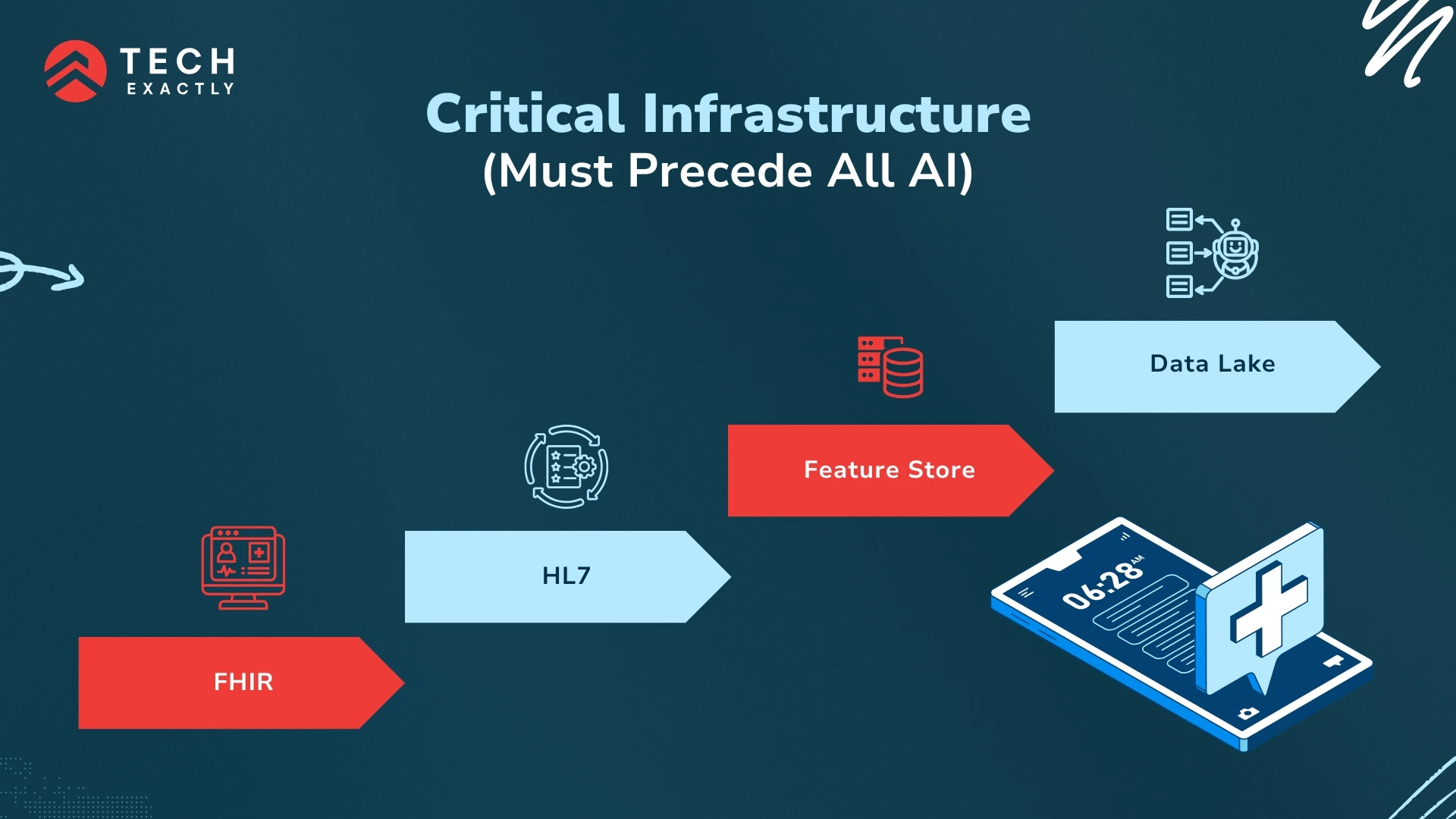
Before adding any AI element, you should make sure that your platform is ready from both a technical standpoint and a compliance standpoint. Failing to do so is the primary mistake made by most teams.
FHIR API Interoperability
Healthcare requires structured data exchange. Without interoperability, AI cannot function properly. The following can be achieved with FHIR (Fast Healthcare Interoperability Resources):
Data exchange standardization
EHR/EMR integration
Scalability of data pipelines
With no FHIR-compatible API:
Your AI won’t have access to standardized data
It will cost more to integrate
It will not be scalable
Robust Data Privacy (HIPAA/GDPR)
Healthcare data is extremely sensitive, and using AI increases risks to privacy. Here’s what must be done:
Encryption end-to-end (AES-256, TLS 1.2+)
Role-based access management
Logging audits
HIPAA & GDPR compliance
You would like to check how Tech Exactly delivered a HIPAA-compliant online therapy platform in New York.
It’s non-negotiable. Regardless of how smart your AI is, without compliance:
Legal liability is possible
You won’t get user trust
Global scalability is impossible
Strategic Considerations for AI Feature Prioritisation
Apart from this list of factors, there should be certain fundamental concepts which should govern prioritizing certain features.
Begin with Workflow, Not Technology
The best healthcare apps are problem-centric, not technology-centric. Think about:
What is your major bottleneck?
Can AI alleviate it?
If yes, proceed; otherwise, it makes no sense.
Check Your Data Preparedness
AI is only as good as its training data. Before implementing:
Are you ready to structure your data?
Are you capable of collecting and improving your data continuously?
Is it compliant and secure?
Without data, you won’t leverage any AI benefits. This research by IBM emphasizes that poor data quality directly limits AI performance, reinforcing the need for structured and reliable datasets.
Calculate Cost vs ROI
AI technologies may be costly not only to implement but also to support. Here, the importance of your knowledge of an AI-powered mobile app development company becomes apparent. Think about:
Training & inference costs
Storage & infrastructure
Monitoring & iteration
You should be able to measure your AI-driven feature’s return on investment.
Implement Scalability Considerations
AI systems are dynamic and constantly evolving. You should think about your system’s capacity to adapt by introducing new capabilities. Think about such key points:
Modular architecture
Integration through API
Continuous improvement of models and algorithms
Most modern healthcare solutions leverage flexible technology stacks like mobile app development with React for front-end scalability and cloud native architecture for AI orchestration.
Work with the Best Development Company
Healthcare and AI development are very complex domains requiring great expertise.
Involving an experienced AI app development company or an AI-powered mobile app development company in the USA will greatly benefit your project.
A Practical AI Feature Roadmap
To streamline decision-making, consider this phased approach:
Minimum Viable Product (MVP) phase (0–6 months)
AI documentation
Conversation triage
Scheduling intelligence
Growth phase (6-18 months)
Remote patient monitoring
Predictive modeling
Engagement personalization
Scaling phase (18+ months)
AI-powered imaging
Advanced Generative AI capabilities
Voice-based AI systems
This phased approach guarantees:
Reduced time to market
Investment
Final Thoughts
AI can revolutionize healthcare applications, but it requires a smart approach. It’s not about building the best AI technology out there. Rather, it’s about building the right technologies at the right times.
Start with a real clinical or operational bottleneck, validate with a simple AI workflow, and scale only when the data quality, compliance, and care processes are truly ready.
That should involve starting by building:
High-impact, low-complexity functionalities
A solid infrastructure and regulatory compliance
User needs alignment
And then evolving into more sophisticated functionalities.
If you are thinking about building or scaling a healthcare application leveraging AI, the key issue is not what AI can do, but rather what your application truly needs.
If you are assessing your AI strategy or are unsure of how to start, scheduling a call with the right experts like Tech Exactly, could be invaluable to avoid errors and missteps.