


Healthcare Software Development Outsourcing: What a BAA Won’t Cover


Key Takeaways
- HIPAA doesn’t care where your vendor is located; it cares who signed the BAA and whether their subprocessors did too. Offshore is legal. Poorly managed subprocessor chains are what get you fined.
- FDA/SaMD outsourcing is a different game altogether. If you’re building Class II software, your vendor’s QMS (ISO 13485, IEC 62304) becomes part of your regulatory filing.
- You can outsource EHR integration work, but not sandbox access. Epic, Oracle Health, and Meditech gate their developer programs to the covered entity; your vendor works through your credentials, not theirs.
- Budget a 15-25% compliance tax on top of generic software rates. BAA-covered cloud services, audit logging, penetration testing, and QMS overhead aren’t optional and aren’t free.
Signing a BAA with your outsourced vendor does not make them HIPAA-compliant. You are jointly liable for their HIPAA compliance.
This is a common misconception that many founders realize too late. You certainly don’t want to find this after a failed FDA review, audit, or worse, a data breach.
The cost benefits that make software development outsourcing attractive for regular builds equally apply in healthcare; they just come with more strings attached. But in healthcare outsourcing, you don’t just finalize a vendor based on cost. You need to know if their cloud infrastructure is HIPAA-compliant, whether their QMS will survive an FDA audit, and if their engineers have worked inside an Epic sandbox.
If you’re new to healthcare software development outsourcing, this guide is worth a read. It focuses on what actually shifts when PHI, medical devices, or EHR systems come into the scope. What you actually need is a partner with proven healthcare app development experience, not a generalist firm that added ‘HIPAA’ to their services page.
Why Healthcare Software Development Outsourcing Is a Different Problem
Generic software outsourcing guides treat the decision as “cost vs. quality vs. speed.” In healthcare, there are three additional criteria that generic guides don’t touch and that will put your project at risk if you ignore them:
Regulatory surface area. HIPAA for anything touching PHI. FDA 21 CFR 820 and IEC 62304 if it qualifies as a medical device. HITRUST if enterprise customers demand it. State-level variations (California CMIA, Texas HB 300) if you’re multi-state. A vendor either has a compliance program that can sustain this, or they don’t. The fact that they don’t usually have it gets revealed six months later, when your first enterprise customer’s security questionnaire comes into the picture.
Integration gravity. Healthcare software almost never lives alone. You’re integrating with an EHR (Epic, Oracle Health/Cerner, Meditech, Athena), a lab network, a device, a payer, or all of the above. FHIR and HL7 aren’t anymore nice to have skills, they’re the critical path.. Most generalist firms will say they can do it. Very few have developed it.
Clinical stakeholder availability. UAT requires nurses, physicians, or patient-facing staff to click through workflows. They have 15 minutes between patients. A vendor 10 hours offset will lose weeks of calendar time to async handoffs. This is why nearshore beats offshore for most US healthcare builds, even when hourly rates are higher.
If your vendor can’t speak fluently about all three before you sign, they’ll learn on your project that too, at your expense.
Can You Outsource Healthcare Software Development Offshore?
The most common question we get from founders evaluating offshore healthcare software development is whether they can legally use an offshore team for a HIPAA-covered app.
The short answer is yes, you can. HIPAA has no geographic restriction on Business Associates. You can sign a BAA with a vendor in Poland, India, Argentina, or Vietnam, and it’s just as enforceable as one signed with a vendor in Ohio.
The catch is, legality isn’t the constraint. Enforceability and subprocessor are.
Here’s what actually matters:
- Can the vendor sign your BAA as written? Some offshore firms will only sign their own templated BAA, which often leads to liability in ways that can make your compliance officer nervous. If they won’t sign yours with reasonable negotiation, that’s a signal.
- Do all of their subprocessors have BAAs? Your vendor’s cloud (AWS, Azure, GCP), their logging tool, their error-tracking tool, their email provider, anything that could conceivably see PHI needs a signed BAA in the chain. Ask for their subprocessor list before signing.
- Are they using BAA-eligible services only? AWS, Azure, and GCP all publish HIPAA-eligible service lists. If your vendor’s architecture uses a non-eligible service like SageMaker endpoints in certain configurations, preview features, or some analytics tools, you have a problem even with a signed BAA.
- Where does the PHI actually live? US data residency is not a HIPAA requirement, but it’s a common enterprise customer requirement and increasingly a state-level one. Confirm the cloud region in writing. Just getting a “We use AWS” is not an answer.
Every technical control required for HIPAA-compliant mobile app development still applies — the outsourcing question is narrower: can your vendor operate inside those controls consistently, or only when someone is watching? The controls themselves don’t change.
FDA and SaMD: When Healthcare Software Outsourcing Gets Regulated
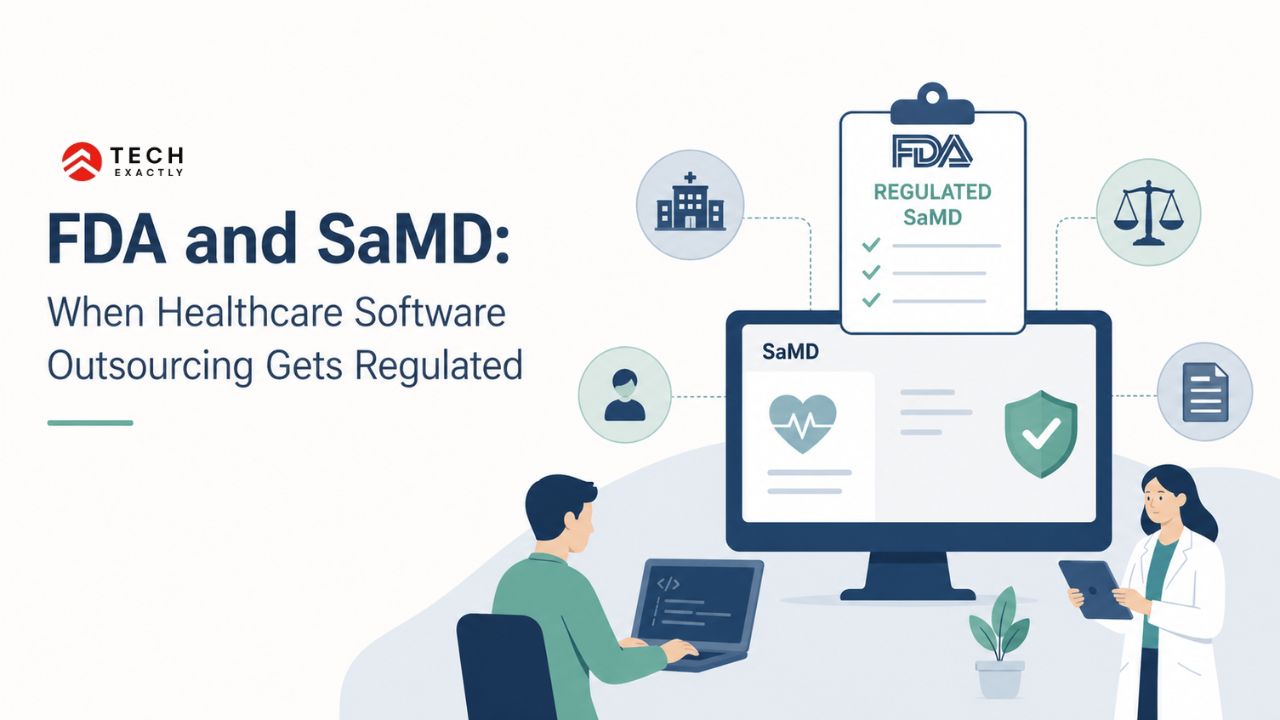
If what you’re building is Software as a Medical Device (SaMD), whether it is a diagnostic, therapeutic, or clinical decision support that meets the FDA’s definition, outsourcing healthcare software development stops being a cost decision and becomes a regulatory one.
Your vendor’s quality management system becomes part of your submission. Specifically:
- ISO 13485 for the QMS itself. Not “ISO 9001 and we follow 13485 principles.” The actual certification.
- IEC 62304 for the software lifecycle process, scaled to your device’s safety classification (Class A/B/C).
- IEC 62366 for usability engineering if the UI touches clinical decisions.
- Design History File (DHF) discipline. Every requirement, every risk control, every verification test, is traced and documented. Vendors who ship fast by skipping documentation will not survive an FDA inspection.
The cost implications of medical device software development under FDA scrutiny run deeper than most founders budget for — you cannot separate your regulatory exposure from your vendor’s QMS. Tech Exactly’s medical device software practice runs on the same ISO 13485 and IEC 62304 requirements, which is why we ask about your device classification before scoping anything. The outsourcing nuance is that Class II SaMD builds need a vendor who has shipped Class II SaMD before. Not just “We can learn”, Not just “We have a compliance team.” Actual prior 510(k) clearance work in their portfolio is required.
This is where offshore pricing arbitrage collapses. A generic shop at $35/hour looks cheaper than a regulated industry specialist at $90/hour, until the FDA sends a deficiency letter and you lose six months fixing the DHF.
EHR Integration Outsourcing: What You Can and Can't Hand Off
You can outsource EHR integration work. However, you cannot outsource the relationship with the EHR vendor.
Every major EHR, like Epic, Oracle Health (Cerner), Meditech, Athenahealth, eClinicalWorks, gates their developer sandbox and production access to the covered entity or the vendor of record. Your offshore engineers don’t get Epic App Orchard credentials, but you do. They build against the sandbox using your organization’s access.
Practically, this means:
- Your vendor needs engineers who have actually worked inside the relevant EHR sandbox, not just engineers who know FHIR in the abstract. Epic’s Hyperspace quirks, Oracle Health’s CCL scripting, Meditech’s Expanse APIs, these don’t come from reading documentation.
- SMART on FHIR app publishing has its own vendor review process. Epic’s Showroom and Oracle’s Code Program both have multi-month review cycles. You need to build this into your timeline and not around it
- Integration testing requires access to real-shape data, not toy fixtures. Most health systems won’t give offshore vendors direct access to even de-identified production data. You’ll need a staging environment with synthesized data that matches your production EHR’s actual field usage.
The FHIR mapping and event-streaming complexity involved in medical device integration with EHR goes beyond what any offshore team can own independently — which is why the 80/20 split exists. For outsourcing, the shorthand is ensuring 80% of the work is offshorable. The other 20%, which includes vendor relationship, sandbox access, and go-live coordination, stays with your internal team or a US-based integration lead.
Let's Start Your Project Today
Ready to outsource your healthcare project to us? Reach out now – our experts are just one click away.
Nearshore vs. Offshore Healthcare Software Development: The Timezone Math
For generic software builds, the nearshore-vs-offshore decision is mostly about culture and communication preference.
For healthcare, it’s about clinical UAT velocity.
Here’s why nearshore LATAM wins for most US healthcare builds:
| Model | Hourly Rate | Timezone Overlap with EST | Clinical UAT Velocity |
|---|---|---|---|
| US onshore | $150-250 | Full | Fast |
| LATAM nearshore (Mexico, Argentina, Colombia) | $55-85 | 4-6 hours | Fast |
| Eastern Europe (Poland, Ukraine) | $45-70 | 1-2 hours (morning only) | Medium |
| India offshore | $30-50 | 0-1 hours (late night / early morning) | Slow |
| Philippines offshore | $28-45 | 0-1 hours | Slow |
The gap between a $45/hour Indian engineer and a $70/hour Colombian engineer looks big on paper. In reality, that gap disappears the moment a clinical stakeholder shows up to a live triage call, and your vendor is not online.
This isn’t universal, though. Offshore works well for backend, data pipelines, ML training, and admin tooling. But anything that needs close clinical iteration, like UI flows, alert logic, and documentation templates, benefits from nearshore. You usually earn back the rate difference in the first UAT cycle.
How Much Does Healthcare Software Development Outsourcing Actually Cost?
Generic offshore dev shops quote in the range of $30 to 60 per hour. Healthcare software outsourcing companies that actually specialize in the regulatory surface quote $60-120/hour, sometimes even higher for FDA-regulated work. The delta isn’t markup. It’s the compliance tax.
What the tax actually pays for:
- BAA-covered cloud services (typically 15-30% more than non-BAA tier for equivalent compute)
- Audit logging and SIEM are integrated from day one, not retrofitted Penetration testing on a defined cadence (usually annual plus major release)
- HITRUST or SOC 2 Type II maintenance if the vendor has it
- Security engineer on staff reviewing architecture, not just a compliance checklist
- QMS overhead (document control, training records, CAPA workflows) if SaMD
- EHR vendor relationship staff, people who can call Epic TS when your webhook breaks
For a typical Class I healthcare SaaS build, you can expect total costs 15-25% above a generic equivalent. For Class II SaMD, it is 40-60% above. The healthcare app development cost breakdown across app types varies more than most founders expect — the 15-25% compliance tax quoted here sits on top of that baseline, not in place of it.
The 15-Question Healthcare Software Development Outsourcing Vendor Checklist
Most vendor-selection checklists ask the wrong questions. If you ask, ” Do you have HIPAA experience?”, you will always get a yes from everyone. Here’s what actually separates healthcare-capable vendors from generalist shops with a marketing page:
Compliance posture:
- Show me your current subprocessor list and the BAAs in place with each.
- Which specific AWS/Azure/GCP services are in your reference architecture, and are all of them on the HIPAA-eligible list?
- When was your last penetration test, who performed it, and can I see the summary?
- Do you have HITRUST CSF certification or SOC 2 Type II? Which, and from which year?
- Walk me through how PHI flows through your development, staging, and production environments.
Regulatory depth (if SaMD):
6. Show me a 510(k) submission your team contributed to. Which sections did you own?
7. What is your QMS? ISO 13485 certified, or mapped-to-13485?
8. How do you handle IEC 62304 traceability across requirements, risks, and tests?
Integration experience:
9. Name three EHRs your engineers have shipped against in production. Not sandboxes, but in production.
10. Who is our point of contact for EHR vendor escalations? Is that person on your team, or do we handle it?
11. What’s your approach to synthesized test data for integration testing?
Delivery reality:
12. Who specifically will be on our project? Could you provide us with names, and not just “senior engineers from our pool”?
13. What’s the attrition rate on your healthcare accounts over the last 12 months?
14. Show me a case study where a healthcare project went sideways. What happened? What did you do?
15. What’s your vendor exit plan? If we terminate, what do we get, in what format, by when?
A vendor who answers all 15 questions cleanly is a real candidate. A vendor who deflects on three or more is a mere sales pitch.
Mistakes to Avoid When Outsourcing Healthcare Projects
The failure patterns are consistent:
Hiring the cheapest compliant on paper vendor. They’ll be compliant the day you sign. They won’t be compliant the day your first SOC 2 auditor arrives, because they stopped maintaining controls between customers.
Treating the BAA as a formality. The BAA is the contract that matters most when something goes wrong. Negotiate it as it does.
Outsourcing clinical workflow design. Offshore engineers can build any workflow you specify. However, they cannot tell you whether the workflow matches how a nurse actually moves through a shift. It’s better to keep workflow design close to clinical stakeholders and outsource the implementation.
Skipping the pilot project. Before you commit to an 18-month build with a new vendor, run a 6-week scoped pilot. Further, integrate with a non-production EHR, build a compliance-sensitive feature, and see how they actually perform. Something that forces their team to demonstrate and not just describe their healthcare competency.
Assuming the vendor owns regulatory risk. They don’t. Only you do. Your name is on the 510(k), the BAA, and the breach notification. A good vendor reduces your risk. They never absorb it.
When to Outsource Healthcare Software Development vs. Build In-House
Outsource when:
- You need velocity and don’t have clinical engineering on staff
- The work is well-scoped (a defined integration, a specific module, an MVP)
- You have internal clinical and compliance leadership to direct the work
- The total project is under 24 months, and thus, outsourcing strains past that as product complexity compounds
Build in-house when:
- The software is the product, and you’re raising a Series B+ on its strength
- You need deep, continuous clinical iteration (a novel diagnostic workflow, a new care model)
- Regulatory risk is existential, meaning Class III SaMD, anything touching direct patient safety
- You can actually hire healthcare-experienced engineers (harder than it sounds; this is usually the reason teams end up outsourcing anyway)
A hybrid model usually tends to work well. Having a small in-house core team that owns the architecture, clinical workflow, and regulatory strategy. Along with this, have an outsourced delivery team, ideally nearshore, and execute against that direction. This is how most successful US digital health companies actually ship.
Let's Start Your Project Today
Ready to outsource your healthcare project to us? Reach out now – our experts are just one click away.
Outsourcing Healthcare Software Development: How to Get It Right
Healthcare software outsourcing isn’t harder than generic outsourcing because the engineering is harder. It’s harder because the regulatory, integration, and clinical iteration demands compound in ways that generic playbooks don’t anticipate.
The vendors who do this well charge more, move more slowly in the setup phase, and ask uncomfortable questions about your architecture before they’ll sign a contract. Those are the ones you should go for. The ones who say yes to everything in the first call are the ones whose names show up in breach notification letters.
When outsourcing healthcare software development, don’t pick a partner based on the pitch deck; pick them based on how they’ll support you in the year after go-live.
If you’re trying to figure out whether your current vendor is actually set up for healthcare, or you’re about to pick one, talk to Tech Exactly’s healthcare outsourcing team.
Frequently Asked Questions
Yes. HIPAA has no geographic restriction on Business Associates. You can sign a BAA with a vendor in Poland, India, Argentina, or Vietnam, and it carries the same legal weight as one signed with a US-based firm. The constraint isn't legality — it's enforceability and subprocessor management. Every tool, cloud service, and third-party integration your offshore vendor uses that could touch PHI needs its own BAA in the chain. That's where most offshore arrangements break down, not at the contract level.
A BAA is a contract that establishes shared liability. It does not make your vendor compliant — it makes you both accountable if they aren't. HIPAA compliance is operational: it lives in access controls, audit logging, encryption standards, subprocessor management, and employee training. A vendor can sign your BAA on day one and fail a SOC 2 audit six months later because they stopped maintaining controls between clients. Ask for their last penetration test results and their subprocessor list — not just the signed BAA.
Expect 15–25% above generic rates for Class I healthcare SaaS, and 40–60% above for Class II SaMD. The premium covers BAA-eligible cloud infrastructure (typically 15–30% more expensive than standard tiers), audit logging, annual penetration testing, HITRUST or SOC 2 Type II maintenance, and QMS overhead if you're in FDA-regulated territory. Vendors who quote generic rates for healthcare work are either absorbing the cost into their margin or skipping the controls.
Yes — but not the vendor relationship. Epic, Oracle Health, Meditech, and Athenahealth all gate sandbox and production access to the covered entity, not the outsourced vendor. Your offshore engineers build against the sandbox using your organization's credentials. What that means in practice: your vendor needs engineers who have shipped against the specific EHR in production before, not just engineers who know FHIR in the abstract. Epic's Hyperspace and Oracle Health's CCL scripting aren't documented skills — they're institutional knowledge built from actual project work.
For HIPAA-covered work: SOC 2 Type II is the baseline. HITRUST CSF certification is stronger and increasingly required by enterprise health system clients. For SaMD: ISO 13485 (QMS certification — not just "mapped to") and documented IEC 62304 lifecycle processes. For any vendor handling PHI: ask specifically about their subprocessor BAAs and which cloud services they use — not all AWS or Azure services are on the HIPAA-eligible list.
SaMD — Software as a Medical Device — is the FDA's classification for software that performs a medical function independently of hardware. If your software diagnoses, treats, or informs clinical decisions, it likely qualifies. This changes outsourcing requirements significantly: your vendor's quality management system becomes part of your regulatory submission, IEC 62304 traceability is mandatory, and you need a vendor with actual 510(k) submission experience — not a vendor who says they can follow the process. Building Class II SaMD with a generalist firm is one of the most reliable ways to receive an FDA deficiency letter.
Healthcare Software Development Outsourcing is the process of hiring an external software development company to build, maintain, or scale healthcare applications, platforms, or digital health solutions. It helps healthcare businesses reduce costs, access expert developers, and speed up product delivery.
Companies choose Healthcare Software Development Outsourcing to gain access to experienced healthcare developers, reduce operational costs, improve development speed, and ensure compliance with healthcare regulations like HIPAA and GDPR.
Yes, reliable Healthcare Software Development Outsourcing companies follow strict security standards, including data encryption, secure APIs, HIPAA compliance, NDA agreements, and regular security testing to protect sensitive patient data.
Healthcare Software Development Outsourcing services typically include healthcare app development, telemedicine solutions, EHR/EMR software, AI healthcare applications, wearable integrations, maintenance, and cloud-based healthcare platforms.
Choose a company with healthcare industry experience, strong security practices, proven case studies, skilled developers, transparent communication, and expertise in healthcare compliance standards.
Yes, Healthcare Software Development Outsourcing helps businesses reduce hiring, infrastructure, and operational costs while maintaining high-quality software development and faster project delivery.
Common technologies include AI, cloud computing, IoT, React Native, Flutter, Node.js, Python, and secure healthcare APIs for building scalable healthcare applications.
Yes, experienced Healthcare Software Development Outsourcing providers build HIPAA-compliant healthcare applications with secure data handling, encrypted communication, and regulatory compliance features.
The main benefits include faster development, lower costs, access to healthcare technology experts, scalability, improved security, and quicker time-to-market for healthcare applications.
Absolutely. Startups can use Healthcare Software Development Outsourcing to quickly validate ideas, build MVPs, reduce upfront costs, and access experienced healthcare software developers without building an in-house team.

Pallabi Mahanta, Senior Content Writer at Tech Exactly, has over 5 years of experience in crafting marketing content strategies across FinTech, MedTech, and emerging technologies. She bridges complex ideas with clear, impactful storytelling.