


How to Log AI-Generated Medical Summaries to Satisfy HIPAA Security Audits

Your AI Summarizer Is Running, But Is Your Audit Trail?
Here’s a scenario that plays out more often than healthcare teams like to admit: a clinician pulls up an AI medical record summary during a patient handoff. The summary is fast, accurate, and genuinely useful. What nobody thought to ask is:
– Was that generation event logged?
– Was the right access level enforced?
– Is there a record of which model version produced it, and what PHI it touched?
If your answer is a hesitant “I think so,” you already have a problem.
AI and HIPAA compliance don’t conflict by design, but they absolutely collide in practice when logging is treated as an afterthought rather than a core engineering requirement. With AI-generated medical summaries now embedded in clinical workflows at scale, OCR auditors are increasingly asking for something simple but devastating when it’s missing: show me every time your AI accessed patient data, and show me who saw the output.
At Tech Exactly, as a hipaa custom software development company, we’ve built HIPAA-compliant healthcare platforms across therapy, telemedicine, and clinical documentation, and this is one of the most common gaps we see, even in teams that thought they had compliance covered.
This blog is for healthcare founders, CTOs, compliance leads, and HIPAA app developers who want to get this right. Not just pass the audit, but build a logging architecture that protects patients.
Why AI-Generated Medical Summaries Are a HIPAA Audit Priority Right Now
AI adoption in healthcare has accelerated sharply. A 2026 AMA survey found that 81% of physicians now use AI professionally, more than double the rate recorded in 2023. That’s an enormous shift in a very short time, and compliance frameworks are struggling to keep pace.
At the same time, the risk landscape is worsening. The number of individuals affected by healthcare data breaches increased from 60 million in 2021 to 259 million in 2024(Source). Most of those breaches originated with third-party service and software providers handling patient data.
AI vendors are now squarely in that third-party risk category. When your platform uses an LLM to generate an AI medical record summary, whether for discharge notes, therapy sessions, or clinical handoffs, every step of that process involves PHI. That makes it subject to the HIPAA Security Rule’s audit control requirements under 45 CFR § 164.312(b).
According to the Medscape/HIMSS AI Adoption in Healthcare Report 2024, administrative AI applications, particularly transcription and routine communications, now top the list of current AI use in medical workplaces, with 86% of respondents reporting AI has substantially or somewhat increased efficiency. Efficiency gains are real. But without a proper audit trail, every one of those AI interactions is a compliance liability.
What HIPAA Requires When AI Touches PHI
Let’s cut through the legal fog. HIPAA doesn’t have a single rule that says “here is exactly how to log AI outputs.” What it does have is a set of Security Rule requirements that collectively define what an audit-ready logging system must do.
The Four Pillars of HIPAA Audit Controls
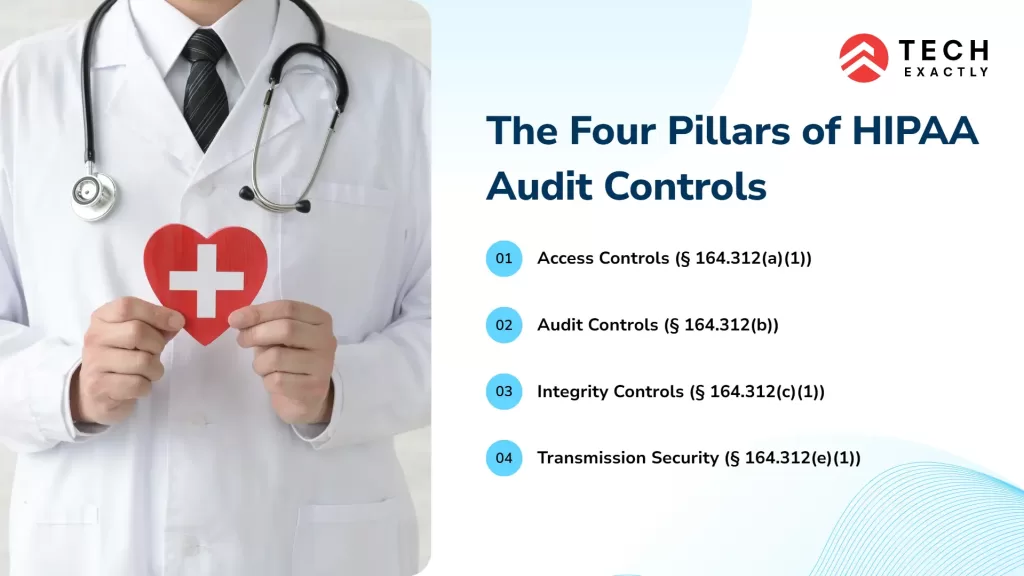
- Access Controls (§ 164.312(a)(1))
Every user, human or system, who accesses PHI must be authenticated and authorized. When an AI model generates a summary, the system triggering the request must be authenticated. Role-based access controls (RBAC) must limit which users can view the output. - Audit Controls (§ 164.312(b))
This is the big one for AI. You must implement hardware, software, and procedural mechanisms to record and examine activity in information systems that contain or use PHI. That includes the API call that sends patient data to your AI model, the model’s response, and every downstream access to the summary. - Integrity Controls (§ 164.312(c)(1))
Logs themselves must be tamper-evident. If an auditor suspects a log was modified to hide a breach, you need to be able to prove it wasn’t. - Transmission Security (§ 164.312(e)(1))
PHI transmitted to and from your AI layer, including summary requests and outputs, must be encrypted in transit using TLS 1.2 or higher.
HHS proposed regulations in January 2025 specify that covered entities must conduct vulnerability scanning at least every six months and penetration testing at least annually. Disaster recovery plans must also outline procedures for critical system restoration within 72 hours of a loss event.
What this means in practice: your AI summarization pipeline is now an auditable system, full stop. Every request in, every output out, every human interaction with that output: logged, timestamped, encrypted, and retained.
What Exactly Needs to Be Logged
This is where most teams get it wrong. They log the obvious stuff – user login, summary viewed and miss the gaps that auditors look for.
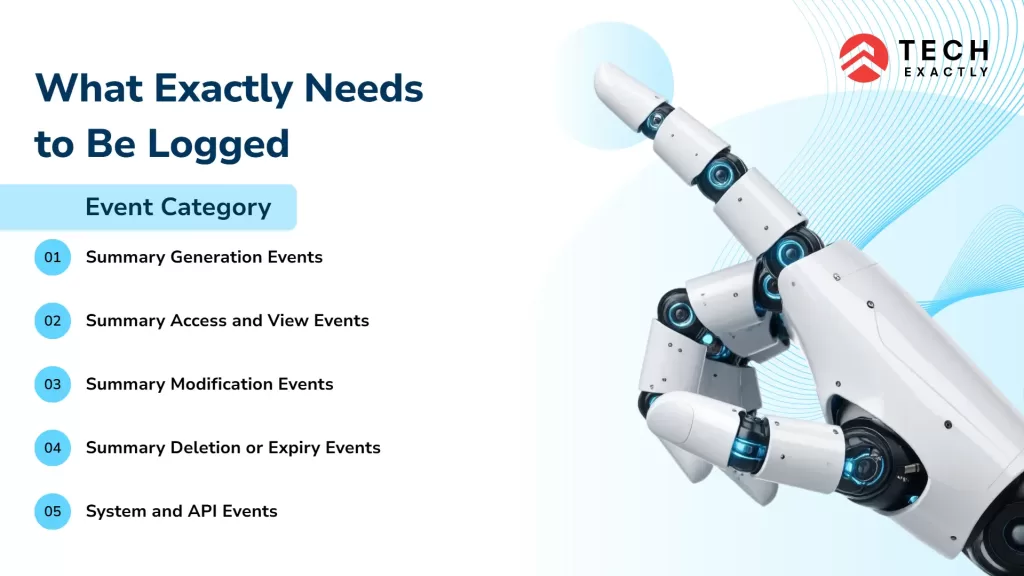
Here’s a complete logging framework for AI-generated medical summaries:
Event Category 1: Summary Generation Events
Each time your AI generates a medical summary, your log must capture:
- Timestamp (UTC, millisecond precision)
- Requesting user ID and role
- Patient record ID (never the PHI itself in the log, just the reference key)
- AI model version and provider (e.g., GPT-4o via Azure OpenAI with a BAA, or your on-device model)
- Input data scope – which fields from the EHR were included in the prompt
- Request outcome – success, error, partial response
- Session ID – to tie multiple events to a single clinical session
Event Category 2: Summary Access and View Events
The summary was generated, but who looked at it?
- User ID and role of the viewer
- Access method (in-app view, export to PDF, API pull)
- Timestamp
- Summary version – was this the original AI output, or a clinician-edited version?
Event Category 3: Summary Modification Events
HIPAA-compliant AI for therapy notes and other clinical documentation must track every edit. When a clinician corrects an AI-generated therapy note, that’s a meaningful clinical and compliance event.
- Original AI output hash – to prove what the AI actually said
- Modified by – user ID and credentials
- Modification timestamp
- Diff – what changed (field level, not necessarily the full text)
- Reason code – clinical correction, factual error, style adjustment
Event Category 4: Summary Deletion or Expiry Events
- Who deleted it
- When
- Reason code
- Whether the underlying PHI record was also affected
Event Category 5: System and API Events
- AI API call initiation – system account, timestamp, endpoint
- Response latency
- Token counts (useful for auditing scope creep, if your prompt is suddenly 10x longer, something changed)
- Error codes and retry events
Building a Tamper-Evident Logging Architecture
Logging events is not enough. The architecture that stores those logs must itself be audit-ready.
Separate Log Storage from Application Storage
Your audit logs should never live in the same database as your application data. Use a dedicated, append-only logging service: AWS CloudTrail, Azure Monitor, or Google Cloud Audit Logs all offer HIPAA-eligible configurations. The key requirement: append-only means no row can be modified after it’s written, only new rows can be added.
Cryptographic Integrity Verification
Implement log chaining. Each log entry should include a hash of the previous entry. This creates a chain where any tampering, even changing a single character in a past log entry, is immediately detectable. This is analogous to a blockchain ledger for your compliance trail.
Encryption at Rest and in Transit
All audit logs must be encrypted at rest (AES-256 minimum) and in transit (TLS 1.2+). This applies to the log storage system, any log aggregation pipelines, and any dashboards used to review logs.
Retention for Six Years Minimum
HIPAA requires documentation retention for six years from creation or the last effective date. Your log retention policy must enforce this automatically, not rely on someone remembering to archive.
Alerting and Anomaly Detection
Audit logging isn’t just for post-incident forensics. Build real-time alerts for:
- Unusually high volumes of summary generations by a single user
- Summary access by users outside normal hours or locations
- Failed access attempts
- Modifications to completed summaries without a reason code
This is the difference between a logging system that satisfies auditors and one that actively protects patients.
Why Your Logging Stack Isn’t Enough Without the Right Contracts
You can have a perfect logging architecture and still fail a HIPAA audit because of a contractual gap.
Every vendor in your AI pipeline that touches PHI must sign a Business Associate Agreement (BAA). That includes:
- Your LLM provider (OpenAI, Anthropic, Google, AWS Bedrock, etc.)
- Your cloud hosting provider
- Your logging and monitoring service
- Your SIEM (Security Information and Event Management) platform
This is non-negotiable. In 2024, a breach exposing the records of 483,000 patients across six hospitals originated with an agentic AI workflow vendor, a third party that almost certainly lacked proper contractual oversight.
HIPAA-compliant AI platforms like Azure OpenAI Service, AWS HealthLake, and Google Cloud Healthcare API explicitly offer BAAs and HIPAA-eligible service tiers. General-purpose LLM APIs that don’t offer a BAA, including many free-tier offerings, cannot be used with real PHI, period. No exceptions, regardless of how good your own logging is.
✅Quick checklist: Before you go live with any AI summarization feature, verify BAAs are signed with every vendor in your data path. If a vendor won’t sign a BAA, find another vendor.
On-Device vs. Cloud AI: The Logging Implications
One architectural decision significantly affects your logging complexity: whether your AI-generated medical summaries are produced by a cloud API or an on-device model.
We covered this in depth in our guide on comparing the HIPAA compliance risks of on-device AI vs cloud-based APIs, but here’s the short version for logging purposes:
Cloud-based AI (e.g., GPT-4o via Azure):
- PHI leaves the device/server to reach the API: requires TLS, BAA, and logging at the API gateway level
- Easier to centralize logs: all AI calls route through a single integration point
- Provider-side logging may supplement your own, but don’t rely on it as your sole audit record
On-device AI (e.g., a local LLM running on a clinical workstation):
- PHI never leaves the local environment, reducing transmission risk
- Logging must be implemented entirely by your application layer. There is no provider-side log to fall back on
- Log exfiltration (getting those local logs to your central audit store) becomes a new attack surface to protect
Neither approach is automatically more compliant. Both require deliberate logging architecture. In fact, the on-device path actually places more burden on your engineering team.
HIPAA-Compliant AI for Therapy Notes: Case Study
Behavioural health is worth calling out. HIPAA-compliant AI for therapy notes sits at the intersection of two high-sensitivity areas: mental health PHI (which carries extra sensitivity under state laws in many jurisdictions) and AI-generated clinical documentation.
When an AI summarizes a therapy session, it may capture:
- Diagnoses (depression, PTSD, substance use)
- Medications and dosages
- Patient disclosures made in session
- Risk assessments (suicidality, self-harm)
This is among the most sensitive PHI that exists. Logging for therapy note AI must be even more rigorous than for general medical summaries:
- Minimum necessary principle enforced at the prompt level: the AI should receive only the data fields required to generate the summary, not the full unstructured session transcript, unless necessary
- Clinician review event must be logged: no AI-generated therapy note should ever be finalized without a documented human review step in your audit trail
- State law compliance layered on top of HIPAA: some states (California, Texas, New York) have additional mental health record privacy requirements that affect how logs must be structured and retained
We built a HIPAA-compliant web app for a therapy platform: Therapized, where exactly these logging and access control requirements shaped the architecture from day one. The platform needed to support therapist workflows without exposing session-level PHI unnecessarily, which required purpose-built data access scoping before any AI feature could be considered.
The Role of Companies Designing Secure Infrastructure for HIPAA Compliance
Logging doesn’t live in isolation; it’s downstream of how your entire platform is architected. Companies designing secure processors for HIPAA compliance, along with cloud-native infrastructure providers, offer hardware-level security features that make compliant logging more reliable:
- Hardware Security Modules (HSMs) for encryption key management. Keys used to encrypt log data should themselves be protected by an HSM, not just stored in software
- Trusted Execution Environments (TEEs) on modern processors allow AI inference to occur in a memory-isolated environment, reducing the attack surface for log tampering
- Secure enclaves (Intel SGX, AMD SEV) allow sensitive computations to occur without exposing plaintext data even to the host OS
If you’re working with agencies providing HIPAA-compliant development for healthcare, make sure they’re architecting at this level, not just putting an HTTPS label on an API endpoint and calling it compliant.
What Auditors Look For: The Practical Audit Scenario
Let’s walk through what a HIPAA security audit involving AI systems looks like in practice. Understanding the auditor’s perspective helps you build logging that actually satisfies the review.
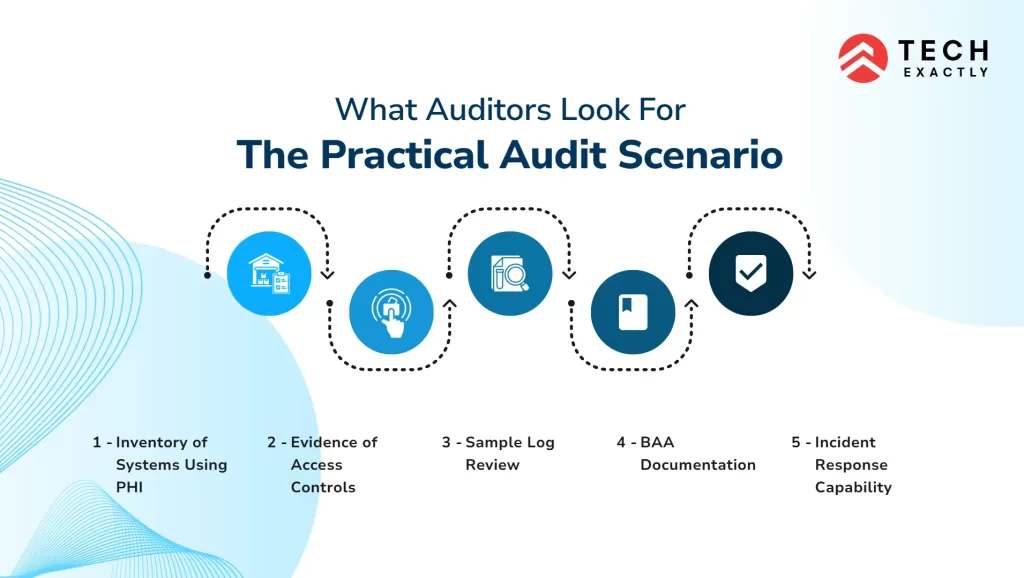
Step 1: Inventory of Systems Using PHI
An auditor will start by asking for your system inventory. Every system that stores, processes, or transmits PHI must be listed. Your AI summarization pipeline, including the model endpoint, the integration layer, the output storage, and the audit log database, must appear on this inventory.
Step 2: Evidence of Access Controls
The auditor will ask: “Who can trigger an AI summary generation? Who can view the output? How is that enforced?” You need documented RBAC policies and technical evidence (log samples showing role enforcement) that the policies are actually implemented, not just written.
Step 3: Sample Log Review
Auditors request log samples. They’ll look for completeness (does every event type have a log?), consistency (are timestamps reliable and timezone-aware?), and integrity (can you prove logs haven’t been modified?).
Common findings that lead to audit failures:
- Logs exist, but don’t tie events to specific patient records
- Log retention periods are shorter than 6 years
- No evidence of regular log review (someone must actually be looking at these logs, an unreviewed log system is not compliant)
- Gaps in logging during system updates or migrations
Step 4: BAA Documentation
The auditor will ask for signed BAAs with every relevant vendor. Missing BAAs, especially for AI providers, are among the most common findings in modern healthcare audits. See our detailed HIPAA audit checklist for healthcare apps for a complete test-and-fix framework.
Step 5: Incident Response Capability
Can you reconstruct what happened during a PHI incident using your logs? Auditors may present a hypothetical: “A user accessed 50 patient summaries in 10 minutes at 2 AM. What can you tell me about that?” If your logging system can answer that question completely within minutes, you’re in good shape.
Choosing the Right HIPAA-Compliant Development Partner
Not every development agency is equipped to build AI systems that are genuinely compliant. The difference between HIPAA-compliant development agencies that understand this space and general-purpose shops that bolt compliance on at the end is significant and the consequences of getting it wrong are severe.
When evaluating a HIPAA app developer or agencies providing HIPAA-compliant development for healthcare, look for:
- Deep familiarity with the Security Rule, not just the Privacy Rule. Many developers understand privacy requirements, but haven’t designed audit logging systems
- Experience with AI-specific HIPAA surface areas: BAA management, prompt scoping, output logging, model versioning
- References in healthcare: ask specifically about audit outcomes, not just whether apps were built and launched
- Understanding of HIPAA compliance services scope, including physical, administrative, and technical safeguards as an integrated system
- Ability to advise on infrastructure. The right hipaa compliant app development partner will push back if you suggest a logging shortcut that creates risk
This is exactly the approach we take at Tech Exactly for hipaa compliant mobile app development. Whether we’re doing HIPAA compliant app development for a therapy platform, a clinical decision support tool, or an AI-driven documentation system, logging and audit trail design are part of the architecture conversation from week one. We also advise on the full compliance landscape across jurisdictions; if your platform operates internationally, you’ll want to review healthcare app compliance across the US, UK, HIPAA, GDPR, FDA, and UKCA.
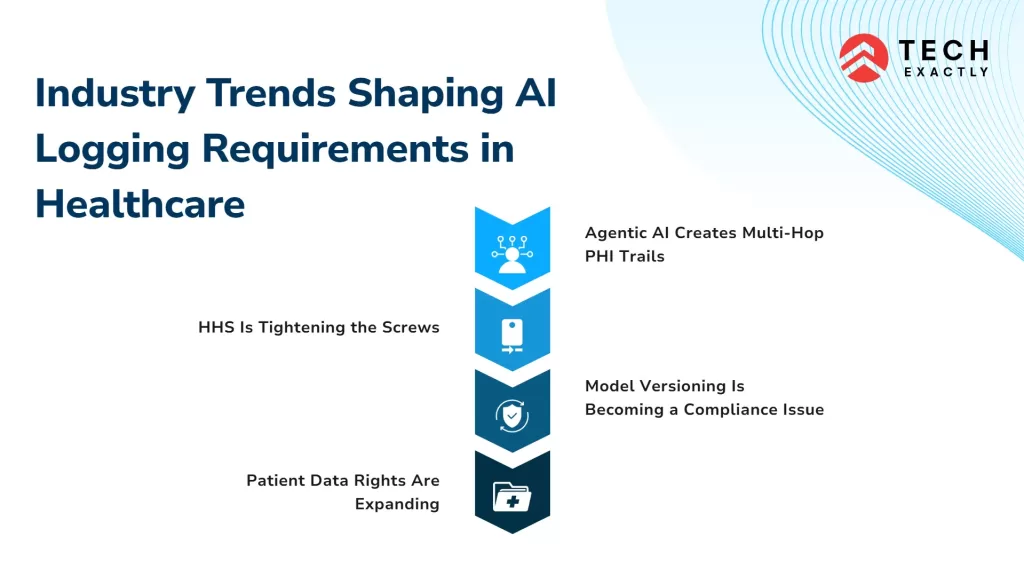
Industry Trends Shaping AI Logging Requirements in Healthcare
Trend 1: Agentic AI Creates Multi-Hop PHI Trails
The next wave of healthcare AI isn’t a single summary generator. It’s agentic systems where one AI triggers another, which triggers a third. Each hop in that chain is a potential PHI exposure event that needs to be logged. If you’re thinking about this now, you’re ahead of most teams.
Trend 2: HHS Is Tightening the Screws
HHS proposed regulations in January 2025 specify that covered entities must conduct vulnerability scanning at least every six months and penetration testing at least annually. This means your AI systems are now part of a regular security review cycle, not a one-time compliance pass.
Trend 3: Model Versioning Is Becoming a Compliance Issue
When your AI model is updated, whether you control the model or use a vendor’s, the output characteristics change. Auditors are beginning to ask: “Which version of the model produced this summary?” If you can’t answer that, you can’t prove the summary reflects the AI system that was evaluated and approved for clinical use. Log your model version with every generation event.
Trend 4: Patient Data Rights Are Expanding
Under proposed updates to the HIPAA Privacy Rule, patients may soon have more explicit rights to access logs of who or what system accessed their PHI. AI summarization events would be included. Building logging infrastructure now that’s patient-queryable is a future-proofing move worth making.
For more on how to think about which AI features belong in your healthcare platform and when, check out our guide on when a healthcare app actually needs AI and our framework for AI feature prioritization in healthcare apps.
A Practical Implementation Checklist
Use this to audit your current state before an auditor does:
Architecture
- AI pipeline components are inventoried as PHI-handling systems
- Audit log storage is separate from application storage
- Logs are append-only with cryptographic integrity verification
- Logs are encrypted at rest (AES-256) and in transit (TLS 1.2+)
- Log retention policy enforces a 6-year minimum automatically
Event Coverage
- Summary generation events logged (model version, user, patient record reference, input scope)
- Summary access and view events logged
- Summary modification events logged with original hash and diff
- Deletion/expiry events logged
- API and system events logged (including token counts and latency)
Contractual
- BAA signed with every AI vendor in the data path
- BAA signed with a cloud hosting provider
- BAA signed with a logging/monitoring vendor
- BAA review schedule documented (BAAs should be reviewed annually or when vendor terms change)
Operational
- Designated person responsible for log review on a defined schedule
- Alerting rules configured for anomalous access patterns
- The incident response playbook includes a log extraction procedure
- Vulnerability scanning schedule documented and active
- Penetration testing schedule documented (at least annually)
Final Thoughts
AI and HIPAA compliance aren’t fundamentally at odds, but they do require deliberate engineering. AI-generated medical summaries are now a standard part of clinical workflows, and the audit trail behind them needs to be just as rigorous as the clinical documentation they support.
The teams that are getting this right aren’t treating logging as a DevOps task or a compliance checkbox. They’re treating it as a first-class engineering requirement: designed in, not bolted on. They’re working with HIPAA-compliant development agencies that understand the full picture: the Security Rule requirements, the BAA obligations, the infrastructure choices, and the operational processes that keep a logging system compliant year after year.
If you’re building an AI-powered healthcare platform and want a development partner who builds compliance into the foundation, not the finish, let’s talk. We’ve done this for therapy platforms, clinical documentation tools, and complex multi-provider healthcare apps. We can help you get it right the first time.


