


How to Integrate EHR into Healthcare Apps (2026)

Most healthcare app conversations get stuck on the same question. A founder has a product idea, has talked to ten potential customers, has outlined a working prototype, and then someone asks, “How does this connect to data inside Epic?”Three weeks of discovery follow and the roadmap shifts six months.
EHR integration decides whether a healthcare app can be launched or is just a theoretical concept. It defines what your app can know about the patient, what it can write back to the chart, who has to approve the connection, and how much you spend before the first user signs in. If you get it right, the rest of the build is mere software engineering. If you get it wrong, you just have a beautiful demo that no clinic will connect to a live EHR.
This guide is for founders scoping EHR integration services for healthcare apps, SaaS for clinicians, mobile apps for patients, telemedicine platforms, behavioral health software, RPM apps, healthcare CRMs, and wellness apps crossing into clinical territory. The numbers below come from healthcare app production builds done by Tech Exactly in 2025 and 2026, focused on the US market with Epic, Oracle Health (Cerner), Athenahealth, and the smaller EHR ecosystem.
Before going any further, an important clarification on the scope. If you’re building a smart pump, glucose monitor, or any other hardware that pushes data into a chart, the regulatory layer is different (FDA SaMD classification, IEC 62304, AAMI/UL 2800), and medical device integration with EHR is the better reference. The rest of this article covers EHR integration software for apps, not hardware.
What Is EHR Integration?
EHR integration is the work of connecting your healthcare app to an Electronic Health Records system so that data can move between the two. That definition sounds obvious, and yet it still has complexity over the part that matters. Data can move can mean three very different things, and the version you pick changes the entire build.
There are three categories of EHR integration in practice:
- Read-only. Your app pulls patient data from the EHR (medications, allergies, problem list, recent labs) and uses it. Nothing flows back. Common for patient apps, wellness apps, second opinion tools.
- Read and write. Your app reads from the EHR and also writes data back, such as observations from a connected glucose meter, a clinician note from a telemedicine visit, or a discrete order. Common for telemedicine, RPM, behavioral health.
- Embedded launch. Your app runs inside the EHR. A clinician opens it from within Epic or Cerner without re-authenticating, and the patient context is already loaded. Common for clinician-facing SaaS.
Integration is also different from interoperability and different from data export. Interoperability is the broader principle of systems being able to exchange data. Integration is the specific implementation between your app and a specific EHR. Data export is a one-time bulk transfer (a CSV, an HL7 v2 file dump) and rarely what founders actually want.
Three EHR Integration Patterns Founders Pick Between
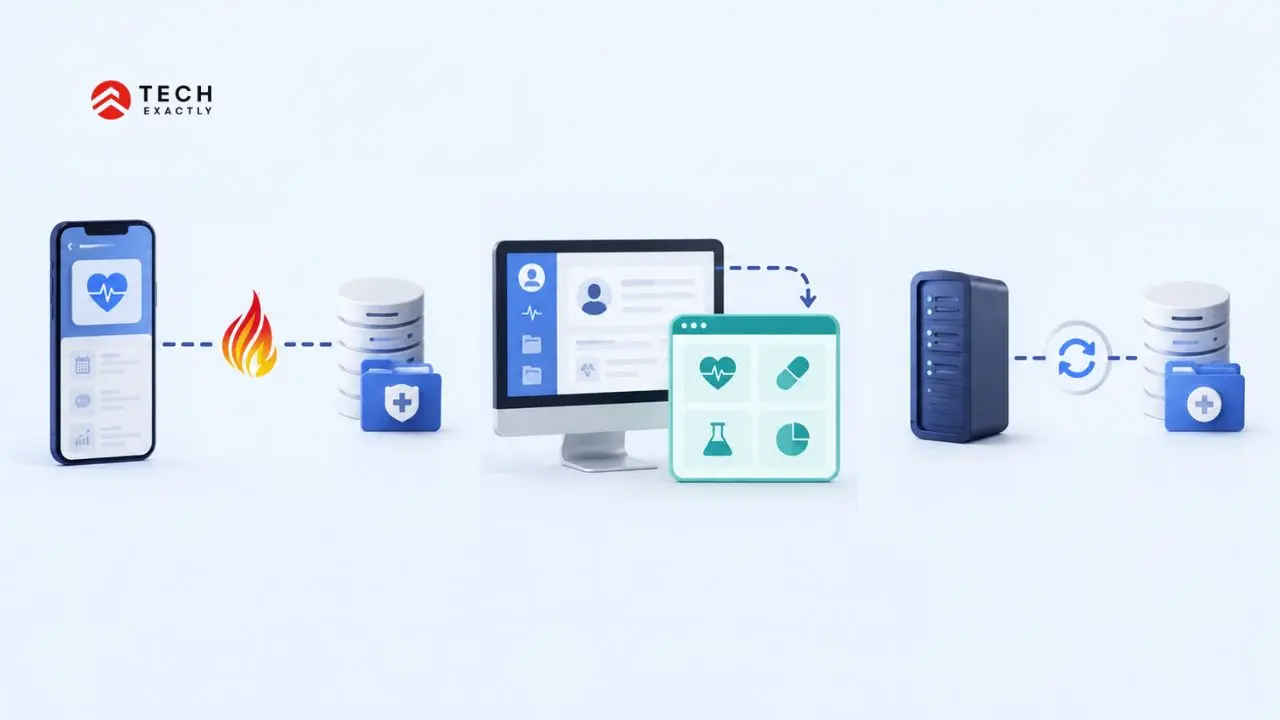
Picking the wrong pattern is the most common five-figure mistake at this stage of a healthcare app build. The three EHR integration solutions below aren’t interchangeable, and each has a different cost curve, vendor process, and engineering footprint. The choice also decides whether your EHR data integration runs in real time (FHIR API integration) or as scheduled batches (server-to-server sync).
| Pattern | What it does | Who it’s for | Build complexity | Typical cost |
|---|---|---|---|---|
| External app with FHIR API | Your app sits outside the EHR, pulls data via standard FHIR endpoints, optionally writes back | Patient-facing apps, RPM, wellness, mobile-first products | Medium | $15K – $80K |
| SMART on FHIR app launch | Your app launches inside Epic, Cerner, or Athena with patient or clinician context already loaded | Clinician-facing SaaS, in-EHR workflow tools | High | $50K – $250K |
| Headless server-to-server sync | No UI, just data. Server pulls or pushes structured records on a schedule or trigger | Analytics, RCM, billing, RPM ingestion, healthcare CRM hydration | Medium-High | $30K – $180K |
The biggest single error founders make is committing to a SMART on FHIR launch when an external app pattern would have shipped six months earlier. SMART on FHIR is the right option when your customer is a clinician who needs your tool inside their existing workflow. For everything else, the external app with a FHIR API path is usually faster, cheaper, and easier to maintain.
Let's Start Your Project Today
Ready to integrate EHR into Healthcare Apps with us? Reach out now – our experts are just one click away.
How to Integrate with Epic, Oracle Health, and Athenahealth & What's Different
The three biggest US EHR vendors run very different programmes. The differences matter at scoping time, not after you’ve signed an agreement.
Epic: App Orchard, Showroom, and App Market
Epic is the largest US EHR with a share of roughly 36% of acute-care hospitals and runs the most structured developer programme. The programme has been renamed a few times as App Orchard, Showroom, and now App Market. The pattern is the same.
- Sandbox access via the Epic FHIR API is free for testing.
- Production access requires submission, technical review, and approval. A realistic timeline for Epic EMR integration is 4 to 9 months from first submission to first hospital site.
- App Market listing is paid; the fee varies by app type and revenue model.
- Each customer hospital still has to install and configure your app on their own Epic instance. Approval doesn’t equal deployment.
The common misconception is thinking App Market approval means you can sell to any Epic customer. It means you can be installed by any Epic customer that chooses to install you. Each hospital is a separate sales cycle. Founders evaluating Epic integration services or shortlisting Epic integration partners should price the post-approval sales effort separately, not group it under a single label.
The Cures Act and ONC’s information blocking rules help a lot, and healthcare app compliance in the USA and UK has shifted accordingly. The rules don’t make sales calls easier, but they remove the easiest excuses.
Oracle Health (Cerner): Code Console and Cerner Open Developer Experience
Oracle’s developer programme for the former Cerner stack runs through Code Console. Sandbox onboarding is faster than Epic’s, but production sign-off has slowed since the Oracle acquisition in 2022 as the joint roadmap stabilises. Cerner’s market share is roughly 23% of acute-care hospitals in the US.
The technical architecture is similar to Epic’s. The FHIR R4 API set covers the USCDI data classes. Production access is per-site, with a partner agreement covering data, security, and indemnity.
Athenahealth: Marketplace and MDP
Athenahealth runs the most accessible developer programme of the three big vendors, which is one of the reasons it’s a popular first integration for SMB focused apps. The Athenahealth Marketplace is the equivalent of App Market. The Marketplace Development Platform (MDP) is where the technical work happens.
Athenahealth’s market position shifts drastically towards outpatient and ambulatory practices, which makes it a natural first target for apps serving private practice, behavioral health, or specialty clinics.
Everyone else: eClinicalWorks, NextGen, AllScripts/Veradigm, Meditech
If your customers run on eClinicalWorks (large outpatient share), NextGen (specialty practice strength), AllScripts/Veradigm (mixed market), or Meditech (community hospitals and rural), you’ll need to integrate with each separately or route through an aggregator. The Cures Act requires all of them to expose certified FHIR APIs covering the USCDI data set, which is your basic expectation regardless of vendor.
Let's Start Your Project Today
Ready to integrate EHR into Healthcare Apps with us? Reach out now – our experts are just one click away.
Best Practices for Integrating with Epic EHR Software
The EHR integration best practices below are the ones we provide to engineers on their first Epic project.
1. Build the patient consent UI before the first API call. Your app’s audit log has to show that the patient (or clinician, for clinician-facing apps) authorised the data pull. The consent screen is the foundation, not a last-minute refinement.
2. Cache aggressively, expire on patient action. Epic rate limits aggressively at the per-site level. A naive app that re-pulls medications on every screen load will hit limits at five concurrent users. Cache reads for the session, expire on any user action that suggests the data has changed.
3. Use FHIR R4 by default. HL7 v2.x only when the EHR forces it. Some legacy interface engines still speak v2 only. Plan for it, but don’t lead with it. FHIR R4 is the certified standard, the rate-limited surface is more predictable, and the JSON payloads are easier to debug.
4. Audit log every patient-data read on day one. HIPAA assumes one. The Office for Civil Rights audits assume one. Adding it later means rewriting half your data layer.
5. Test sandbox failure modes, not just happy paths. Sandbox returns rate limit errors, 500s, and schema variations that differ from production. The production debugging skills come from breaking the sandbox.
6. Plan for App Market re-certification at each major Epic release. Epics ship two major versions a year. Your app’s FHIR resource handling can drift between releases. Integrate re-certification time into your roadmap.
FHIR API: What Healthcare App Founders Actually Need to Know
In simple words, FHIR API is the modern healthcare data standard for exchanging clinical records over REST and JSON. FHIR R4 is the version every US EHR is required to expose, and the HL7 FHIR specification is the primary reference. For founder-grade understanding, three concepts matter.
Resources are typed records. A Patient, a MedicationRequest, an Observation, each is a resource with a defined schema, a stable URL pattern, and predictable JSON. No parsing pipe-delimited HL7 v2 messages.
Bundles are how you batch. A Bundle is a collection of resources returned together. If you ask for this patient’s medications, conditions, and allergies, you get a Bundle. Pagination is part of the Bundle response.
USCDI is the minimum data set. The ONC United States Core Data for Interoperability defines what every certified EHR has to expose. USCDI v3 covers demographics, problems, allergies, medications, immunisations, lab results, vitals, procedures, encounters, smoking status, and care team. If you’re scoping a Cures Act-compliant integration, this is the floor.
SMART on FHIR sits on top of FHIR. The SMART on FHIR API is the OAuth 2.0 plus OpenID Connect layer handling authentication and authorisation. There are two options: SMART app launch (your app launches inside the EHR with context pre-loaded, used by clinician-facing apps) and SMART standalone (your app launches separately, the user authorises through the EHR’s screen, used by patient-facing apps).
A practical note on the Epic FHIR API is that Epic splits endpoints into public and confidential. Public endpoints support patient apps via OAuth with PKCE. On the other hand, confidential endpoints require a registered app with a client secret, usually used by clinician-facing apps and server-to-server integrations. Picking the wrong client type wastes two weeks.
EHR Integration for Patient-Facing Apps
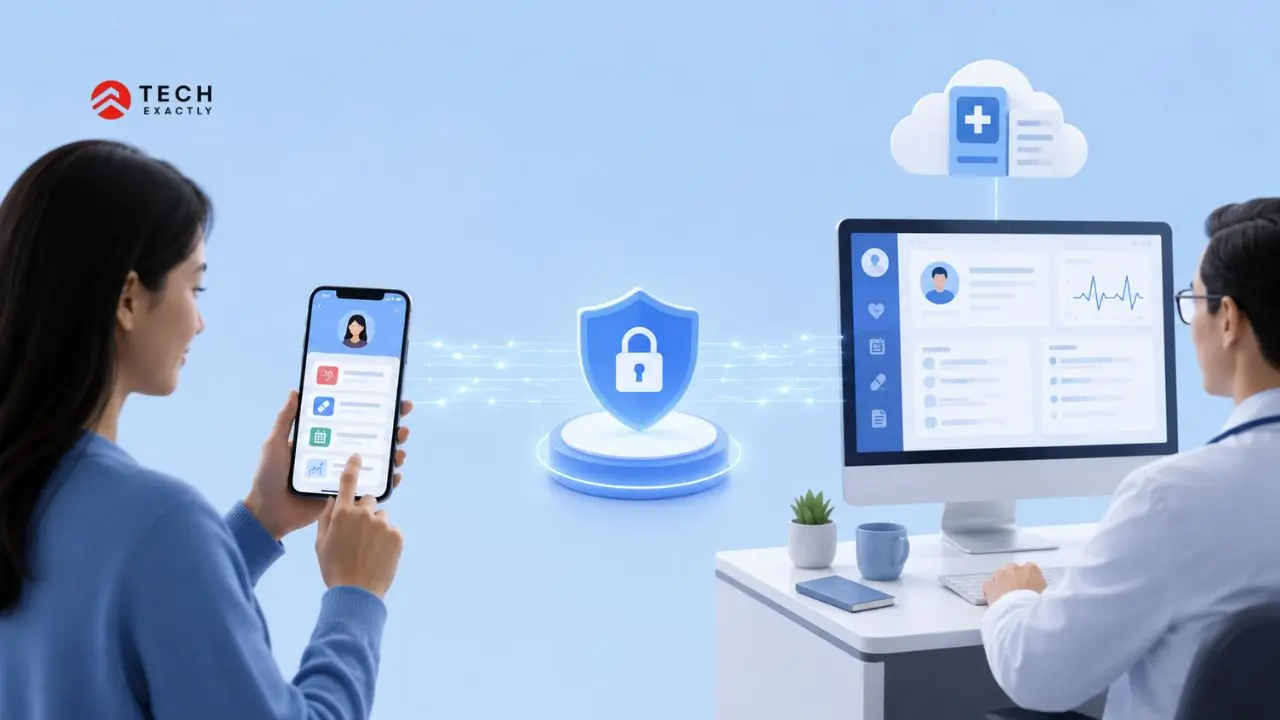
If your customer is the patient, the build looks meaningfully different from a clinician-facing one. The patient authorises data access, so your app’s onboarding has to walk a non-technical user through an OAuth flow into MyChart, the Athena patient portal, or whichever portal their provider uses.
The usual flow is a patient signs in, taps “connect your health records,” gets redirected to their provider’s portal, authenticates with existing portal credentials, approves an authorisation screen listing what your app is requesting, and gets redirected back with an authorisation code. Your app exchanges the code for an access token and starts pulling data.
Three things break for patient-facing app founders most often.
The patient doesn’t remember their portal credentials. Most have set up MyChart once, never used it, and have no idea what their password is. Handle the I forgot my login option gracefully.
Refresh tokens expire silently. OAuth refresh tokens have a lifetime of 90 days. When they expire, the patient has to re-authorise. Detect this and prompt for re-auth without breaking the user’s expectation of always-on data.
HealthKit and Health Connect are sometimes the better source. Apple HealthKit (iOS) and Google Health Connect (Android) can pull data from MyChart and other portals via the FHIR Bulk Data export API. Workout data, wearables, and self-reported vitals are easier through HealthKit than through a clinical FHIR call.
For telemedicine app development, telehealth EHR integration is the most common starting point. The patient connects their records, has a visit, and the visit notes write back via the SMART on FHIR clinician launch at the provider’s end with two separate integrations, one product. The same integrated EHR flow shows up in patient portal development cost and compliance projects when a clinic wants a branded patient portal as part of the build.
EHR Integration for Clinician-Facing Apps and SaaS
Clinician-facing apps run inside the clinician’s existing workflow. The integration model is SMART on FHIR app launch from within Hyperspace (Epic’s clinician workstation) or its Cerner and Athena equivalents.
The launch passes context to understand which patient is on screen, which encounter is active, and which clinician is signed in. Your app receives this context as part of the SMART launch parameters, then makes its own FHIR API calls to fetch whatever else it needs. The clinician never re-authenticates.
For a SaaS development project where the clinical user is the primary buyer, this is the integration pattern that justifies premium pricing. A SaaS tool that requires the clinician to leave Epic, log in elsewhere, and copy-paste data is sold at $30 per user per month. On the contrary, a SaaS tool that opens directly inside Epic with the patient context loaded sells at $300 per user per month and renews more reliably.
The trade-off is the buying decision maker. Even with App Market approval, you sell hospital-by-hospital. Each one runs its own IT review, its own security questionnaire, and often its own legal redlines on your DPA. Founder-side estimate is to assume 60 to 180 days from signed contract to first live user at each new hospital site.
EHR Integration for RPM, Behavioral Health, and Wellness Apps
Three verticals have integration patterns worth calling out separately.
Remote Patient Monitoring (RPM). Device data flows from the device, then the app, and then the headless FHIR write to the Observation resource on the EHR. Cellular devices are easier than Bluetooth ones for clinical-grade reliability, even though Bluetooth is cheaper per unit. The clinical side reads the Observations from the EHR side; the patient sees their own data in your app. The data volume at scale is the hard part. A single CGM device generates 288 readings a day, which is 105,000 readings a year per patient. At 1,000 patients, that’s 105 million data points a year, and your cloud healthcare computing infrastructure has to be planned with that volume in mind.
Behavioral health. Behavioral health adds 42 CFR Part 2 on top of HIPAA. Part 2 covers substance-use-disorder records and requires segmented consent where patients have to specifically authorise the sharing of SUD-related data, separately from general health data. Your app needs to handle the segmentation natively. Most EHRs have a way to tag Part 2 data, but the patterns differ by vendor.
Wellness apps. Wellness usually doesn’t need EHR integration at all. Apple HealthKit or Google Health Connect handles the patient-self-reported and wearable data, and the app stays out of the regulated lane. EHR integration enters the picture only when the app crosses into clinical territory, i.e., during a diagnosis screen, a clinician chat, or a prescription flow. At that point, the wellness app is now a clinical app and the rest of this article applies.
Let's Start Your Project Today
Ready to integrate EHR into Healthcare Apps with us? Reach out now – our experts are just one click away.
EHR with CRM Integration: The Pattern Most Teams Build Badly
The single most expensive integration mistake we see at the healthcare CRM layer is syncing Protected Health Information from the EHR into HubSpot or Salesforce by default. It’s tempting since everyone wants the 360-degree view, it’s allowed under BAAs with both vendors, and it’s almost always a bad architectural choice. The CRM becomes a HIPAA-scoped system, the audit scope doubles, and a breach in your CRM now means a HIPAA breach.
The pattern that works is to split the data. The CRM holds identifiers, contact records, conversation history, scheduling intent, marketing consent. Whereas the EHR holds the clinical record. They reference each other by a stable identifier (usually a patient ID your app mints, or an EHR MRN if you have one), but the clinical data never duplicates into the CRM.
Healthcare CRMs done right look more like sales CRMs with patient identifiers than like limited functionality EHRs. The patterns we see hold up across builds are covered in more depth in healthcare CRM software development dos and don’ts, which is worth reading alongside the integration scope discussion.
The MRN problem is real. If your app has its own patient ID, and the EHR has an MRN, and the CRM has its own contact ID, you have three identifiers for the same human. The matching logic between them is where most healthcare CRM integrations leak. Build identity resolution as a service, not as a column.
EHR Integration Cost and Timeline for App Founders
Below are the real numbers for US-targeted builds in 2026. These cover app-founder scope, but not hospital-side scope.
| Tier | Scope | Cost | Timeline |
|---|---|---|---|
| Single-EHR read-only | One vendor (Epic or Cerner), patient data read, sandbox-to-pilot | $15K – $40K | 6 – 10 weeks |
| Single-EHR read/write with App Market listing | One vendor, full submission, basic write-back, listing | $50K – $120K | 4 – 6 months |
| Multi-EHR via aggregator | Redox, Health Gorilla, 1upHealth, or Particle Health front; 2 to 5 EHR vendors | $80K – $180K | 3 – 5 months |
| Direct multi-EHR integration | Each EHR direct, no aggregator | $200K – $500K+ | 9 – 18 months |
In addition to this, there are monthly run costs. Aggregators charge anywhere from $1,500 to $15,000 a month at production volume. Direct integration has minimal aggregator cost but higher engineering overhead per vendor.
We come across three patterns consistently:
Aggregators are usually the right call for the first two years. Redox, Health Gorilla, and 1upHealth simplify per-vendor differences. You ship faster, learn one API contract, and trade a significant margin for time. The exit path is replatforming onto direct integrations once your customer base justifies the engineering cost. Building this trade-off into the EHR integration strategy up front saves you a painful replatform later.
The first hospital is always twice as long as the second. Site-specific Epic configuration, customer IT review, security questionnaires- all of it gets faster once you’ve done one. The estimated time for the first deployment is 90 to 180 days; the fifth ships in 30.
The cost ladder doesn’t include the App Market fee. Epic, Athena, and Oracle all charge listing or revenue-share fees that aren’t part of your build budget. Confirm the fee structure during scoping.
For the broader app-build cost stack, including hosting, compliance audits, and ongoing maintenance, the breakdown in healthcare app development cost by app type covers the recurring side in detail.
EHR Integration Challenges and How to Avoid Them
Six things break founder integration projects, in roughly the order they show up.
1. App Market submission rejection. The most common rejection reasons are inadequate audit logging, missing or unclear consent UI, FHIR scope requests that exceed the use case, and security gaps in the OAuth implementation. Build for the review, not just the demo.
2. Sandbox doesn’t match production. Sandbox data is synthetic. The schema is mostly identical, but real production data has edge cases the sandbox doesn’t, such as nulls, deprecated codes, and vendor-specific extensions. Allocate time for the post-sandbox shakedown.
3. Per-site Epic configuration. Each hospital configures Epic differently. The same FHIR resource can have different extensions, different value sets, and different optional fields by site. Your app’s parsing logic needs defensive defaults.
4. Patient identity matching. Probabilistic matching across names, DOBs, and other identifiers is the actual hard problem in healthcare integration. Master Patient Index libraries exist, but the matching thresholds need tuning per dataset.
5. Rate limits during patient surges. A campaign that drives 5,000 patients to your app over a weekend can saturate Epic’s per-site rate limits and degrade for every existing user. Build queueing and back-pressure in from day one.
6. FHIR version drift. Epic ships two major versions a year. Cerner and Athena have their own cadences. Resources change. Your app’s parsing has to track. This is a mobile app maintenance and support commitment, not a one-time build task. Add it into the contract.
If you want to know about the audit log side of these challenges, How to build a HIPAA-compliant app explains it in more depth, especially the parts that come up during the OCR-style review the App Market reviewers run.
How to Select an EHR Integration Company For Your Healthcare App
Below is a 7-point checklist for evaluating a healthcare app development partner specifically on EHR integration.
1. Have they shipped through App Market, Athena Marketplace, or Oracle Code Console? Ask for the public listing URL. A claimed integration capability without a live listing is not the same as a delivered one.
2. Will they sign a BAA before discovery? A BAA in the proposal stage is a signal that the partner takes HIPAA seriously. A BAA “after we scope” is a signal they don’t.
3. Do they default to FHIR R4, or push HL7 v2 because that’s what they know? Some teams default to the standard they’re comfortable with. Make sure your partner’s default matches the 2026 reality.
4. Have they shipped a SMART on FHIR launch in production? Not just a sandbox demo. A live in-Epic or in-Cerner launch with real clinical users.
5. Who owns the App Market listing after launch? It should be you. Get it in writing during scoping.
6. What’s the maintenance plan for FHIR version drift? A partner who treats integration as a one-time delivery doesn’t understand the long-tail cost.
7. Have they been through an OCR investigation or an Epic-equivalent security review? Pattern recognition matters. A partner that’s been through one of these once will avoid the design choices that trigger the next one.
Let's Start Your Project Today
Ready to integrate EHR into Healthcare Apps with us? Reach out now – our experts are just one click away.
FAQs
It takes about four to nine months from first submission to first hospital go-live is the realistic range. It varies mostly because of the partner in terms of completeness of the submission, response speed to Epic's questions, and whether the use case fits within the standard FHIR scopes or requires custom Epic engagement.
Aggregators are cheaper in year one and more expensive at scale. The break-even point for most founder builds is somewhere between 3,000 and 10,000 active patients across multiple EHR vendors. Below that, the aggregator's monthly fee is worth the time saved. Above that, direct integration usually wins on per-record cost.
Yes, only if your app makes clinical decisions or recommendations that meet the FDA's Software as a Medical Device (SaMD) definition. Reading data from an EHR is not by itself a medical device function. However, if you are writing diagnostic predictions back to the chart, you need it.
FHIR R4 is a modern RESTful standard using JSON, and modern EHR API integration work defaults to it. On the other hand, HL7 v2.x is a pipe-delimited message format from the 1980s, still in production at most hospitals for feeds like ADT (admit-discharge-transfer). HL7 v2.x is what you fall back to when a specific data feed doesn't have a FHIR equivalent yet.
Rarely can it, and that too not without specific clinician sign-off in the workflow. Patient apps can usually write patient-reported outcomes, blood pressure readings, glucose values, and similar self-reported data into a designated patient-generated health data area. They generally cannot write into the formal clinical chart without a clinician approving the entry.

Manas Das, Mobile App Architect at Tech Exactly, has over 9 years of experience leading teams in iOS, Android, and cross-platform development. He specialises in scalable app architecture and GenAI-driven mobile innovation.