

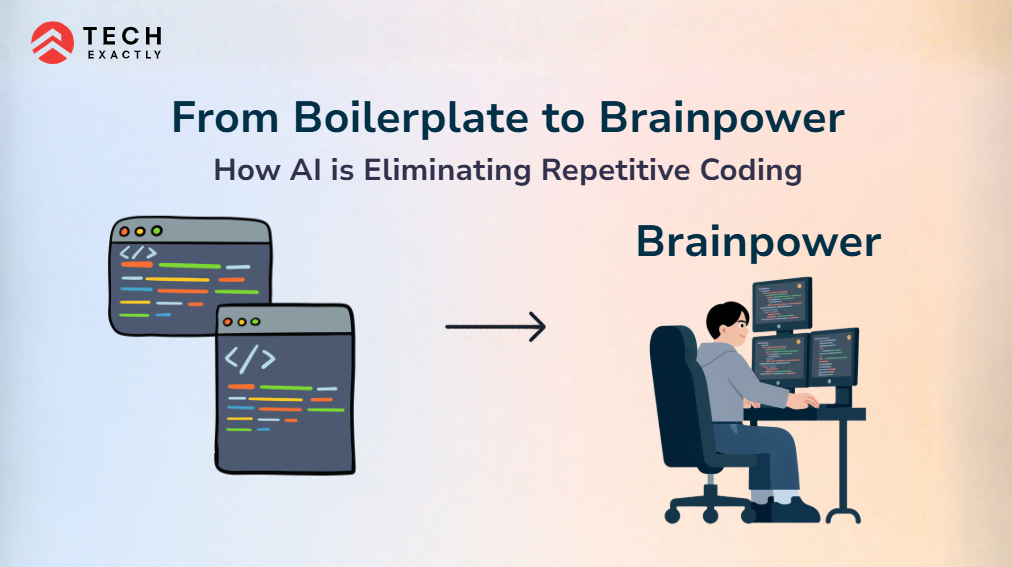
From Boilerplate to Brainpower: How AI is Eliminating Repetitive Coding

The 40% Problem No Developer Talks About
Every developer knows the feeling. You open a new project, and before you write a single line of actual logic, you’ve already spent hours setting up authentication boilerplate, configuring error handlers, writing CRUD templates, and scaffolding components that look eerily identical to what you wrote last quarter. If you’re working with an AI app development company in USA, that problem is fast becoming a relic of the past.
Here’s a stat that should make every CTO pause: developers spend up to 40% of their time writing repetitive, templated code. Code that adds no unique business value but is necessary for the system to function. That’s nearly half your dev budget, gone before a single feature ships.
But what if AI could handle that 40%? Not someday. Right now.
This blog breaks down exactly what boilerplate code is, why it slows teams down, and most importantly, how AI is flipping the script, turning weeks of repetitive scaffolding into minutes of intelligent generation. Whether you’re a startup founder, a CTO, or a senior developer, by the end of this article, you’ll understand why the smartest engineering teams in 2025 have stopped writing boilerplate by hand entirely.
What Is Boilerplate Code?
Boilerplate code (also written as “boiler plate code”) refers to sections of code that are repeated across multiple places in a program or across different projects with little to no modification. It is standard, reusable code that provides a structural foundation but carries no unique business logic.
The term originates from the newspaper industry, where “boilerplate” referred to standardized type plates used to print the same content repeatedly across publications. In software, it carries the same meaning: code you write again and again because the structure demands it, not because it’s creative or novel.
Common Examples of Boilerplate Code
- React component scaffolding: import React, state declarations, prop-types definitions
- Java class templates: getters, setters, constructors, toString(), and equals() methods
- REST API setup: route registration, middleware wiring, response formatting
- Authentication flows: JWT validation, session handlers, refresh token logic
- Database connection boilerplate: ORM configuration, connection pooling, migration files
- Error handling wrappers: try-catch blocks repeated across every async function
- Mobile app boilerplate: navigation setup, Redux store configuration, theme providers
What Is Boiler Plate Code vs. Regular Code?
Think of it this way, if you deleted a block of code and a template from the internet could replace it in five minutes, it’s probably boilerplate. If deleting it breaks something only your product does, that’s feature/regular code. The distinction matters because these two types of code deserve completely different levels of developer attention. Boilerplate is structural plumbing, necessary, yes, but not where your team’s creativity or competitive advantage lives. Feature code is where your product’s identity is built. Mixing them up or worse, treating them with equal manual effort, is exactly what drains developer bandwidth and inflates project timelines without adding real value.

Features | Boilerplate Code | Feature Code |
What it is | Structural, repetitive setup code | Unique logic tied to your product |
Written how often? | Every project, every module | Once per feature |
Business value | Indirect (enables the app to run) | Direct (defines what the app does) |
Unique to your product? | Rarely | Always |
Can it be templated? | Yes, easily | Rarely |
Risk if done wrong | Inconsistency, security gaps | Broken product logic |
Who should write it? | AI tools (in 2025) | Your engineers |
Examples | Auth setup, CRUD routes, DB config | Payment flows, recommendation engines |
Time spent on it (avg.) | ~35–40% of dev time | ~60–65% of dev time |
AI generation accuracy | Very high | High, but needs human oversight |
Why Boilerplate Code Is Costing You More Than You Think
Before we explore the AI-powered solution, it’s worth understanding the full weight of the boilerplate problem. It’s not just about tedium.
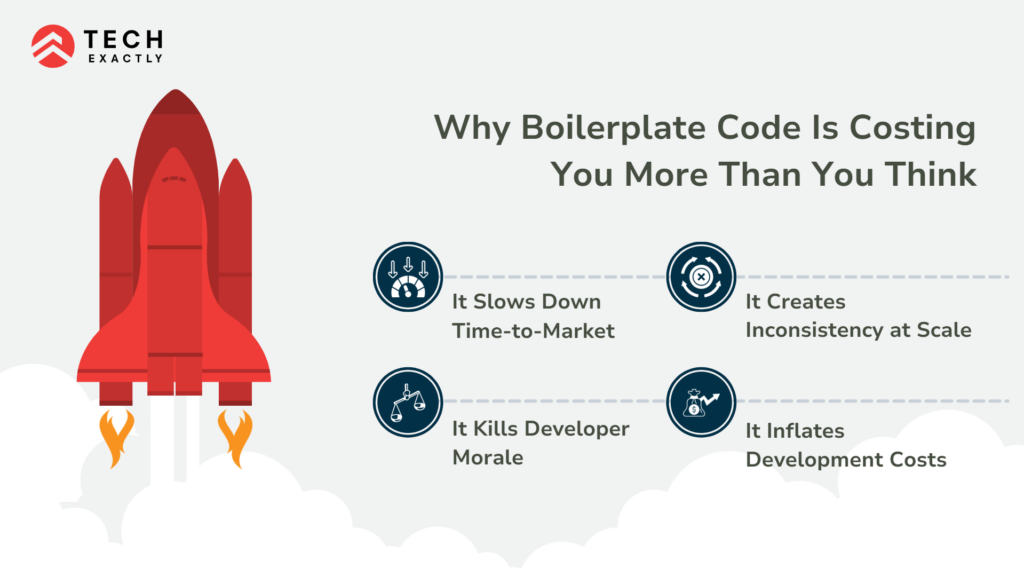
1. It Slows Down Time-to-Market
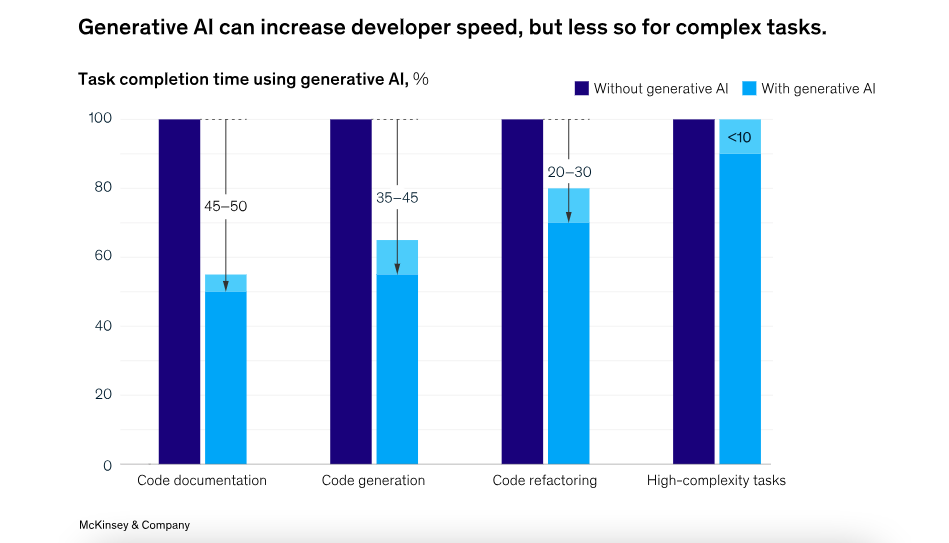
Every sprint wasted on scaffolding is a sprint not spent on features your users actually want. According to a McKinsey Global Institute report, poor developer productivity, largely driven by repetitive tasks, costs companies an estimated 15-60% in lost value of total IT budget.
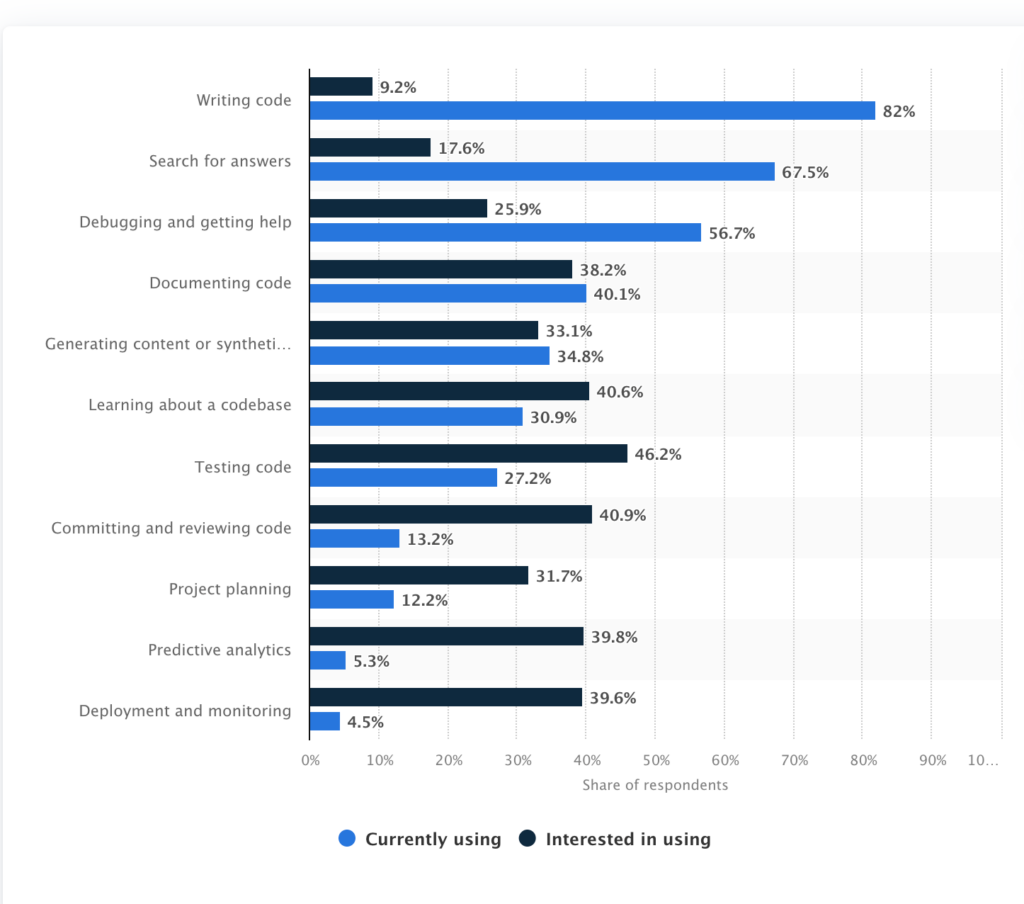
Image source.
2. It Creates Inconsistency at Scale
When five different developers write their own version of the same authentication middleware, you end up with five different implementations – some secure, some not. Boilerplate written manually introduces subtle variation that becomes a maintenance nightmare.
3. It Kills Developer Morale
In a Stack Overflow Developer Survey, over 72% of developers reported that repetitive, low-value tasks were a significant factor in burnout and job dissatisfaction. The best engineers didn’t enter the field to copy-paste class definitions.
4. It Inflates Development Costs
Whether you’re building in-house or outsourcing to an AI powered mobile app development company, paying senior engineers to write CRUD endpoints is an expensive use of talent. Every hour spent on boilerplate code is an hour not spent on architecture, performance, or innovation.
How AI Is Eliminating Repetitive Coding (And Changing Everything)
This is where it gets exciting. The emergence of large language models (LLMs) trained on billions of lines of code has made something genuinely remarkable possible: AI that understands code structure deeply enough to generate entire scaffolds, components, and module templates from a single prompt.
The Core Mechanism: How AI Understands Code Boilerplate
AI code generation tools don’t just autocomplete. They:
- Understand intent: From a natural language prompt or a partial code snippet, the AI infers what you’re trying to build.
- Apply patterns: It maps your intent to established design patterns (MVC, Repository Pattern, Factory, etc.).
- Generate full scaffolds: Not just a function, but an entire module, with proper imports, error handling, and documentation.
- Adapt to your stack: Modern AI tools detect your language, framework, and conventions to generate contextually correct code.
Step-by-Step: How to Reduce Boilerplate Code With AI
Our developers at Tech Exactly have been using AI to minimize the usage of Boilerplate code with necessary precautions. Here’s a how-to guide for development teams looking to integrate AI into their workflow to eliminate repetitive coding.
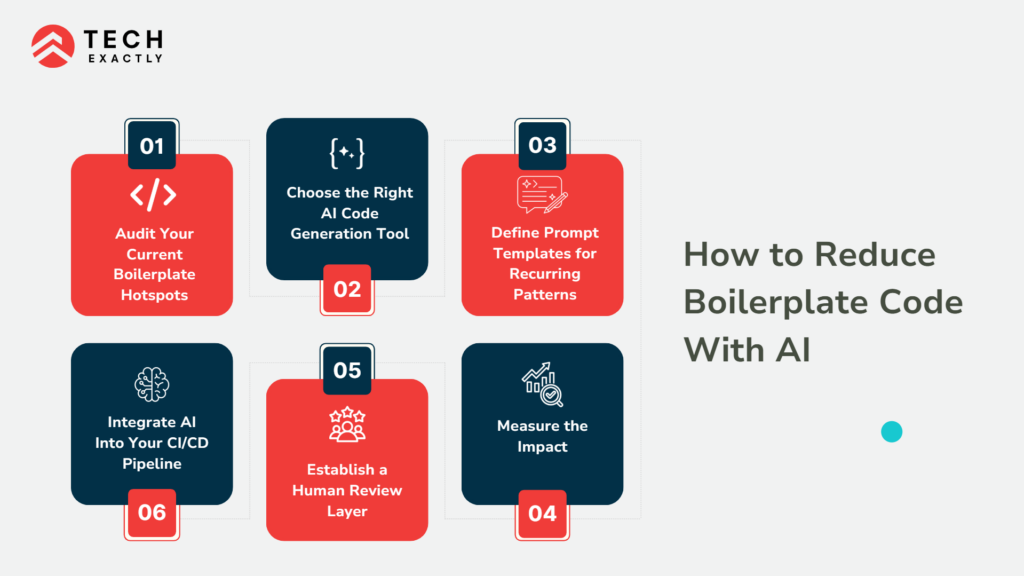
Step 1: Audit Your Current Boilerplate Hotspots
Before you automate, you need to identify. Run a codebase audit to answer:
- Which modules or patterns are copied and pasted most frequently?
- What file types (routes, controllers, models, tests) are structured identically across features?
- How much time per sprint is logged against “setup” or “scaffolding” tasks?
Tools to use: SonarQube, CodeClimate, or a simple grep-based audit.
Step 2: Choose the Right AI Code Generation Tool
Not all AI tools eliminate boilerplate equally. Here’s a breakdown by use case:
Use Case | AI Tool | Best For |
In-editor autocomplete | GitHub Copilot | Real-time line and block completion |
Full-file generation | Cursor AI | Generating entire files from prompts |
API scaffolding | Amazon CodeWhisperer | AWS-connected backend generation |
Mobile app boilerplate | Tabnine + custom models | React Native / Flutter scaffolding |
Custom enterprise AI | Fine-tuned LLMs | Company-specific code patterns |
If your organization needs custom AI generation tuned to your proprietary stack, this is where partnering with an AI app development company in USA, like Tech Exactly, that specializes in enterprise AI integration, becomes critical.
Step 3: Define Prompt Templates for Recurring Patterns
The quality of AI-generated code is only as good as the prompt. For boilerplate elimination, you want structured prompt templates, not ad hoc queries.
Example prompt for a REST API controller:
Generate a Node.js Express controller for a [resource: Product] with:
– GET all (paginated)
– GET by ID
– POST (with Joi validation)
– PUT (partial update)
– DELETE (soft delete)
Use async/await, centralized error handling, and JSDoc comments.
Save these prompts as team-shared snippets. Over time, they become your internal code generation playbook.
Step 4: Integrate AI Into Your CI/CD Pipeline
The most advanced teams don’t just use AI in their IDE; they bake it into their pipeline. Here’s how:
- Pre-commit hooks: AI reviews staged code for missing boilerplate (e.g., missing error handlers, undocumented functions).
- PR templates with AI suggestions: AI flags when a new feature lacks standard test scaffolding.
- Auto-generation scripts: CLI tools powered by AI generate model/controller/service triplets from a single command.
- AI-assisted code review: Tools like CodeRabbit or GitHub Copilot for PRs review boilerplate compliance automatically.
Step 5: Establish a Human Review Layer
AI-generated code is fast, but it’s not infallible. Build a lightweight review process:
- All AI-generated scaffolds go through a 30-minute senior dev review before merging.
- Maintain a “golden template” library that reflects your team’s approved patterns.
- Run automated security scans (Snyk, Dependabot) on all AI-generated files.
- Document which parts of the codebase were AI-generated for future maintainability.
Step 6: Measure the Impact
Set clear KPIs before and after AI adoption:
- Average time from feature brief to first code commit
- Lines of boilerplate code written manually vs. AI-generated
- Sprint velocity change over 3 months
- Developer satisfaction scores (use anonymous surveys)
Key Advantages of Using AI to Eliminate Boilerplate Code
Let’s make these explicit, because the business case is powerful.
Dramatically Faster Development Cycles
AI can generate a full CRUD module: routes, controller, service, model, tests in under 60 seconds. What would take a developer 3–4 hours is now done before the coffee finishes brewing.
Consistent Code Quality Across the Entire Team
Every AI-generated scaffold follows the same structure, naming conventions, and error handling patterns. Junior developers produce code that looks like it was written by your most experienced engineer.
Reduced Onboarding Time for New Developers
When boilerplate is AI-generated and standardized, new hires spend less time learning “how we do things here” and more time contributing actual features. Onboarding time can drop by 30–50%.
Lower Development Costs Without Lowering Standards
For companies working with an AI powered mobile app development company, AI generation means fewer billable hours spent on rote tasks, translating directly into lower project costs without sacrificing quality.
Developer Focus Shifts to High-Value Work
When AI handles the scaffolding, developers focus on architecture decisions, complex business logic, performance optimization, and user experience, the work that actually differentiates your product.
Faster AI Chatbot App Development
For teams building conversational AI products, the benefits are compounded. An AI chatbot app development company leveraging AI code generation can scaffold intent handlers, entity parsers, webhook endpoints, and NLU training pipelines in a fraction of the traditional time.
Improved Documentation by Default
Modern AI tools generate JSDoc, docstrings, and inline comments alongside the code. Many developers skip this habit when writing boilerplate manually under deadline pressure.
Real-World Use Cases: AI Eliminating Boilerplate Across Stacks
React / React Native (Mobile Apps)
AI tools can generate complete component trees with hooks, prop-types, styled-components, and unit tests from a component specification prompt. For an AI powered mobile app development company, this means shipping screens faster without sacrificing testability.
Example: A 15-screen React Native app that would take 3 weeks of scaffolding manually can have its boilerplate generated in under a day, leaving the team to focus entirely on animations, API integration, and edge cases.
Java / Spring Boot (Enterprise Backend)
Java is notoriously verbose. AI tools can generate entire Spring Boot service layers: entity classes, repositories, service interfaces, controllers, and DTO mappers from a simple entity description. This eliminates hundreds of lines of boilerplate code that Lombok only partially solves.
Python / Django / FastAPI
Django’s manage.py startapp gives you a skeleton. AI gives you a fully functional app module. FastAPI projects benefit enormously from AI generation of Pydantic schemas, dependency injection patterns, and router configurations.
AI Chatbot Development
Building a chatbot involves massive amounts of repetitive plumbing: intent routing, context management, session handling, webhook validation, and fallback responses. An AI chatbot app development company using AI generation tools can automate 60–70% of this infrastructure, focusing human effort on conversation design and training data curation.
The Role of an AI App Development Company in USA
If you’re evaluating whether to build in-house or partner externally, consider what a specialized AI app development company in USA brings to the table:
- Pre-built AI generation pipelines tuned to common frameworks (React, Flutter, Node, Python, Java)
- Custom model fine-tuning on your existing codebase patterns
- Enterprise-grade security reviews for AI-generated code
- Ongoing AI toolchain management: keeping generation tools updated as models improve
- Speed-to-market guarantees backed by AI augmentation
For startups, especially, partnering with the best AI app development company in USA for startups means you’re not just getting developers. You’re getting a team that’s already solved the boilerplate problem and can hit the ground running from day one.
📌 Related Read: Why Startups Should Choose an AI-First Development Partner in 2026
The Future: Zero-Boilerplate Development
The trajectory is clear. As AI models become more capable and context-aware, the concept of a developer manually writing setup code will seem as antiquated as hand-compiling binaries.
What’s coming next:
- Natural language to full application scaffolds: Describe your app in plain English, receive a production-ready scaffold
- Self-updating boilerplate: AI monitors dependency updates and automatically refactors generated scaffolds to stay current
- Context-aware generation: AI reads your existing codebase and generates new modules that perfectly match your architecture, not just general best practices
- AI-to-AI generation chains: One AI model designs the architecture; another generates the boilerplate; a third writes the tests
The AI developers and companies that embrace this shift, particularly those aligned with a forward-thinking AI powered mobile app development company will have a compounding advantage over those still writing setup files by hand.
Conclusion
Boilerplate code isn’t going to write itself. Until it does, and thanks to AI, that moment is effectively already here. Every hour your team spends on repetitive scaffolding is an hour stolen from the work that actually matters.
The question isn’t whether AI will eliminate boilerplate code. It already is. The question is whether your team is leveraging it yet.
Whether you’re building a mobile product, a backend API, or an AI-powered chatbot, the fastest path from idea to launch in 2025 runs directly through intelligent code generation. Working with an experienced AI app development company in USA, like Tech Exactly, means you’re not just keeping pace with this shift, you’re ahead of it.
If you are ready to eliminate repetitive coding from your workflow, Partner with a reliable development partner like Tech Exactly that has already made boilerplate a solved problem. Your next sprint should start with features, not setup files.