


Hire AI Developers in 2026: Skills, Architecture & Mistakes to Avoid

AI has evolved from a futuristic catchphrase to a competitive advantage. It is clear from working with multiple AI-powered teams and businesses that execution is far more crucial than the concept itself.
According to research by McKinsey & Company, organizations adopting AI are already seeing measurable improvements in efficiency, decision-making, and overall business performance.
Whether you’re building a product from scratch or augmenting an existing one, the right AI talent can make or break your roadmap. Of course, the problem is that there are a million portfolios, buzzwords, and “AI experts” out there who may not even understand production-grade AI.
As a founder or CTO, your choice isn’t whether or not to use AI, but how to hire the right people to build it for you. This decision guide will help you understand exactly what to look for in AI developers for hire, as well as what not to look for.
What is AI App Development?
When it comes to AI app development, it is not just about adding a chatbot or integrating an API. It is about creating intelligent systems that can learn and automate decision-making.
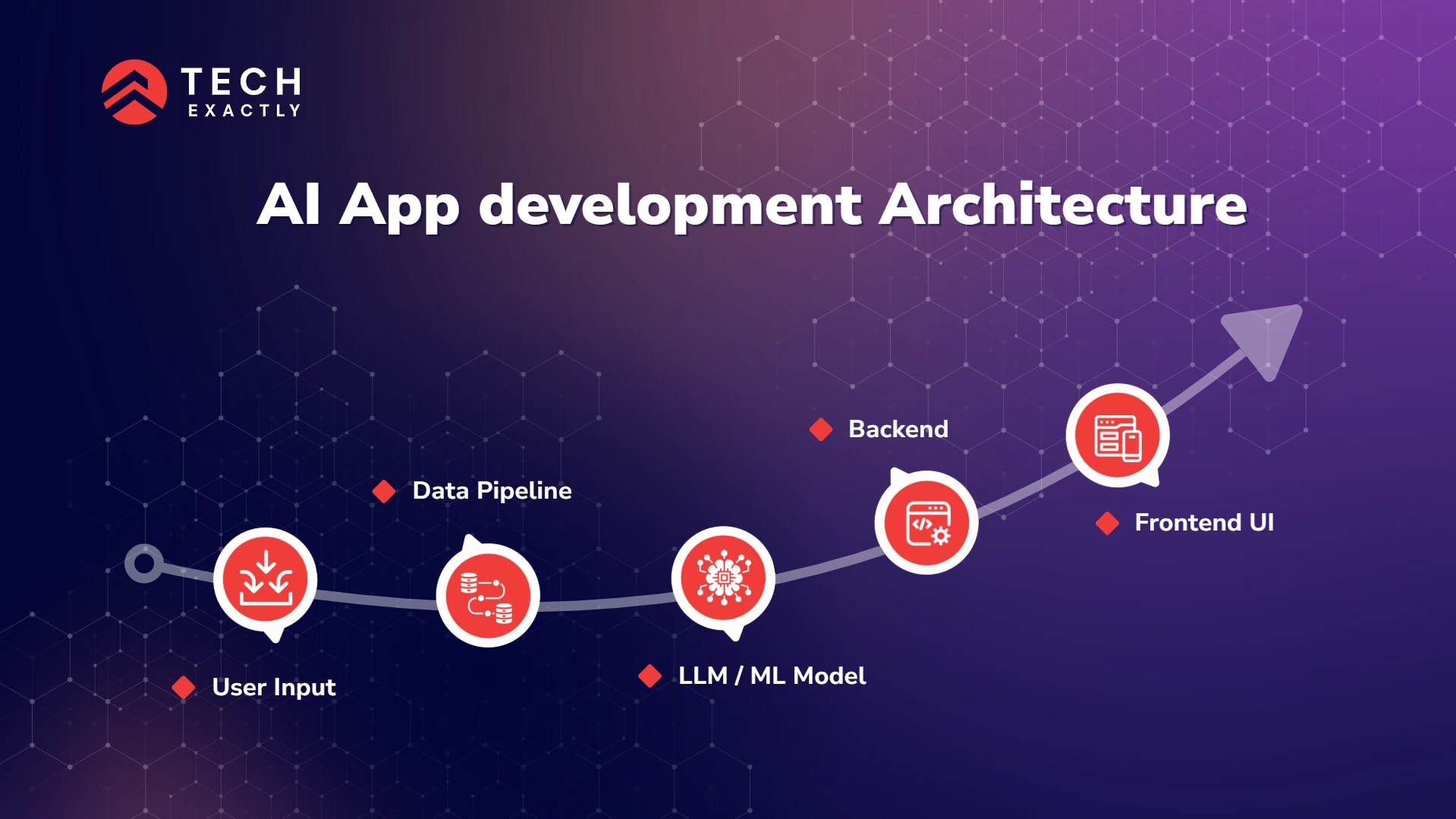
A true AI-powered application will have:
Data pipelines that collect and process data
Machine learning or Large Language Models
Backend systems that integrate AI into the application
Frontend systems that provide intelligent experiences
Whether it is a recommendation engine, a conversational interface, or predictive analytics, AI app development is about integrating intelligence into the core of your application, rather than just adding it on top.
This is why it is important to find the right AI app development company or team in the USA when it comes to scalability.
Is AI App Development Relevant in 2026?
Short answer: more than ever.
The Stanford University highlights rapid growth in AI adoption, model capabilities, and enterprise investment, reinforcing why AI is becoming a default expectation in modern applications.
It’s an assumption that apps are:
Personalized
Context-aware
Predictive
Conversational
From SaaS to consumer apps, AI is driving user experience in various industries. Businesses that don’t implement AI technologies risk missing out on the opportunity to offer their customers better user experiences than their competitors.
A report by PwC estimates that AI could contribute trillions to the global economy, making it a critical investment rather than an optional innovation.
Further, with the development of LLM, edge AI, and real-time technologies, it’s easier to build production-ready AI technologies. This has created a huge market for AI-powered mobile app development company services, especially for new businesses seeking to make their mark.
What are Essential Skills and Technical Proficiencies for AI App Development?
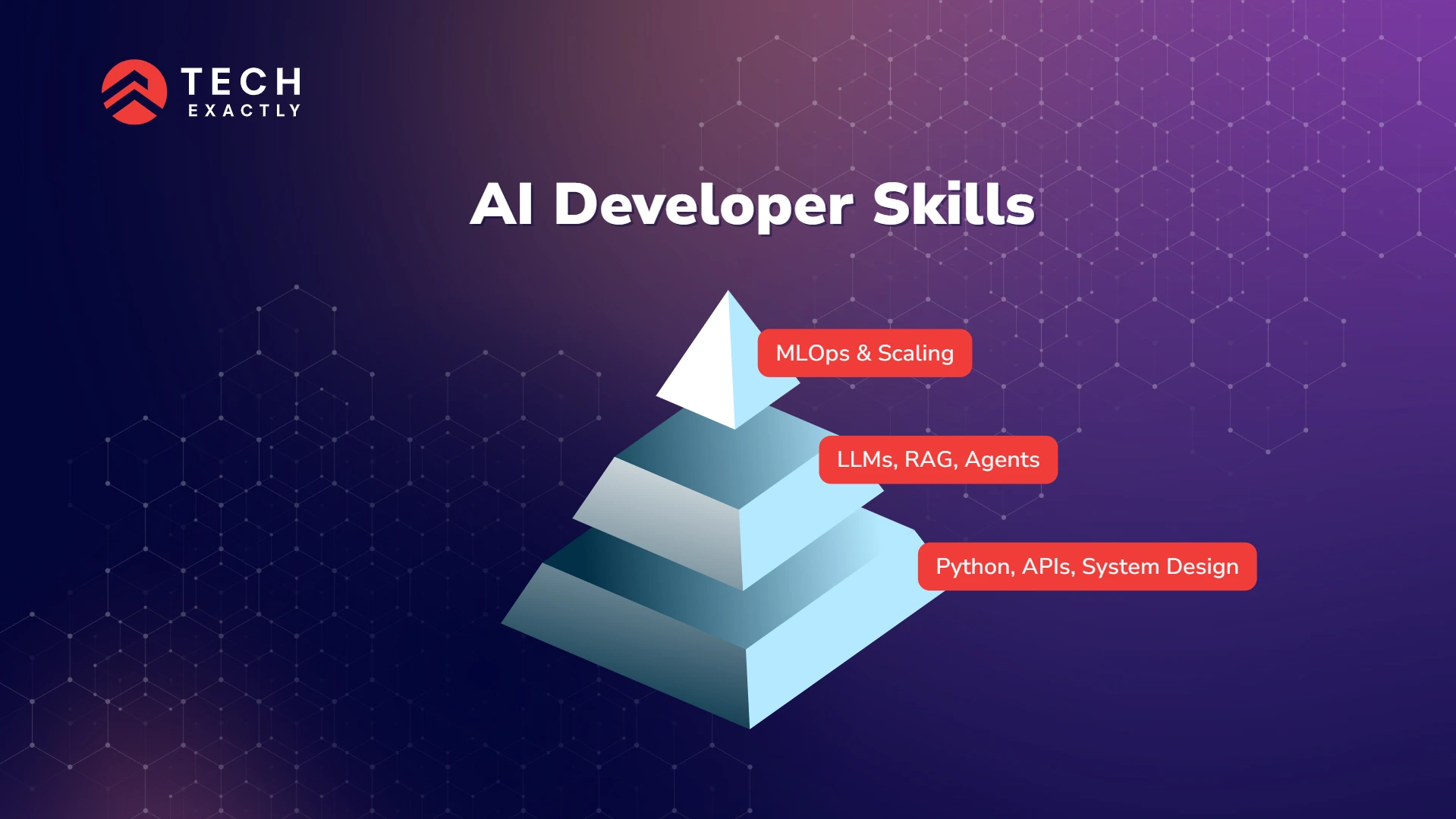
The process of hiring AI developers is not about marking off general skills; it is about determining the depth of expertise in critical areas.
LLM Application Engineering
Your developers should be able to build applications around the large language models, not simply consume the API.
Practical implementation of LLMs requires a deep understanding of how models behave in production, as outlined in the official documentation by OpenAI. Core concepts in LLM application engineering are:
Prompt pipelines
Context management
Token optimization
Latency reduction
A good LLM engineer is someone who knows how to make the models useful. You can learn more about the role of Generative AI in reshaping the software building process.
RAG Architecture (Retrieval-Augmented Generation)
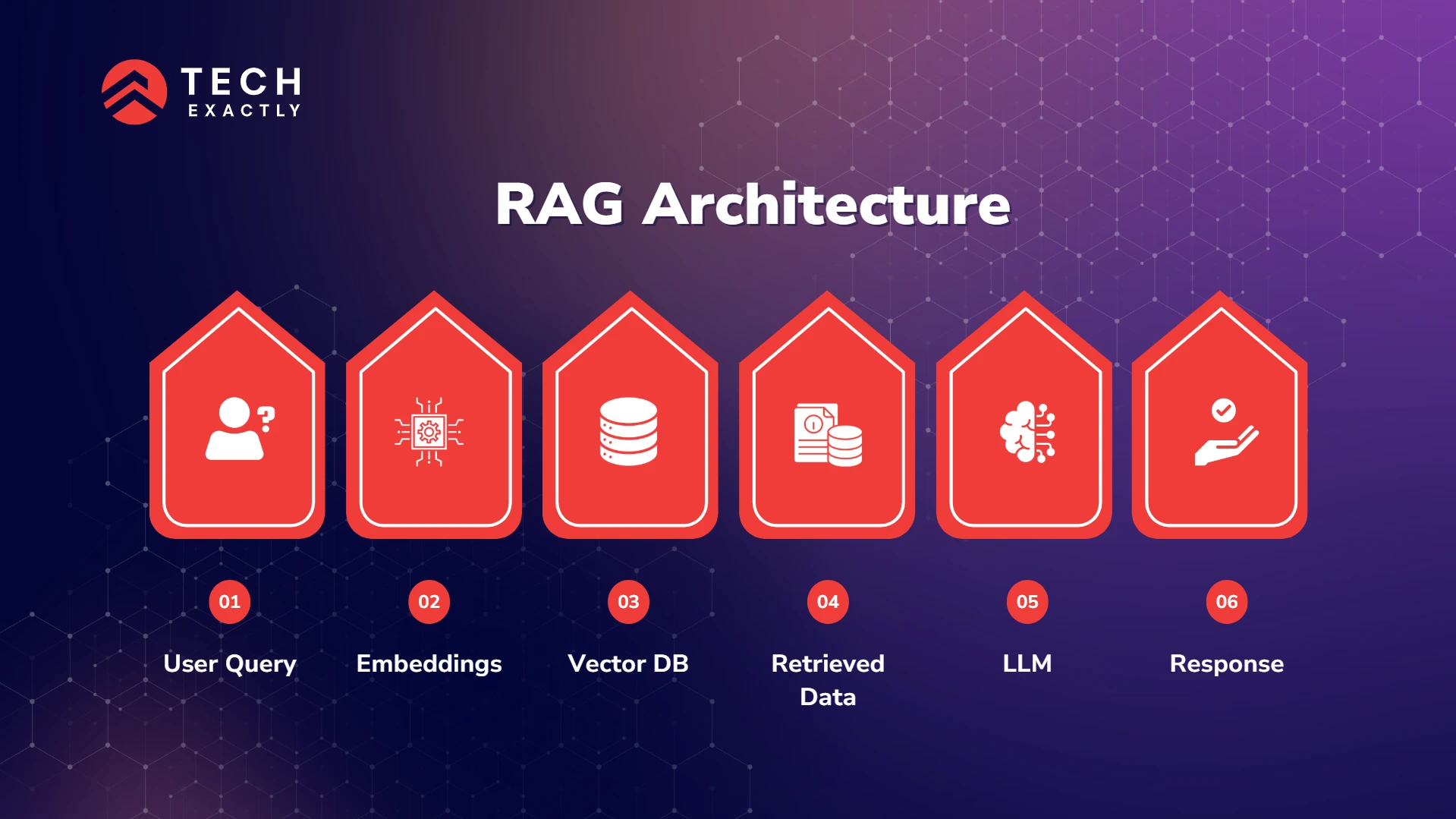
RAG is the backbone of modern AI applications. The concept of retrieval-augmented generation was introduced by Meta AI, combining information retrieval with generative models to improve factual accuracy.
It allows models to retrieve real-time, domain-specific data instead of relying only on training data. In practical implementations, as explained by Pinecone, this involves combining vector search with external knowledge sources to ground LLM responses.
Developers should be comfortable with:
Vector databases
Embeddings
Semantic search
Knowledge base integration
Without RAG, most AI apps remain generic and unreliable. The SaaS firm developed a chatbot with basic API calls to an LLM. The chatbot responded well, but the responses were general in nature.
The SaaS firm used the RAG with vector search functionality and internal knowledge base integration, which improved the accuracy of the chatbot responses, leading to better user satisfaction.
Agentic Systems
AI is shifting from static responses to autonomous agents.
Your team members must have the necessary knowledge about:
Multi-step reasoning
Using tools (APIs, databases)
Workflow automation
Memory management
This is particularly important if you’re developing complex systems such as copilots or automation tools.
MLOps and Model Deployment
One thing is creating a model, but deploying it is a different story altogether.
Experience with:
CI/CD pipelines for AI models
Model performance monitoring
Version control of models
Scaling inference systems
This is where most projects go wrong, so don’t skip it.
Prompt Engineering & Evaluation
Prompt engineering is not only about crafting queries; it is about developing reliable behavior for AI systems.
Developers should:
Test prompts
Check for accuracy in outputs
Minimize hallucinations
Optimize for consistency
Core Programming
At the end of the day, AI apps are still software. Strong fundamentals in:
Python, especially for AI/ML
Backend frameworks
API and system integration
Data structures and performance are non-negotiable.
If you are looking for an AI chatbot app development company, look for a team that has both AI and solid programming fundamentals.
Key Architecture and System Experience
However, skills alone are not enough; experience in real-world architecture is what differentiates junior developers from experts.
Scalable AI Design
The ability to deal with more and more users, data, and requests without failing.
Experience with:
Distributed systems
Load balancing techniques
Cache strategies
Asynchronous processing
Multi-Tenant Architecture
If you are designing a SaaS-based application, your AI system should be designed to handle multiple users or clients. A developer should know:
Data isolation
Access control
Client-specific customization
Cloud and DevOps Familiarity
AI apps are heavily dependent on cloud infrastructure.
Hands-on experience:
AWS, GCP, or Azure
Containerization (Docker, Kubernetes)
Serverless
This ensures that the product is highly scalable and cost-effective.
Error Handling Discipline
Unpredictability is inherent in AI systems. A good developer will:
Handle edge cases nicely
Implement fallbacks
Log and monitor failures
Design for resilience
This is often forgotten, and it’s really important for production code.
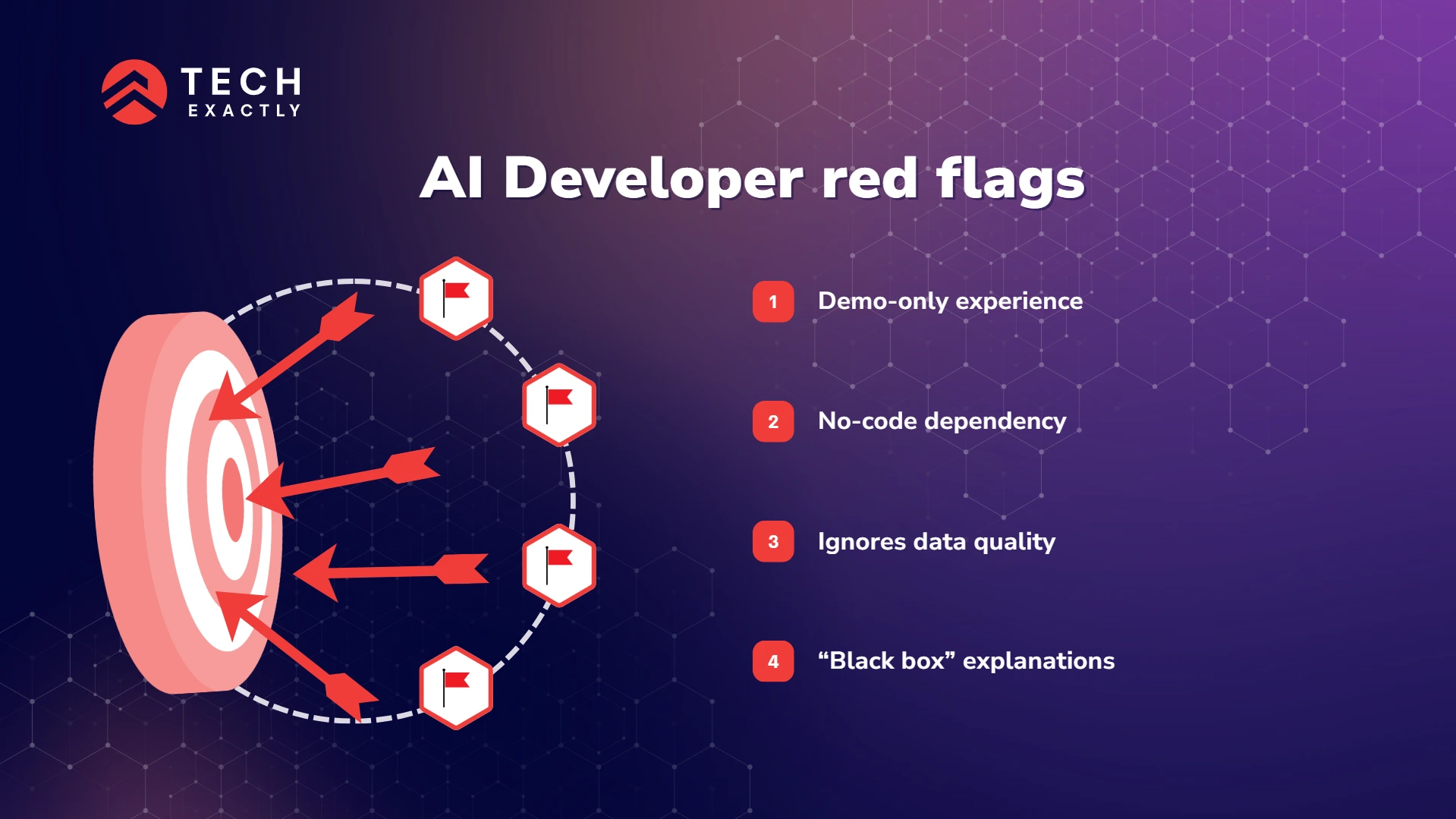
Red Flags to Watch Out For
Not all developers of AI are the same. The warning signs that you should never ignore are:
Demo-Only Market
Some developers may have impressive demos, but they don’t necessarily have production experience.
Ask:
Has this ever been deployed at scale?
Are users actively using this?
If you’re unsure, proceed with caution.
Over-Reliance on No-Code Tools
While no-code tools may be helpful in some ways, they are not suitable for sophisticated AI systems. When a programmer depends too heavily on:
Drag and drop tools
Pre-built workflows
Lack of customization
…it may be a sign that he or she is not knowledgeable enough.
Ignoring Data Quality
AI is only as good as its data. Issues like bias, inconsistency, and poor data labeling can significantly impact model performance, as highlighted by IBM.
If your developer does not talk about:
Data cleaning
Validation
Bias handling
…then it is a red flag.
Black Box Approach
If you say, “The model just works,” but don’t elaborate on that, that’s a problem. You need transparency in:
Decision-making processes
System behavior
Performance metrics
Unrealistic Skill Mastery
Be wary of developers who claim to be experts in all things, including LLMs, computer vision, robotics, blockchain, etc. Real experts tend to be experts in specific areas, not broad areas.
What Happens If You Hire the Wrong AI Developer?
If you hire the wrong AI talent, not only will you slow yourself down, but you’ll also affect your product, your budget, and your reputation.
This is what’s on the line:
Wasted Infrastructure Costs
It is also important to understand that running an AI system, especially if it is based on an LLM, can be very expensive. This is especially true if it is not properly optimized and results in many unnecessary API calls.
Hallucination risks in production
If not properly evaluated and governed, there is a possibility that the results produced by the AI system may not be accurate, leading to a loss of trust.
Research from Stanford University highlights how large language models can generate confident but incorrect outputs, making evaluation and guardrails critical in production systems.
Security and compliance issues
Mismanaging sensitive information or not having adequate safeguards in place can cause significant compliance risks, especially in fields such as healthcare and finance.
Delayed product timelines
Inexperienced developers tend to underestimate the complexity of AI systems, which can cause them to fail to meet deadlines.
Poor user experience and trust
In addition, unreliable AI features can also be frustrating for users and may negatively impact your brand. In most cases, it actually ends up costing more to fix an AI system that was originally constructed incorrectly.
Best Practices for Hiring in 2026
Hiring AI developers is different from hiring other software professionals. Hiring trends analyzed by LinkedIn show a growing demand for specialized AI roles, with employers prioritizing practical experience over traditional credentials. Hiring processes are listed below:
Proof of Work > Credentials
Experience is more valuable than degrees or certifications. Ask for:
Case studies
Live applications
GitHub Repositories
This will give you a clear idea of their skills.
Paid Two-Week Projects
Rather than conducting interviews, consider giving the candidate a small paid project.
This will allow you to assess:
Problem Solving
Communication
Speed
This is one of the most effective ways to mitigate hiring risks.
Ask “Why,” Not Just “How”
Anyone can describe how something works, but a good developer knows why it works. Some questions to ask:
Why did you choose this architecture?
Why this particular model, rather than another?
Why this particular approach to scaling?
This tests their understanding.
Questions to Ask Before Hiring AI Developers
Beyond the strategy itself, the ability to ask the “right” questions in interviews is what sets experienced engineers apart from the “surface-level” practitioners.
To effectively assess the expertise of the AI developer, it is important to ask the right questions. The following are some of the important questions that can help you assess the expertise of the AI developer:
How would you design a RAG pipeline for our use case?
This will help assess the developer’s knowledge of retrieval systems, embeddings, and architectures.How do you evaluate the quality of the output of LLMs?
This will help assess the developer’s knowledge of how to test and improve the quality of the output of LLMs, such as how to reduce hallucinations.How do you reduce the latency of LLM-based applications?
A good developer should be able to identify caching, batching, tokenization, and asynchronous processing as ways to improve the performance of LLM-based applications.Can you tell me about a production-grade AI system you have developed?
This will help assess the developer’s hands-on experience, not just theory.Why did you decide to use a particular model or architecture in your previous projects?
This will help assess the developer’s decision-making capabilities.
Final Thoughts
It is not only a matter of hiring the right AI developers, but also a strategic move. The quality of the people you hire to work on your product can significantly affect the quality of your product.
The gap between average and outstanding AI talent in 2026 is bigger than ever. Founders and CTOs who thoughtfully approach hiring will build products that truly stand out.
If you are developing an AI-based product and want to get it right the first time around, the best way to do so is to get the right team behind your project. From the architecture design stage to the production deployment stage, the best AI developers can guide you through the process, helping you avoid costly errors along the way.
