

When to Use APIs vs Custom Models in AI App Development (Complete Guide)

There are already no questions related to whether to add AI to the product. Nowadays, CTOs and developers think about how to implement AI more effectively.
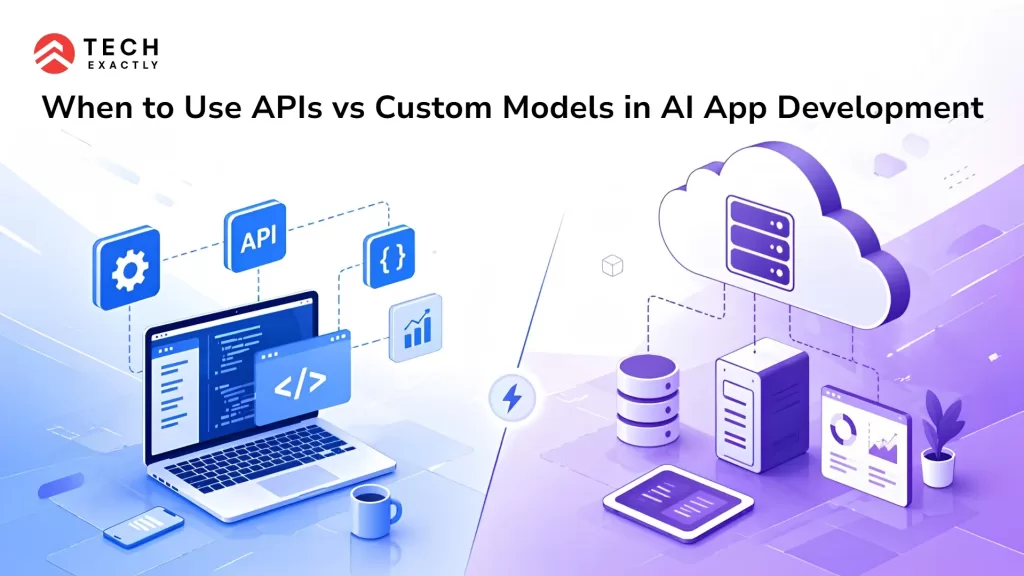
Among the most important decisions in the process of adding AI to the product is choosing between APIs and custom AI models. The selection is essential in terms of performance, scalability, costs, and flexibility.
The recent research on enterprise AI adoption trends, organizations are rapidly moving from experimentation to production-scale AI systems.
Knowing when it’s better to build your custom models and when it’s more reasonable to use APIs can save you many development hours and help optimise the process.
Choosing Between APIs and Custom Models When Developing Your Product
What Are APIs?
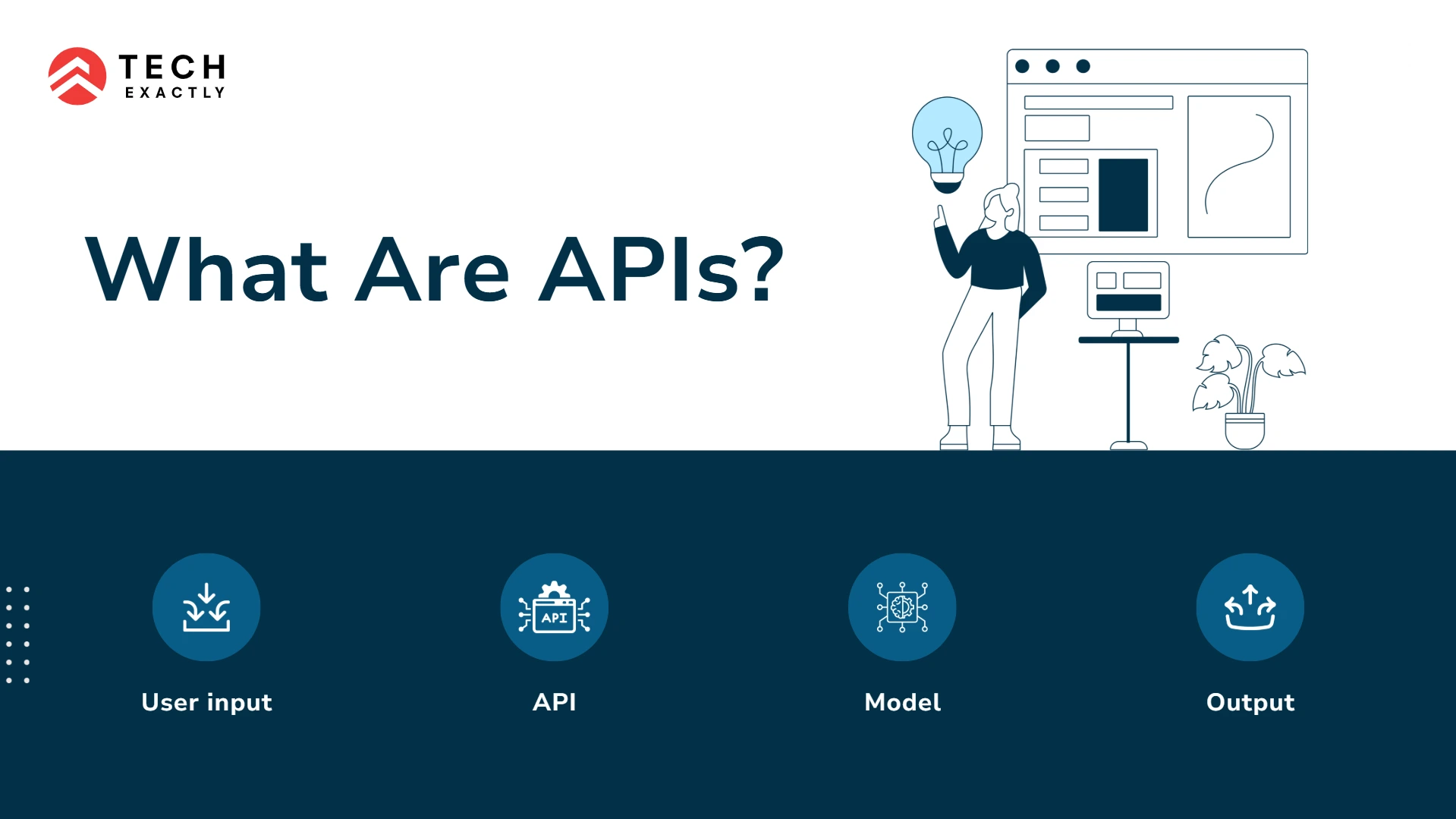
APIs of artificial intelligence mean the availability of pre-trained ML models. You don’t need to train them because such models are stored on the servers of providers like OpenAI, Google, or Amazon.
Modern APIs are powered by foundation models, and understanding how large language models work helps explain their ability to generalise across tasks.
Using APIs, you just send data (for example, text) to the server, and in return, get the result. Such ML components can be integrated into the app very quickly.
Here are some common AI APIs features:
Natural Language Processing (chatbots, summarisation)
Recognition and generation of images
Transcription from audio and vice versa
Recommendation system
Such APIs comply with all the requirements of good API design principles (modularity, scalable architecture, cross-platform support, and so on).
If you want to add AI as fast as possible, APIs are your first choice. They can be useful in case you work on custom mobile app development.
When Should You Use APIs?
Creating MVP
When building a new product or validating an idea, it is highly recommended to use APIs.
Why? Because they allow:
To create a product fast without any machine learning engineers;
To test different ideas fast and easily;
To collect feedback.
Let’s take an example: a start-up decides to develop a chatbot that will help customers solve their problems. In this case, they don’t have to spend a lot of money on creating a conversational model; it’s enough to integrate API.
In other words, APIs help reduce AI app development cost, especially during the initial development phase.
General Use Cases
Using APIs, it’s easy to create applications and add AI to the project if your goal isn’t building something unique but developing the product. So, if you need to integrate some non-proprietary features of AI in the app:
Simple chatbots for FAQ
Recommendation engines (in case of online shops)
Text summarization
Translation
As you can see, many AI chatbot app development services rely on APIs for the same reason. If your product doesn’t require any unique intelligence, APIs are the perfect solution.
This aligns with research on common applications of generative AI, where most early use cases focus on automation, summarisation, and conversational interfaces.
Lack of ML Engineers
Using APIs means having a ready-made solution for integrating the feature into the app.
If you decide to use an AI-powered mobile app development company, this aspect plays a crucial role.
Cost Efficiency at Low Volume
The key benefit of using APIs is cost efficiency. APIs are paid on a usage basis, which means:
You will pay for requests only;
No upfront infrastructure costs and training model costs;
Pay-as-you-go.
If your application works at low volume, using APIs will help you spend fewer financial resources on its development. However, the bigger the number of users who interact with the product, the higher your costs will become. Here comes custom models.
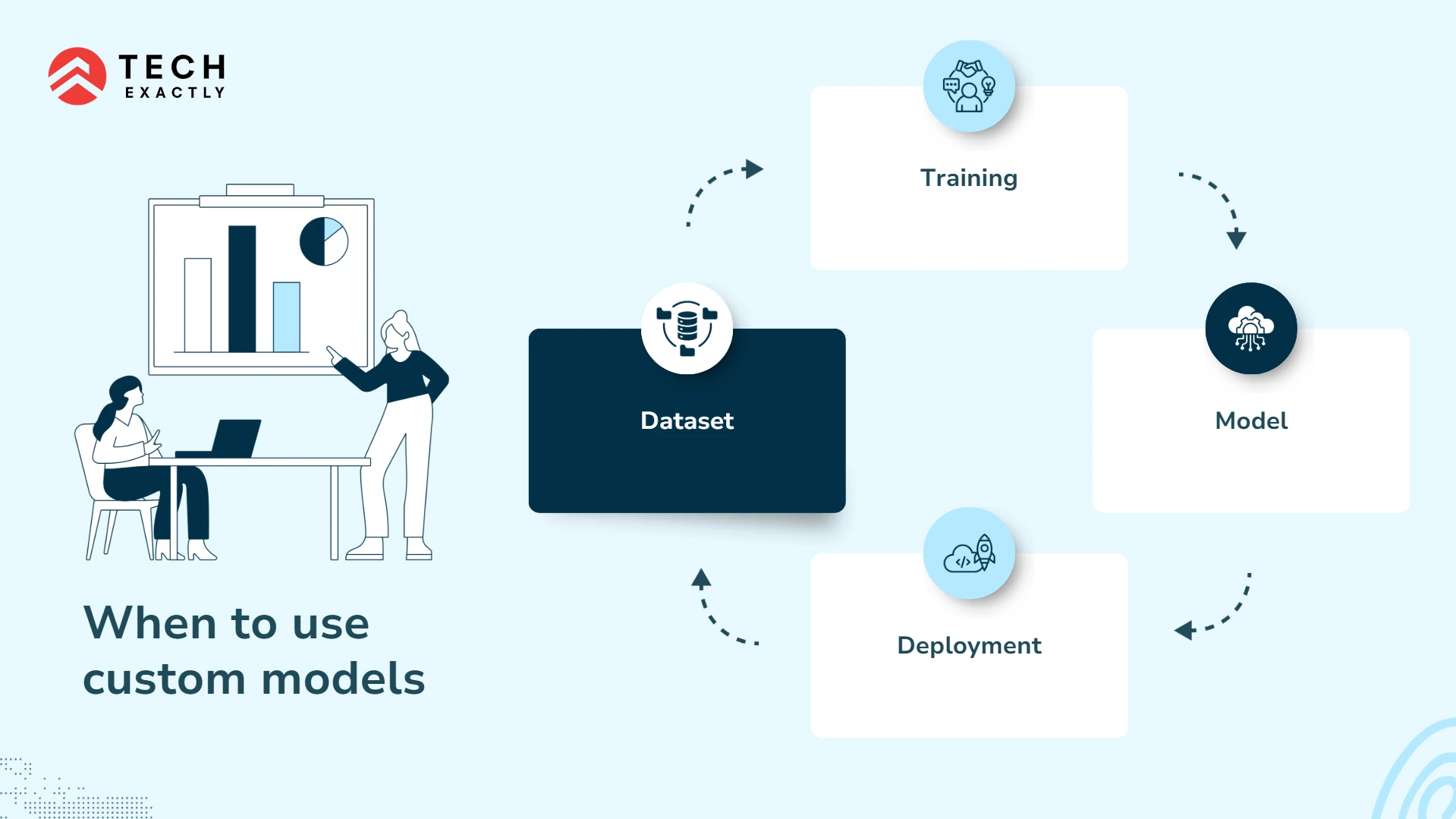
When Should You Build Custom Models?
Requirement for Proprietary Datasets
The main benefit of using custom models is that you are able to train your ML model according to your own datasets.
It can be helpful in the following situations:
Developing applications used in healthcare that use data of patients;
Financial platforms that can analyze user behavior on the site, transactions, and so on;
Enterprise-level software solutions that use internal data (documents).
In such cases, building a custom model becomes not only a necessity but also provides a competitive advantage.
Requirement for Strict Data Privacy & Compliance
The use of APIs involves the sending of data to servers that are located on the provider’s premises.
This option is not available for companies operating in industries with strict regulation (healthcare, finance). For them, it’s necessary to develop applications according to the HIPPA or GDPR regulations.
This is critical, as AI data privacy and compliance challenges continue to be a major concern in regulated industries like healthcare and finance.
Custom models guarantee the full control of the process. Besides, such models can be deployed on-premises or private clouds.
Scaling Cost Optimisation
Using APIs, you pay a small amount for requests. But when the number of interactions with the model increases, the price also grows. Building custom models allows reducing costs, optimizing infrastructure usage, and improving ROI.
The use of custom models is recommended if you develop an application with a large number of requests per day (thousands or millions). At scale, AI ROI and scaling economics favor custom models, especially when handling millions of requests daily.
Low Latency & Offline Use Cases
One more disadvantage of using APIs is increased latency because you make requests through the network.
By using custom models, you can avoid this drawback and deploy models locally on edge servers. Besides, custom models can enable offline applications.
Such solutions are preferable for:
Applications that require quick responses, for example, voice assistants;
Mobile applications working offline;
IoT and edge computing systems.
It’s especially important in case of custom android app development services.
Comparison of AI APIs and Custom Models
Feature | AI APIs | Custom Models |
Time to market | Days to Weeks | Months to a Year |
Upfront Cost | Low (Pay as you Go) | High (infrastructure & talent) |
Specialization | General (one-size-fits-all) | Bespoke (Niche/Propreitary Data) |
Privacy | Shared (requires trust) | Total Control (in-house/private cloud) |
Maintenance | Handled by provider | Internal team responsibility |
The Hybrid Approach: A Modern Standard
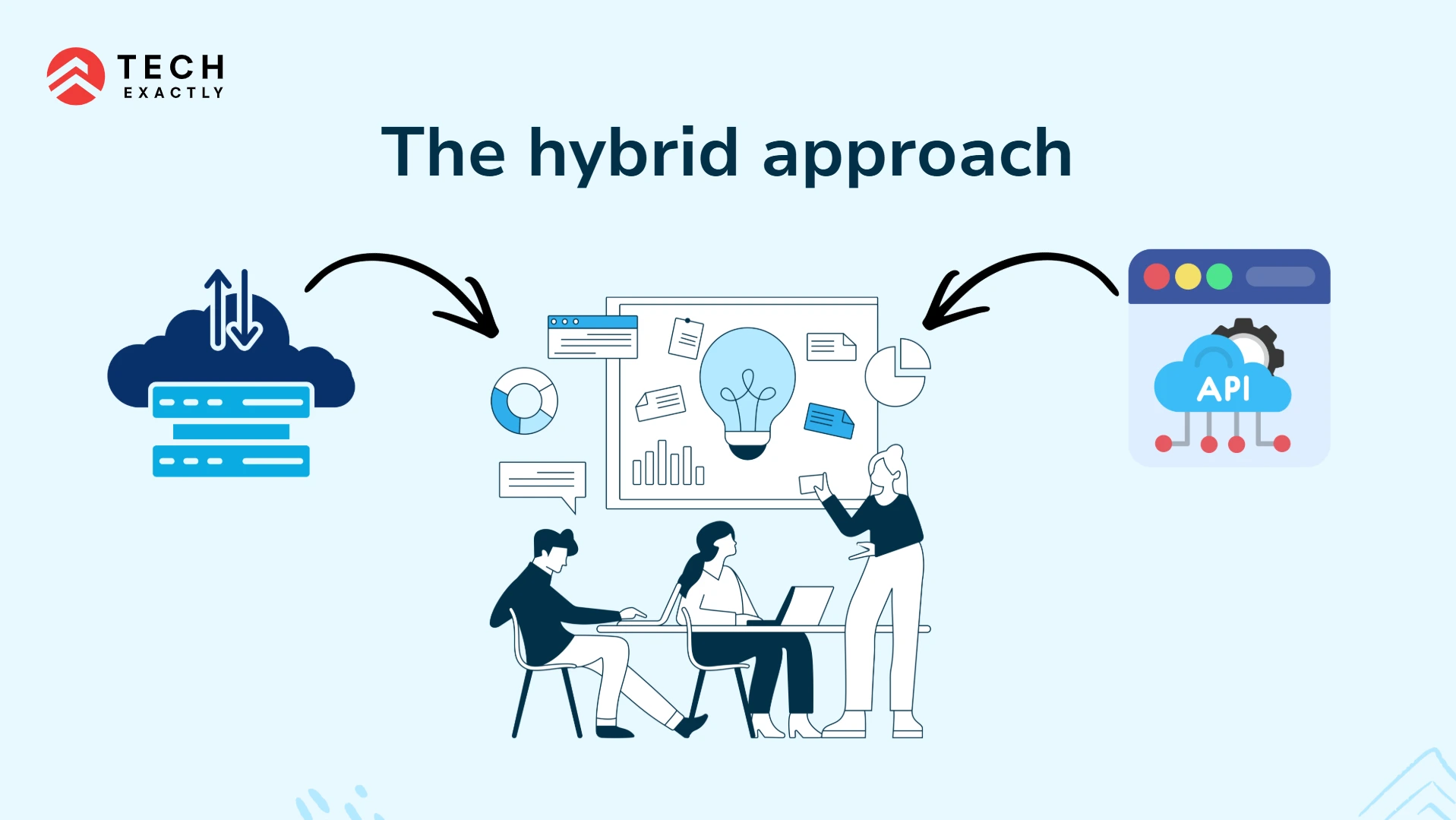
The reality, however, is often more complex than this black-or-white question. In fact, most modern AI apps use a combination of APIs and custom solutions for best results.
API for the “Brain”
APIs are utilized for:
General intelligence (language, reasoning)
Quick feature development
Regular updates from the providers
Think of APIs as the “brain” that gives you the necessary level of intelligence.
Custom for the “Action”
Custom models are used for:
Specialized logic
Processing sensitive data
Speed-critical actions
They can be considered the “execution layer,” specifically designed for your product needs.
Example Architecture
Here is what a typical hybrid architecture of an AI app looks like:
API (LLM) — manages conversations and reasoning
Custom model — processes proprietary data
Backend logic — integrates different workloads
Frontend app — offers user experience
By using this architecture, you can ensure:
Speed (thanks to APIs)
Control (thanks to custom models)
Scalability (due to the modular structure)
Moreover, you will align your solution with such AI engineering practices as:
Retrieval-augmented generation (RAG)
Modular AI pipelines
Agent-based architectures
Techniques like retrieval-augmented generation explained show how combining external data with LLMs improves accuracy and reduces hallucinations.
More on Retrieval-Augmented Generation: How RAG pipelines work.
Final Thoughts
Choosing the right strategy – between API and custom – is not only about technical considerations but also about business priorities.
APIs are recommended when:
You need flexibility and speed
The use case is generic
You prefer not to spend on R&D up front
Custom solutions are needed if:
You aim for unique experiences
Data privacy matters for you
Your operations require massive scalability
What most startups should opt for is a hybrid approach that starts with APIs and later incorporates custom solutions.
As AI evolves, the role of a developer shifts towards building an orchestra of intelligent solutions rather than building all components from scratch.
Whatever approach you choose – working alone or partnering with an AI chatbot app development company – your priority should be alignment with business goals.
If you’re building your next AI product and looking for the right architecture, don’t hesitate to book a consultation today!