


Agentic AI in Healthcare: How Autonomous Systems Are Transforming Patient Care

Let us start with a familiar problem.
Healthcare teams are not short on tools. They have dashboards, alerts, reports, and analytics. Yet patients still miss follow-ups. Chronic conditions still escalate quietly. Clinicians still find out too late.
According to the WHO, the global healthcare workforce shortage is expected to reach 10 million by 2030, putting immense strain on existing systems.
This is exactly the gap agentic AI in healthcare is designed to close.
For entrepreneurs, startup founders, and CTOs building healthcare platforms, the question is no longer if autonomy will enter healthcare, but how safely and strategically it can be deployed.
Instead of waiting for a human to pull insights or trigger workflows, agentic AI systems work continuously in the background.
This shift matters because healthcare is not about speed alone. It is about timing, context, and restraint.
In this blog, we break down what is agentic AI in healthcare, how it differs from generative AI and copilots, practical agentic AI applications in healthcare, and implementing agentic AI in healthcare.
What Is Agentic AI in Healthcare?
When people ask what is agentic AI in healthcare, the confusion usually comes from equating it with automation or generative AI.
If you strip away the buzzwords, agentic AI is simple. It is AI that can decide:
- When to escalate an alert.
- When to wait for more data.
- Which workflow to trigger.
- Who should be notified and when.
In enterprise settings, agentic systems manage workflows and decisions. In healthcare, that responsibility is more sensitive. Here, the focus is on coordinating care, monitoring patients, and supporting decisions without replacing clinical judgement.
When most AI today stops at “here is an insight.” Agentic AI goes one step further and says, “Here is what we should do next.”
Core Capabilities of Agentic AI
From our experience building AI-driven healthcare platforms, effective agentic systems share five capabilities:
- Goal Orientation – for example, reducing readmissions or improving discharge efficiency.
- Planning – breaking complex healthcare workflows into actionable steps.
- Execution – interacting with EHRs, scheduling systems, and patient communication tools.
- Learning – adapting based on outcomes and clinician feedback.
- Coordination – orchestrating actions across departments.
Why autonomy matters in clinical and operational environments
Healthcare is not short on data. It is short on timely action.
A McKinsey study shows clinicians spend nearly 40% of their working hours on administrative tasks such as documentation, scheduling, and coordination. The American Medical Association links this directly to burnout, which now affects over 60% of physicians.
Agentic AI addresses this gap by introducing autonomy where delays are costly, such as discharge planning, follow-up scheduling, or capacity management.
Think of it like autopilot in aviation. Pilots are still in control, but automation handles routine operations so humans can focus on critical decisions. In healthcare, this means clinicians regain time for complex judgement and patient interaction.
How Does Agentic AI Differ from Generative AI?
Generative AI excels at creating content. Clinical summaries. Discharge notes. Patient explanations. Data insights.
At Tech Exactly, we have covered this extensively in our article on types of generative AI, where we explain how these models generate value through language and reasoning.
But generative AI typically waits for a prompt.
Agentic AI does not wait. It observes systems continuously and decides:
- Should this insight trigger action?
- Is now the right time?
- Should a human be involved?
This is critical in healthcare, where over-alerting can be just as harmful as under-alerting.
A simple brief works well here.
- Generative AI is the analyst explaining what is happening.
- Agentic AI is the operator making sure something happens next.
Healthcare needs both, but confusing the two leads to poor system design.
Generative AI vs Agentic AI in Healthcare
| Aspect | Generative AI in Healthcare | Agentic AI in Healthcare |
| Primary role | Generates content, insights, and explanations | Makes decisions and coordinates actions |
| Core behaviour | Responds when prompted | Observes continuously and acts when needed |
| Typical question it answers | “What does this data mean?” | “What should happen next, and when?” |
| Level of autonomy | Low – output only | Medium to high – bounded with rules |
| Memory & context | Short-term or session-based | Long-term, goal-oriented context |
| Action execution | Cannot act on its own | Can trigger workflows, alerts, and integrations |
| Learning loop | Learns during model training or fine-tuning | Learns from real-world outcomes and human feedback |
| Human involvement | Humans always initiate and act | Human supervises, approves, or overrides |
| Risk profile in healthcare | Low risk, mostly informational | Higher risk, requires governance and compliance |
| Best-fit healthcare use cases | Clinical summaries, discharge notes, patient education, and insights | Care coordination, chronic care monitoring, scheduling, and patient flow optimization |
| Example | Drafts a discharge note for a heart patient | Automatically schedules follow-ups, alerts caregivers, and monitors post-discharge signals |
Business and Clinical Benefits of Agentic AI
Personalized, Continuous Patient Care
One of the most powerful agentic AI use cases in healthcare is chronic care management.
Instead of fixed thresholds, agentic systems learn individual baselines. They notice trends, not just spikes. They escalate only when patterns indicate risk.
➡️ Learn how we delivered a HIPAA-compliant website that offers online therapy sessions in NYC
Operational Transformation at Scale
Doctors spend nearly half their working hours on administrative tasks.
Agentic AI helps by:
- Coordinating follow-ups automatically.
- Managing scheduling conflicts.
- Reducing manual handoffs.
Cost Optimization Without Compromising Care Quality
Hospitals using AI-driven capacity management report:
- Reduced length of stay.
- Improved bed utilization.
- Fewer missed appointments.
📝 You might like reading: 9 Full-Proof Strategies to Increase Healthcare Mobile App Revenue & Customer Base
Enterprise Framework for Implementing Agentic AI in Healthcare
The following outlines a practical, step-by-step way to introduce agentic AI safely, starting with controlled use cases and scaling with confidence:
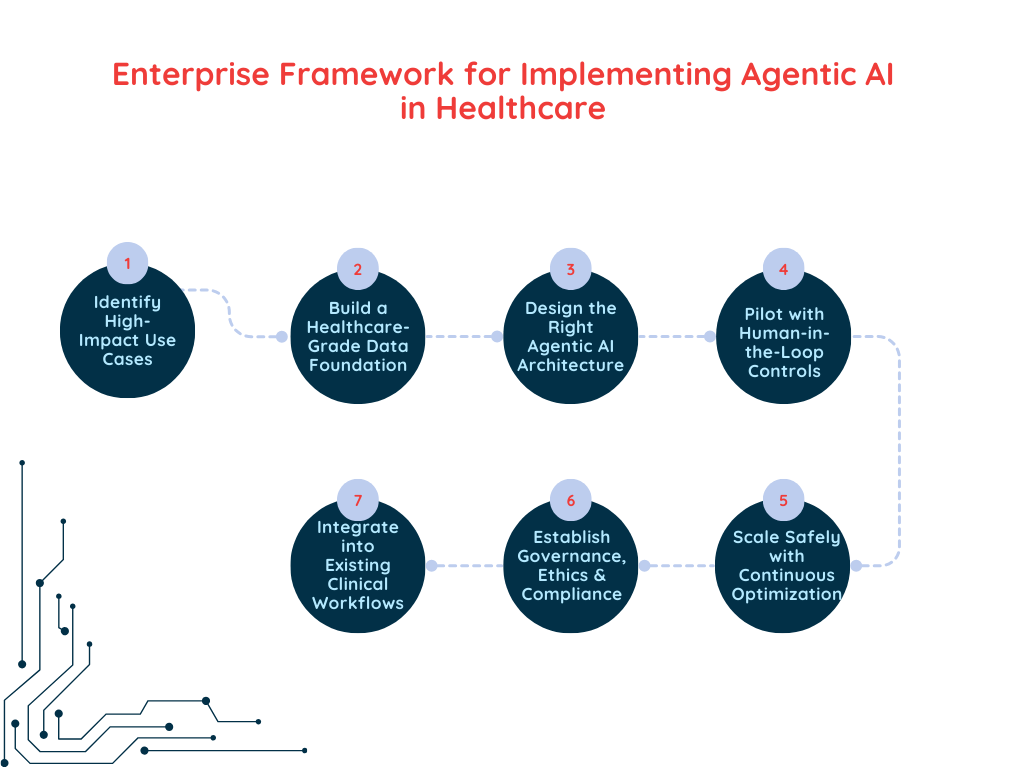
Step 1 – Identify High-Impact Use Cases
Start with areas where mistakes are reversible and the impact is visible. Scheduling, care coordination, reminders. These are ideal entry points for implementing agentic AI.
Step 2 – Build a Healthcare-Grade Data Foundation
Interoperability is critical. Fragmented data kills autonomy. This is where strong healthcare IT development insights matter.
Step 3 – Design the Right Agentic AI Architecture
Your Agenctic AI architecture must include:
- Orchestration layers
- Audit trails
- Decision boundaries
Step 4 – Pilot with Human-in-the-Loop Controls
Human-in-the-loop is not optional. Every action must be reviewable and reversible.
Step 5 – Integrate into Existing Clinical Workflows
If it disrupts workflows, adoption fails. Agentic AI should operate invisibly when working effectively.
Step 6 – Establish Governance, Ethics & Compliance
Clear governance frameworks ensure compliance and long-term trust.
Step 7 – Scale Safely with Continuous Optimization
Scale only after behaviour is predictable, explainable, and measurable.
Insight from Shubhankar, GenAI Developer at Tech Exactly
“People think that agentic AI removes humans from the loop. But what we have seen here, it means the opposite. Agentic AI works best when humans can interrupt, correct, or ignore it. That feedback is what actually makes the system smarter over time.”
High-Impact Agentic AI Use Cases in Healthcare
When people hear about agentic AI in healthcare, the first reaction is often excitement mixed with caution. The reality is that the highest-impact use cases are not flashy or risky. They are practical, workflow-driven, and designed to support humans at scale.
Let us look at where agentic AI in healthcare is already proving value.
Clinical Decision Intelligence Agents
Clinical decision intelligence is one of the most mature and valuable agentic AI use cases in healthcare.
These agents continuously analyze patient data across EHRs, diagnostics, vitals, and historical records to support risk assessment and treatment pathways. Instead of producing a one-time recommendation, they monitor how a patient’s condition evolves and adapt suggestions accordingly.
For example, an agentic AI system can:
- Identify patients at rising risk based on subtle trend changes.
- Suggest evidence-backed treatment adjustments.
- Decide when escalation is necessary and when observation is safer.
What makes this different from traditional AI is traceability. Every recommendation is linked to data sources, clinical guidelines, and past outcomes.
Diagnostic & Imaging Analysis Agents
Diagnostic workflows are another strong area for agentic AI applications in healthcare, especially in imaging-heavy environments.
Traditional AI models analyze images and return probabilities. Agentic AI goes a step further by managing the workflow around those insights.
In practice, diagnostic and imaging agents can:
- Perform automated triage and prioritization of scans.
- Escalate urgent cases to specialists immediately.
- Defer low-risk cases to reduce backlog pressure.
This significantly reduces diagnostic delays, which is especially valuable in radiology and oncology settings where timing directly impacts outcomes.
➡️ Read to know how we developed an IEC 62304-Compliant Mobile App for Accurate Test Interpretation
Clinical Documentation & Coding Automation
Documentation is one of the biggest contributors to clinician burnout. This is where agentic AI delivers fast, measurable wins.
Unlike basic generative tools that simply draft notes, agentic systems manage the entire documentation flow:
- Real-time clinical note generation during encounters.
- Context-aware prompts to capture missing information.
- Automated coding aligned with regulatory and payer requirements.
This is a practical example of how agentic AI is being applied in healthcare to reduce errors, improve reimbursement accuracy, and give clinicians time back.
Autonomous Discharge & Care Transition Agents
Discharge is one of the most fragile moments in patient care. Missed instructions, delayed follow-ups, or poor coordination often lead to readmissions.
Agentic AI systems address this by managing discharge as a continuous process rather than a one-time event.
These agents enable:
- Personalized discharge workflows based on patient risk and context.
- Automated coordination between care teams, pharmacies, and caregivers.
- Post-discharge monitoring and follow-ups triggered by real-world signals.
For example, if a patient misses a follow-up or reports concerning symptoms through a patient app, the agent decides whether to notify a nurse, reschedule an appointment, or escalate care.
Scheduling, Capacity & Patient Flow Optimization
Hospitals are complex systems with constantly shifting demand. Static scheduling rules struggle to keep up.
Agentic AI brings results through learning and orchestration.
These systems:
- Send intelligent appointment reminders that reduce no-shows.
- Rebalance schedules dynamically when cancellations occur.
- Optimize resource and bed management based on real-time capacity.
An Agentic AI Project in Progress at Tech Exactly
At Tech Exactly, we are currently working on an active, in-progress agentic AI project focused on autism care. The aim is to explore how agentic AI can support caregivers in real-world, high-context situations.
The Problem
Most digital tools in care environments act like basic chatbots or trackers. They respond to prompts but forget context, forcing caregivers to repeat information. In autism care, where routines, responses, and triggers evolve constantly, this lack of memory limits usefulness and can even increase cognitive load.
Our Solution (In Progress)
As explained by Shubhankar, GenAI Developer at Tech Exactly, we are building an agentic AI assistant, not a traditional chatbot. While it interacts conversationally, it learns continuously through human interaction.
The system asks context-aware questions about routines, interventions, and outcomes, and stores these inputs as long-term memory. Caregivers can accept, adjust, or ignore suggestions at any time. The AI learns not just from success, but from human correction, ensuring autonomy remains bounded and safe.
📝 Key Takeaways
- Agentic AI is moving healthcare from reactive responses to proactive, continuous care.
- Unlike traditional AI or copilots, agentic AI operates with intent, context, and responsibility.
- The most effective agentic AI applications in healthcare support clinicians and caregivers rather than replacing them.
- Human-in-the-loop design, governance, and compliance are non-negotiable for safe deployment.
- With the right architecture and partner, implementing agentic AI in healthcare is both feasible and safe.
Why Tech Exactly Is the Right Partner for Agentic AI in Healthcare
Building agentic AI in healthcare is not just a model problem. It is a systems, governance, and execution challenge. Tech Exactly brings a pragmatic, compliance-first approach to implementing agentic AI in healthcare.
We specialize in HealthcareAI systems that work across fragmented environments. Our teams understand interoperability challenges, EHR constraints, and real-world clinical workflows. This ensures agentic systems are designed for production, not just pilots.
Every agentic AI solution we build includes:
- Clear decision boundaries.
- Auditability and traceability.
- Alignment with regulatory and compliant requirements.
From identifying the right use cases to architecture, deployment, and optimization, we support the full lifecycle. Our experience spans healthcare application development, generative AI, and autonomous systems.
You can explore our relevant work in our portfolio and healthcare case studies, where we demonstrate how advanced AI solutions are delivered safely in regulated environments.
If you are exploring agentic AI applications and want to move from ideas to impact, Tech Exactly can help you design, build, and scale systems that deliver real value without unnecessary risk.
▶️To know more, feel free to write to us at [email protected]
