


Custom AI Chatbot Development: A Founder’s Guide to Building Your Own


Key Takeaways
- Most founders ask the build-vs-buy question too early — staying on the platform is the right call ~70% of the time. Build when the cost ceiling, customisation wall, and data-ownership needs hit at once.
- There are three build paths: no-code/low-code ($5K–$15K), wrapped LLM + RAG (the 2026 default, $15K–$50K), and full custom with tool-using agents ($50K–$150K).
- Default to RAG. Only add fine-tuning when RAG probably can’t solve it, and only build agent capability when the bot needs to take actions, not just answer questions.
- Integration — not the model — is where ~70% of budget and timeline overruns happen. Audit your data layer before building.
- Most founder chatbots don’t need SOC 2 or HIPAA at launch; GDPR + CCPA + basic privacy hygiene covers it until you sell to enterprise.
At first, the off-the-shelf tools feel good enough. Then the challenges keep showing. You are paying for platforms like Intercom Fin, but the bot still can’t properly access your Stripe data. Your Tidio bill keeps climbing as support volume grows. Chatbase works for simple FAQ use cases, but struggles once the chatbot needs to take real actions or integrate deeply into workflows. After enough pricing increases and “this integration isn’t supported” responses, most founders eventually start asking the same thing whether to just build on their own.
Customer service is now the single biggest GenAI use case across companies. McKinsey’s 2025 State of AI report put it as one of the most adopted functions, and the gap between platform chatbots and what teams actually want has only widened since. This guide walks you through when custom AI chatbot development services actually pay off, what the build looks like in 2026, what it costs at SaaS and SMB scale, and where the hidden costs are.
If you’re a CIO at a 5,000-person company scoping a $500K platform, jump to the Enterprise AI Chatbot Development Company section. For everyone else, like SaaS founders, ecommerce operators, indie builders, SMB ops leads, this is the article. Some of the patterns from our take on AI readiness in 2026 apply, but at a build this quarter level.
Why You Need Custom AI Chatbot Development Service
Most founders ask the build-vs-buy question too early. In reality, the honest answer 70% of the time is to stay on the platform a bit longer. But when these three show up together, the cost-benefit equation changes quickly.
1. The cost ceiling. Intercom Fin can crest $2,500/mo for a busy SaaS at 5K resolutions. Chatbase Pro starts at $499/mo and climbs. Drift, Zendesk AI, and Fin alternatives bill per resolution, per seat, or per AI message. The unit economics break the moment you’re a real product.
2. The customisation wall. You want the bot to do something the platform doesn’t natively support, for example, read Shopify order metadata, cross-reference a Stripe customer with a Postgres row, or trigger a refund after a chat. Most platforms support 60% of what you want, charge premium tiers for the next 20%, and just say no to the last 20%.
3. Data ownership and IP. You’re training the bot on your knowledge base, tickets, and product docs. Founders with B2B data-residency clauses or M&A on the horizon want the model layer and data in their own account. Custom is the only path that gives you that.
If one of these is true, run a build-vs-buy spreadsheet. If two or more, you’re past the deliberation phase.
Custom AI Chatbot Development Options for Founders
Once you’ve decided to move off platforms, you’re not picking between “build” and “don’t.” You’re picking between three architectures that have very different costs.
Path 1: No-code / low-code platform builder
Tools: Voiceflow, Botpress Cloud, Stack AI, Chatbase Custom. You’re still on someone’s platform, but you control the conversation design and the integrations.
- Build time: 2–4 weeks
Build cost: $5K–$15K if you bring in help; under $5K if you DIY - Run cost: $100–$800/mo
Best for: Founders who want more control than Intercom Fin but aren’t ready for engineering investment. - Ceiling: You’ll hit the same customisation wall in 6–12 months. This is a way station, not a destination.
Path 2: Wrapped LLM + RAG (the 2026 default)
You run a thin app layer on top of OpenAI, Anthropic, or self-hosted Llama. You add a vector database (Supabase pgvector, Pinecone, Qdrant) for retrieval over your own data. You ship a chat UI on your site or in your product.
- Build time: 6–12 weeks
- Build cost: $15K–$50K
- Run cost: $200–$2,000/mo depending on volume
- Best for: Most funded startups and SMBs. This is the default for a reason — you get 90% of what you actually need at a fraction of the full-custom cost.
- What you skip: Multi-step actions, tool use, and advanced agentic behaviour.
Path 3: Full custom + agentic
Wrapped LLM along with RAG, plus an orchestration layer (LangChain, LlamaIndex, or DSPy), plus tool-use so the bot can take actions like trigger Stripe refunds, update HubSpot records, create Linear issues, run SQL against your warehouse.
- Build time: 3–6 months
Build cost: $50K–$150K - Run cost: $500–$5,000/mo
- Best for: Founders where integration depth is the product moat — i.e. when the bot taking action (not only answering questions) is the whole point. This is that tier.
A clean way to think about it is to choose Path 1 for unvalidated use cases. Path 2 is for the use case you’ve validated. Path 3 is for the use case you’ve validated, monetised, and now need to scale. Skipping paths usually wastes money, and our piece on APIs vs. custom AI models gets deeper into the model-layer trade-offs each path forces on you.
Let's Start Your Project Today
Ready to build your custom AI chatbot with us? Reach out now – our experts are just one click away.
Custom AI Chatbot Development Services for E-commerce
If you’re running a Shopify or WooCommerce store, you’re the highest-leverage user of custom AI chatbot development services in 2026. The reason is practical. The customer support and pre-sale Q&A are 60–80% of your operational chat volume, and both have hard structured-data backends (orders, products, inventory) that off-the-shelf bots don’t connect to cleanly.
A custom AI chatbot for e-commerce typically handles:
- Order lookup and shipment tracking. Customer asks, “where’s my order,” bot queries the Shopify Orders API by email or phone and returns the status with a tracking link.
- Returns and refund initiation. Bot collects reason, validates against your return policy in code, and kicks off the refund flow in Stripe or Shopify Returns.
- Product Q&A grounded in your catalogue. RAG over product descriptions, reviews, and FAQs, which are not a generic “what does this product do” hallucination.
- Cart recovery. Bot reaches out via WhatsApp or email when a checkout abandons, referencing the actual item.
- Inventory and availability questions. “Do you have the medium in navy?” where bot checks live inventory, it doesn’t promise stock you don’t have.
The trap most e-commerce founders fall into is to build the bot before nailing the data layer. If your Shopify product descriptions are inconsistent, your bot will hallucinate inconsistently. If your refund policy lives only in a Notion page that hasn’t been updated since 2024, the bot will quote stale terms. Clean the source of truth first, as the bot inherits whatever you feed it.
A good customer support AI chatbot development service for e-commerce will spend the first two weeks of the engagement just auditing your data. If a vendor wants to start building before that audit, walk away from the vendor.
Custom AI Chatbot Development for SaaS Products
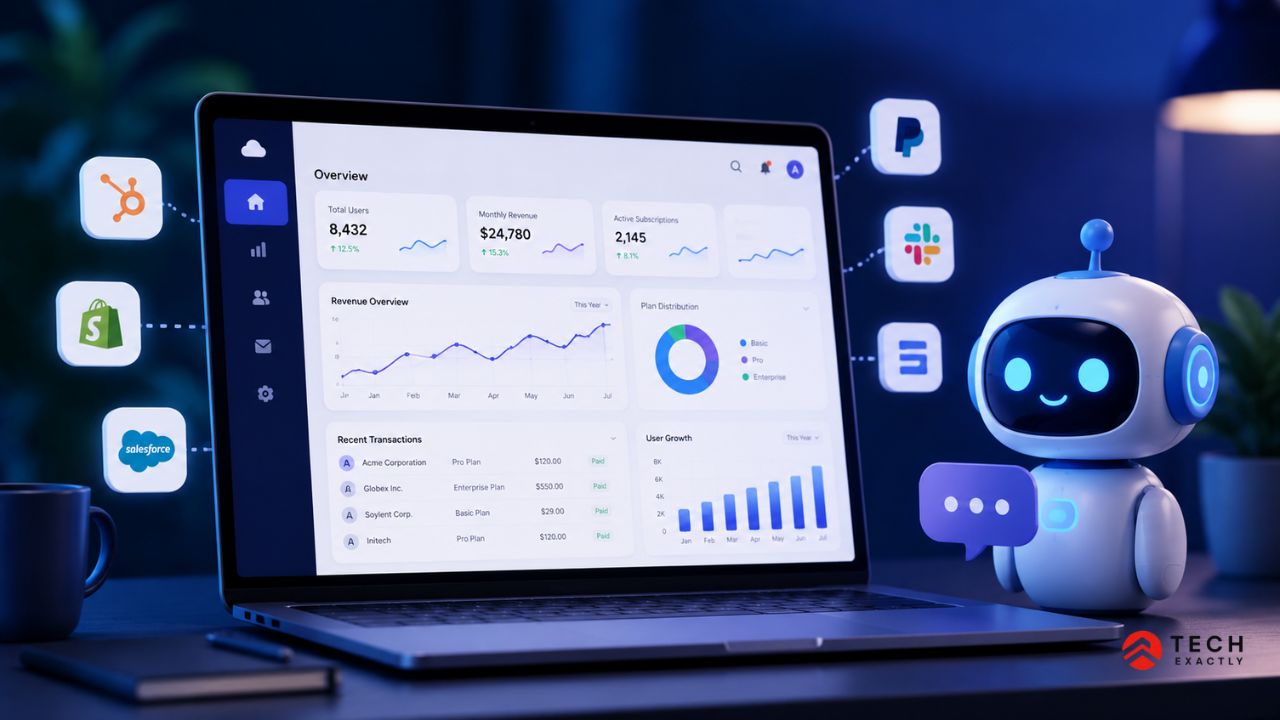
SaaS founders use custom chatbots for three things, in roughly this order:
In-app support deflection. The chatbot lives inside your product with access to the user account state, and can answer “why doesn’t this feature work” with reference to what the user actually has set up. Off-the-shelf tools don’t have that user context; a custom bot does.
Onboarding and activation. The bot gets new signups through setup, prompts at the right moment, and books a call when activation stalls. Most SaaS products lose 50% plus of signups before activation. A chatbot that intercepts at the right friction point retrieves some back.
Sales enablement. Pre-sale Q&A from the website, with the bot routing qualified leads to your CRM (HubSpot, Pipedrive, Attio) and disqualifying noise. Your pipeline rules, your scoring model, the bot acts on them.
For a SaaS chatbot, the most commonly built integrations are Stripe (subscription state), HubSpot or Pipedrive (CRM), Linear or Jira (escalation), and your product database. The same SaaS development work on the platform side applies, and these aren’t separate projects; they’re the same data model wearing two interfaces.
Let's Start Your Project Today
Ready to build your custom AI chatbot with us? Reach out now – our experts are just one click away.
Integrating Your Custom AI Chatbot: Where Most Founder Projects Die
The model layer is usually the easy part. Integration is where 70% of the budget and timeline overruns happen. It is worth flagging the realistic founder/SMB stack here, because most published guides assume Salesforce and ServiceNow along with Snowflake, which is not where you live.
| Layer | Founder/SMB tools | What to ask your dev partner |
|---|---|---|
| CRM | HubSpot, Pipedrive, Attio, Close | “Have you built a HubSpot Custom Objects integration that survives schema changes?” |
| Payments | Stripe, Paddle, LemonSqueezy | “How do you handle the webhook lag between a chat action and Stripe state?” |
| Ecommerce | Shopify, WooCommerce, BigCommerce | “Do you use Shopify Functions or just the REST API?” |
| Helpdesk | Intercom (data only), Help Scout, Front, Zendesk | “How do you route handoffs without losing chat context?” |
| Productivity / docs | Notion, Google Drive, Slack | “How do you handle Notion’s API rate limits when re-indexing?” |
| Identity | Clerk, Auth0, Supabase Auth, NextAuth | “How do you scope chatbot permissions to the logged-in user?” |
| Data | Supabase, Neon, Postgres, BigQuery, PlanetScale | “Where does the RAG index live and how do you keep it fresh?” |
The ServiceNow / Salesforce Enterprise tier exists, but it isn’t your problem yet. If a vendor pitches you their deep Salesforce integration capability, ask whether they’ve shipped on HubSpot or Stripe instead. Those require a very different kind of product and integration experience.
RAG vs. Fine-Tuning vs. Agentic AI Chatbots: Picking the Right Pattern
This is one of the biggest places founders overspend. The instinct is often to ask, “Should we fine-tune?” because it sounds more advanced. But the better question is, “What’s the cheapest way to achieve the behaviour we actually need?”
Default to RAG. Retrieval-augmented generation is faster, cheaper, easier to update, and produces 90% of the results founders ask for. Have you changed your refund policy? Update the document; the bot updates with it. No retraining. Use this until you’ve proven RAG can’t solve it.
Consider fine-tuning when RAG can’t. Fine-tuning helps when the bot needs to adopt a very specific tone, follow a specific reasoning pattern, or work with low context queries where retrieval misses. It does not really solve the problem of “the bot should know information about our company.” That’s usually a RAG problem in disguise.
Add agentic capability when the bot needs to act. Tool-use, function-calling, multi-step orchestration. Pricier, slower to debug, harder to monitor. Only when the bot needs to do something, rather than just answer. The architectural patterns we use in our generative AI development work apply here too, and our take on agentic AI in healthcare is healthcare-specific but the lessons port directly.
A clean rule of thumb is, if you can’t draw the agent’s action graph on a whiteboard in under 10 minutes, you’re not ready to build agentic.
AI Chatbot Development Tech Stack for 2026
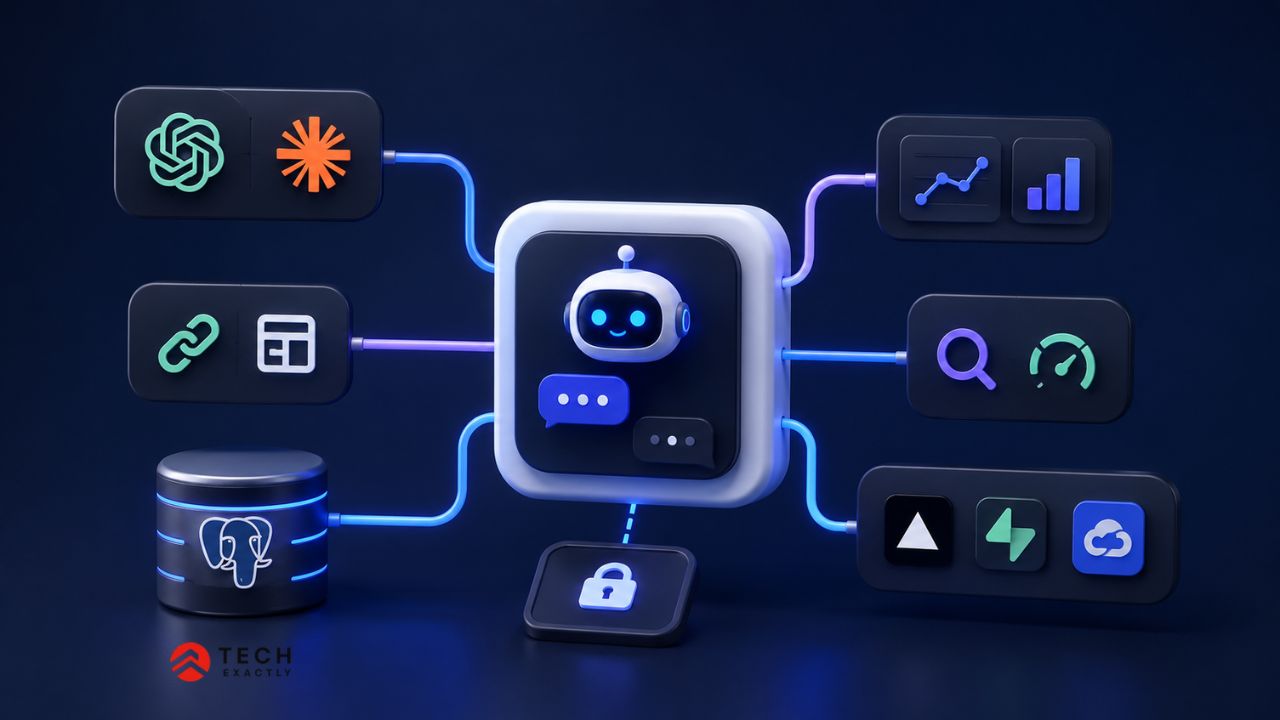
This stack is what we actually use on founder budget projects. Cheaper than the enterprise typical Snowflake with Pinecone and Datadog setup, and fully production-grade.
Models (pick one or two):
- OpenAI GPT-4.1 or GPT-5 for general use
- Claude 3.7 Sonnet for longer context and stronger reasoning
- Llama 3.3 (self-hosted on Modal, Together, or Replicate) when you want to escape vendor lock-in
Orchestration:
- LangChain or LlamaIndex for the standard build
- DSPy when you want to systematically optimise prompts (worth it past month three)
Vector DB:
- Supabase pgvector is the cheapest, and also ships with your DB, fine up to ~5M chunks
- Pinecone Starter or Qdrant Cloud when pgvector hits its limits
Eval and observability:
- Ragas for RAG eval
- LangSmith or Helicone for tracing and cost monitoring
- Langfuse if you want open-source
Hosting:
- Vercel and Supabase for the typical SaaS-style chatbot deployment
- Railway or Render for a backend-heavy build
- AWS or GCP only when you have a real compliance reason
The point of this stack is to spend $50–$300/mo on infrastructure, not $3,000. Your model usage is the variable. Most founder chatbots run $200–$2,000/mo in OpenAI / Anthropic spend at moderate volume.
If you’re hiring or staffing a team to build this, our hire AI developers page walks through the typical role mix.
Cost to Build a Custom AI Chatbot in 2026 — Founder Tiers
Real ranges. These are what TE and similar shops quote for US, UK, and Canadian founder/SMB builds in 2026.
| Tier | Scope | Build cost | Build time | Monthly run cost |
|---|---|---|---|---|
| Pilot / PoC | One use case, RAG over one data source, one channel (web chat) | $5K–$15K | 2–4 weeks | $50–$300 |
| Production MVP | Live chatbot, 2–3 integrations (Stripe with HubSpot and Slack), basic eval | $15K–$50K | 6–10 weeks | $200–$1,200 |
| Full custom | Multi-channel (web with WhatsApp and email), multi-source RAG, agentic actions, eval suite | $50K–$150K | 3–6 months | $800–$4,000 |
| Enterprise / regulated | SSO, on-prem deployment, full audit log, SOC 2 / HIPAA posture | $150K+ | 6+ months | $2,000+ |
A few patterns we see consistently:
- Pilot underspend is the most common founder mistake. Going below $5K usually means cutting eval entirely. A chatbot you can’t measure is a chatbot you can’t improve.
- The MVP-to-full-custom jump usually doubles the cost. It’s not 1.5x, honestly. Every integration adds an error surface, every channel needs its own handoff logic, and eval gets significantly harder once the bot can take action.
- Monthly run cost grows faster than expected. Volume spikes (a launch, a viral post, a holiday) can double the OpenAI bill overnight. Build a cost cap into the architecture from day one to have control.
For a SaaS-specific take on this, our SaaS software development cost estimator covers the broader platform economics that the chatbot sits inside.
Let's Start Your Project Today
Ready to build your custom AI chatbot with us? Reach out now – our experts are just one click away.
AI Chatbot Compliance and Governance
Most founder chatbots don’t need SOC 2. Most don’t need HIPAA. But you do need enough basics that you’re not embarrassed when a B2B customer asks for a security review.
The founder baseline:
- GDPR, if anyone in the EU or UK might touch the bot, you need a Data Processing Agreement with OpenAI (or your model provider), a privacy policy that names the bot, and a way to honour deletion requests.
- CCPA and US state privacy laws (Texas, Virginia, Colorado, etc.) are similar in spirit. A baseline privacy policy that names AI data use covers most of it.
- Logging and retention where there is a log chat history with a retention window (90 days is a common default), and you let users delete their history, and don’t log PII you don’t need.
- Prompt injection defence at minimum, system-prompt hardening, and an output filter for sensitive actions. Pen-testing the bot before launch is cheap insurance.
When you cross into regulated territory:
- If the bot touches Protected Health Information, you’re in HIPAA. Don’t half-build this, you can see our healthcare app compliance guide for USA and UK for the full scope.
- If the bot processes payment card data, PCI-DSS is in scope. Most chatbots stay out by routing payment flows to Stripe Checkout and never seeing the PAN.
- If the bot is used in hiring, NYC Local Law 144 and the EU AI Act high-risk classification may apply.
For an industry standard baseline before going to production, the NIST AI Risk Management Framework is the most cited US government reference, and our piece on how to audit your AI system before production covers the launch readiness checklist.
Enterprise AI Chatbot Development Company: When Should You Hire One?

A quick note for the readers who landed here from “enterprise ai chatbot development company” searches. If you’re at a 5,000-employee company with a real procurement team, the article above isn’t quite right for you. This is because you are not anymore picking between a $15K pilot and a $50K MVP, instead you are scoping a $300K–$800K platform with security review, change management, and a 12-month timeline.
The signals you’ve actually crossed into enterprise territory:
- SSO is mandatory (Okta, Azure AD, Ping Identity), not a nice-to-have.
- On-prem or private-cloud deployment is a procurement requirement, not a preference.
- Audit log review is a formal process, with retention measured in years.
- Data residency is contractually enforced (EU data stays in EU, etc.).
- Regulated data (PHI, financial records, government data) sits in the chatbot’s scope.
If three or more of those are true, you need an enterprise AI chatbot development company that is typically a partner with a six-figure engagement minimum, named security architects, and a written SLA. That’s a different conversation. For everyone else, you need to stick with the founder-tier playbook above. You’ll be back here when you actually need the enterprise tier, and by then, you’ll have the revenue to fund it properly.
How to Choose a Custom AI Chatbot Development Partner
Here are six questions worth asking during a discovery call. If the team can’t give clear, specific answers to at least five of them, that’s usually a red flag, and you should keep looking.
- What’s your eval methodology? “We test it manually” is not an answer. Look for Ragas, LangSmith, or a homegrown eval suite with documented metrics.
- Show me a chatbot you’ve shipped to production. Live URL or live demo, not a case-study PDF.
- How do you handle model swaps? GPT-4.1 today, Claude 4 tomorrow. If they’re hard-coded to one provider, you’re locked in.
- What’s your cost-monitoring setup? They should have an answer ready (Helicone, Langfuse, native LangSmith).
- How do you handle prompt injection? If the answer is “we trust the model,” walk away.
- What happens after launch? Pen-test cadence, retraining frequency, and monitoring. A chatbot is not a build-and-forget project; specify this in the maintenance and support contract from day one.
Bonus checks for e-commerce / SaaS specifically:
- Have they shipped a Shopify or WooCommerce integration that’s still live?
- Have they shipped a HubSpot or Pipedrive integration?
- Have they shipped a Stripe webhook-driven action flow?
There’s a big difference between promising and proving. A vendor that only says “we can build it” is still pitching. A vendor that can walk you through a live product or running code is showing real delivery experience.
Expert Tips for Custom AI Chatbot Development
A few lessons learned from building chatbots in production environments:
Build eval before you build features. A chatbot you can’t measure is a chatbot you can’t ship. Spend the first two weeks on a regression suite of 50–100 expected Q&A pairs. Every prompt change runs against that suite before deploy.
Cap costs in code. Set per-user, per-conversation, and per-day spending caps in the model call wrapper. The “viral launch that 10x’d our OpenAI bill” story is a tax on founders who don’t.
Test prompt injection on day one. A pen-test of the system prompt should run before the first beta user touches it. Use Garak, PromptInject, or hire someone for an hour.
Don’t ship voice on v1. Voice triples QA complexity. Get the text bot working first, then add voice AI integration services in v2 if the use case demands it.
Let's Start Your Project Today
Ready to build your custom AI chatbot with us? Reach out now – our experts are just one click away.
Frequently Asked Questions
A pilot for one use case starts at $5K–$15K. A production MVP with 2–3 integrations costs around $15K–$50K. A full custom build with multi-channel, multi-source RAG, and agentic actions costs around $50K–$150K. Enterprise builds with SSO, on-prem, and full compliance posture start at $150K. Founder/SMB chatbots almost never need to start above the MVP tier.
It takes around 2–4 weeks for a pilot and 6–10 weeks for a production MVP. It takes around 3–6 months for a full custom build with agentic capability. If you're starting from a messy data layer that needs cleanup before the build, you might end up adding extra 2-3 months.
You can use RAG as the default. You can add fine-tuning only if you've proven RAG can't solve the specific behaviour you need. Tone is usually a fine-tune problem; knowledge is usually a RAG problem. Build agentic capability only when the bot taking action is the whole point.
If you're past validation and have the engineering capacity (or a build partner), it can usually. The break-even point for most SaaS founders is between $1,000 and $2,000/mo in platform spend. Below that, the cost of building rarely pays back in under 18 months.
Probably not at launch. GDPR plus CCPA, along with basic privacy policy hygiene, covers most founder cases. SOC 2 typically becomes a requirement when you sell to mid-market or enterprise B2B customers. HIPAA only matters if the bot touches Protected Health Information, and if it does, don't half-build it.

Manas Das, Mobile App Architect at Tech Exactly, has over 9 years of experience leading teams in iOS, Android, and cross-platform development. He specialises in scalable app architecture and GenAI-driven mobile innovation.