


When Does a Healthcare App Actually Need AI? A Practical Decision Guide

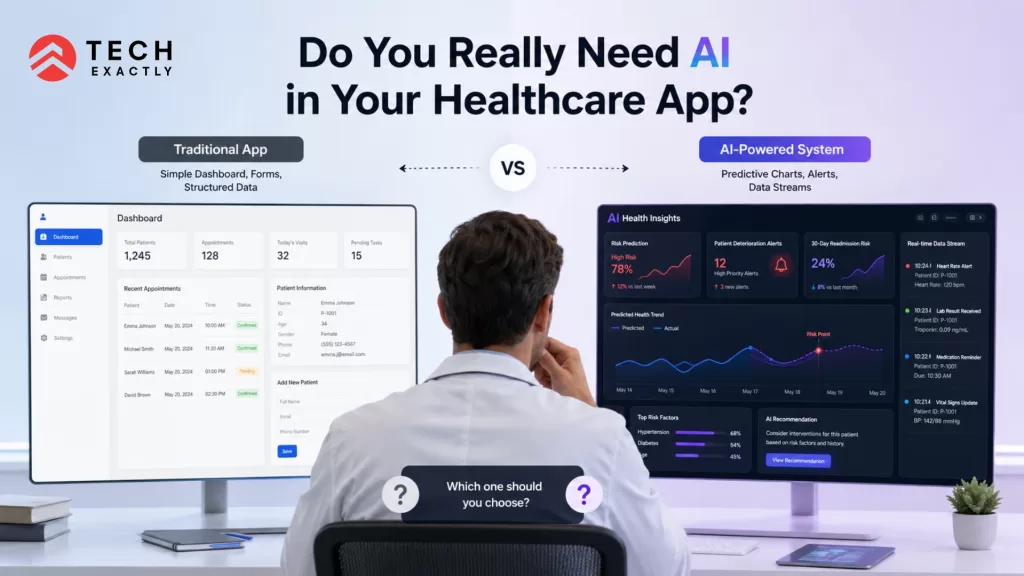
AI technology is becoming one of the most important layers in contemporary healthcare apps. AI offers great efficiency, personalisation, and scalability.
It’s observed that industry adoption of AI in healthcare is increasing quickly; further enhancing operational efficiency and patient outcomes.
However, there’s one crucial question that all founders and healthcare product managers should ask themselves before implementing AI in their apps: Does my app require AI, or am I complicating the product for nothing?
From a technological perspective, I would say that this choice is not only about ability; it depends on:
- Architecture complexity
- Data readiness
- Scalability
- Operational Maturity
When we observe in the real world, I have seen many teams include AI systems in the initial stage of their app development. This can be made seamless by establishing reliable data pipelines, evaluation systems, or operational readiness in the first stage.
This results in additional expenses, poor performance, and regulatory problems. Alternatively, in the right context, AI can help make the product unique and distinct from its competitors.
In my opinion, many healthcare workflow benefits from stable deterministic systems than premature AI adoption. Especially during early product stages, where reliability matters more than intelligence. It is important to distinguish between those situations in which AI will add value and those in which it won’t be necessary.
This article provides insights into when AI becomes a requirement, when it is superfluous, and what to consider when deciding whether or not to use AI in healthcare app development.
When AI is Necessary in Healthcare Apps
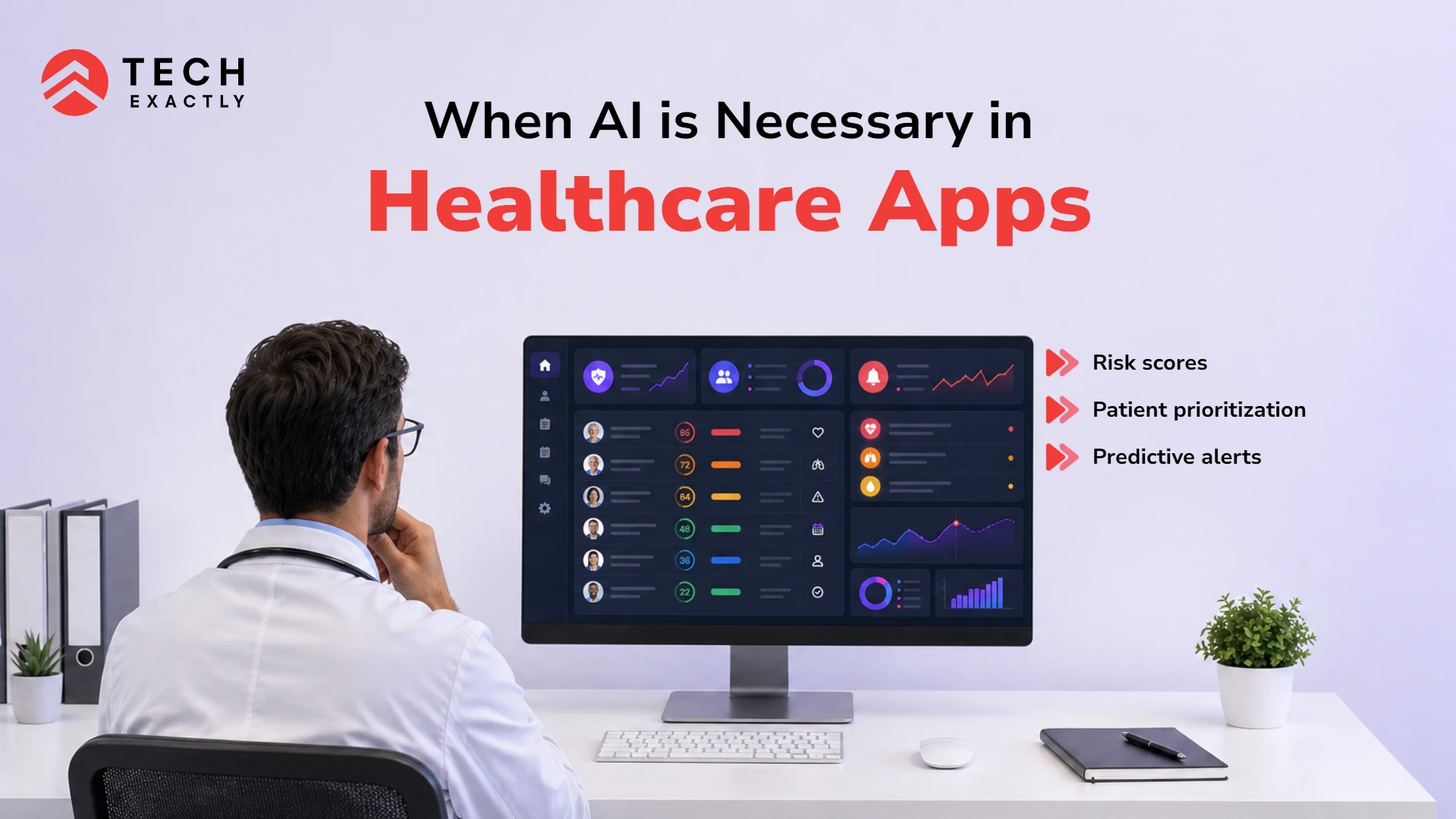
High volume decision-making
In some cases, a system may need to make a high number of decisions. That is when AI algorithms become necessary.
Examples:
Triage in telehealth platforms
Risk score estimation and patient prioritisation
Large-scale decision support in hospitals
Rule-based systems will not cope in such cases due to the following reasons:
Too complicated decision trees will have to be constructed.
There would be many edge cases that should be considered manually.
Learning capabilities of AI algorithms make them capable of continuously analysing the data and improving decision accuracy. This is how many of today’s advanced healthcare mobile app developers work.
The official data confirms that machine learning systems are proven to be highly effective in large-scale clinical decision support systems.
Predictive analytics and prevention
There is a shift towards proactive treatment in the field. This is where AI is becoming an irreplaceable tool for medical professionals.
Cases when AI is needed in the field:
Prediction of the possible future diseases (heart attack, diabetes, etc.)
Detection of abnormalities
Proactive measures that should be taken based on patient data
Without AI, such decisions would require:
A huge manual analysis of all available data sets.
Creation of static rules that may miss some patterns in the data.
AI allows recognising patterns in the analysed data and taking preventive actions before the occurrence of any negative events. This feature differentiates modern medical software products offered by a Healthcare App Development Company in the USA and the UK.
Predictive analytics is increasingly used to identify early disease risks and improve preventive care outcomes.
Unstructured data analysis
In the field, there is much unstructured data like doctors’ notes, patients’ conversations, etc. Handling such kind of data manually takes a lot of time and energy. AI, especially NLP techniques, helps to automate this task.
Natural language processing is widely used to extract insights from unstructured clinical data, such as physician notes.
Examples of the usage of AI technologies in the area include:
Processing doctors’ notes and converting them to EHR data.
Analysis of patients’ conversations.
Automated documentation.
Such capabilities make the integration of a chatbot into your application possible.
Personalized medicine
The concept of personalised medicine is widely spread now. It requires using AI algorithms for analysis and treatment adjustment.
Some of the capabilities that can be realised with the help of AI include:
Treatment recommendations based on patient history.
Dynamic adjustments of treatment plans.
Personal health monitoring based on analysis of patients’ data.
Why would the traditional approach not work in this case? It is impossible to create static rules in this situation. Personalised medicine involves many different cases and variations that cannot be covered with the help of traditional algorithms.
AI-driven personalised medicine enables treatment recommendations tailored to individual patient profiles.
Inefficient administrative processes
There is much administrative work that can be automated with the help of AI algorithms.
Examples of tasks when AI is needed in the area include:
Optimisation of the appointment scheduling process.
Automation of billing and coding tasks.
Claims processing.
AI automation is helping reduce administrative burden and operational costs in healthcare systems. By using AI, the mentioned processes can be optimised and human errors eliminated.
Real-time decision support
Some healthcare systems involve real-time decision-making that requires processing of streaming data.
Use cases when AI would be needed:
Monitoring of ICU patients.
Instant notifications about anomalies in patients.
Emergency assistance.
AI allows processing data streamed from the following sources:
Wearables.
Medical devices.
The healthcare system itself.
This technology helps to analyse data in real-time mode.
Decision Guide: AI vs. Traditional Software
Capability | Traditional Software | AI-powered App |
Workflow | Static, rule-based | Adaptive, real-time |
Data usage | Structured records | Unstructured (imaging, notes) |
Function | Descriptive (What happened) | Predictive (What will happen?) |
Outcome | Data entry/reporting | Clinical support and Action |
When AI is NOT Necessary (or Misused)
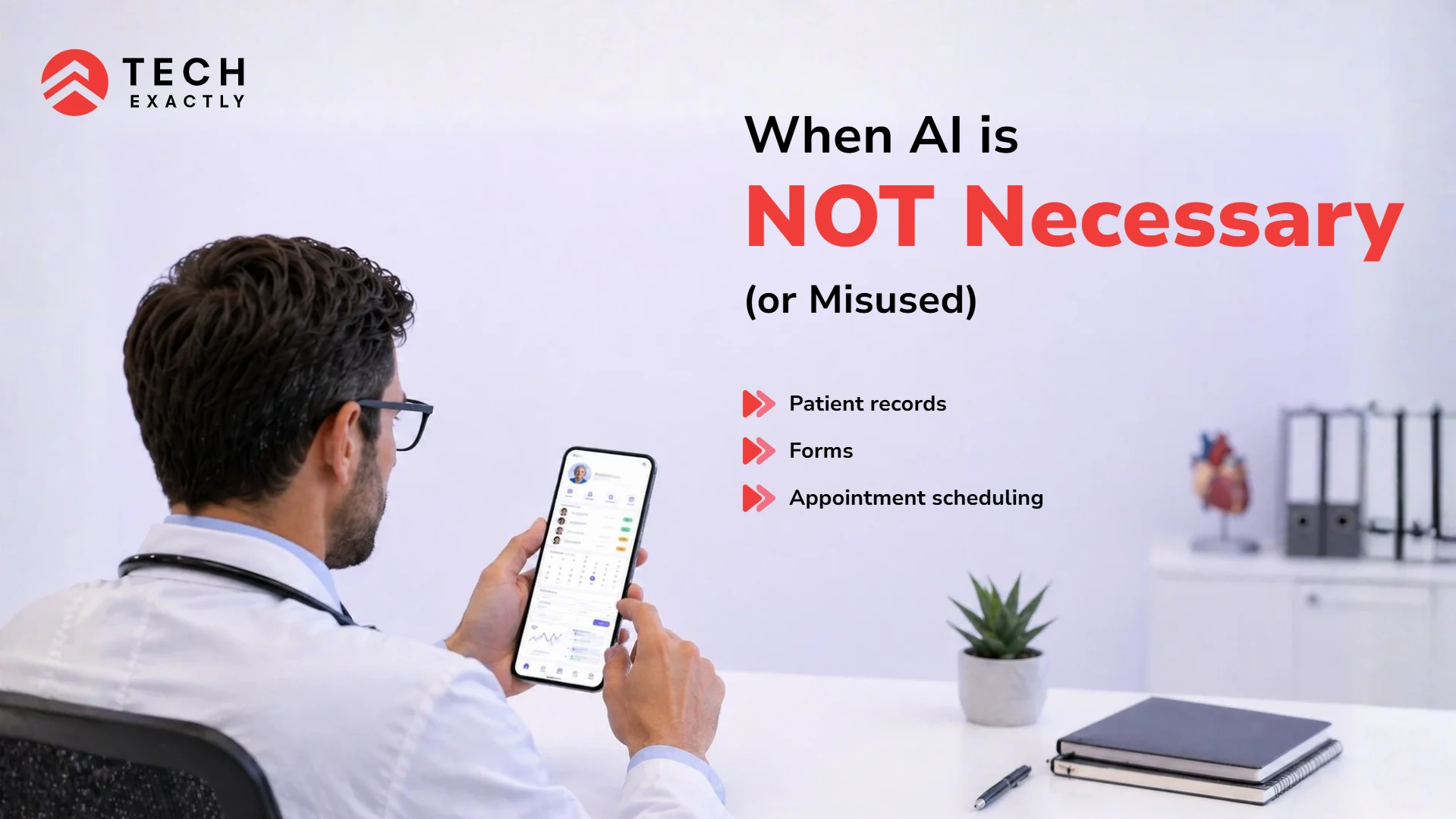
Simple Data Logging
If your app is primarily:
Recording patient data
Displaying dashboards
Managing basic workflows
AI is unnecessary.
Why?
No complex decision-making required
Adds cost without meaningful benefit
Increases system complexity
A well-designed back-end with structured data handling is more than sufficient here.
Linear Decision Flows
If your app follows predictable, rule-based logic:
Form submissions
Eligibility checks
Standard workflows
Then traditional programming is more reliable.
Example:
If A → then B
If X → then Y
AI introduces uncertainty where determinism is preferred. In regulated environments like healthcare, this can create compliance risks.
Lack of Data or Resources
AI systems are only as good as the data they are trained on.
If you lack:
High-quality datasets
Historical patient data
Infrastructure for model training
Then AI will likely underperform.
Common mistake:
Startups often integrate AI early without sufficient data, resulting in:
Poor accuracy
High costs
Low user trust
In such cases, it’s better to start with traditional systems and evolve later.
High Requirement for Interpretability
Healthcare decisions often require transparency. Explainability is a critical requirement for AI systems used in regulated healthcare environments.
If your product needs:
Explainable outcomes
Audit trails
Regulatory approval
Then black-box AI models may not be suitable.
Example scenarios:
Clinical diagnosis tools
Prescription recommendations
Regulatory-compliant systems
In these cases, simpler models or even rule-based systems may be more appropriate until explainable AI frameworks are implemented.
Practical Considerations
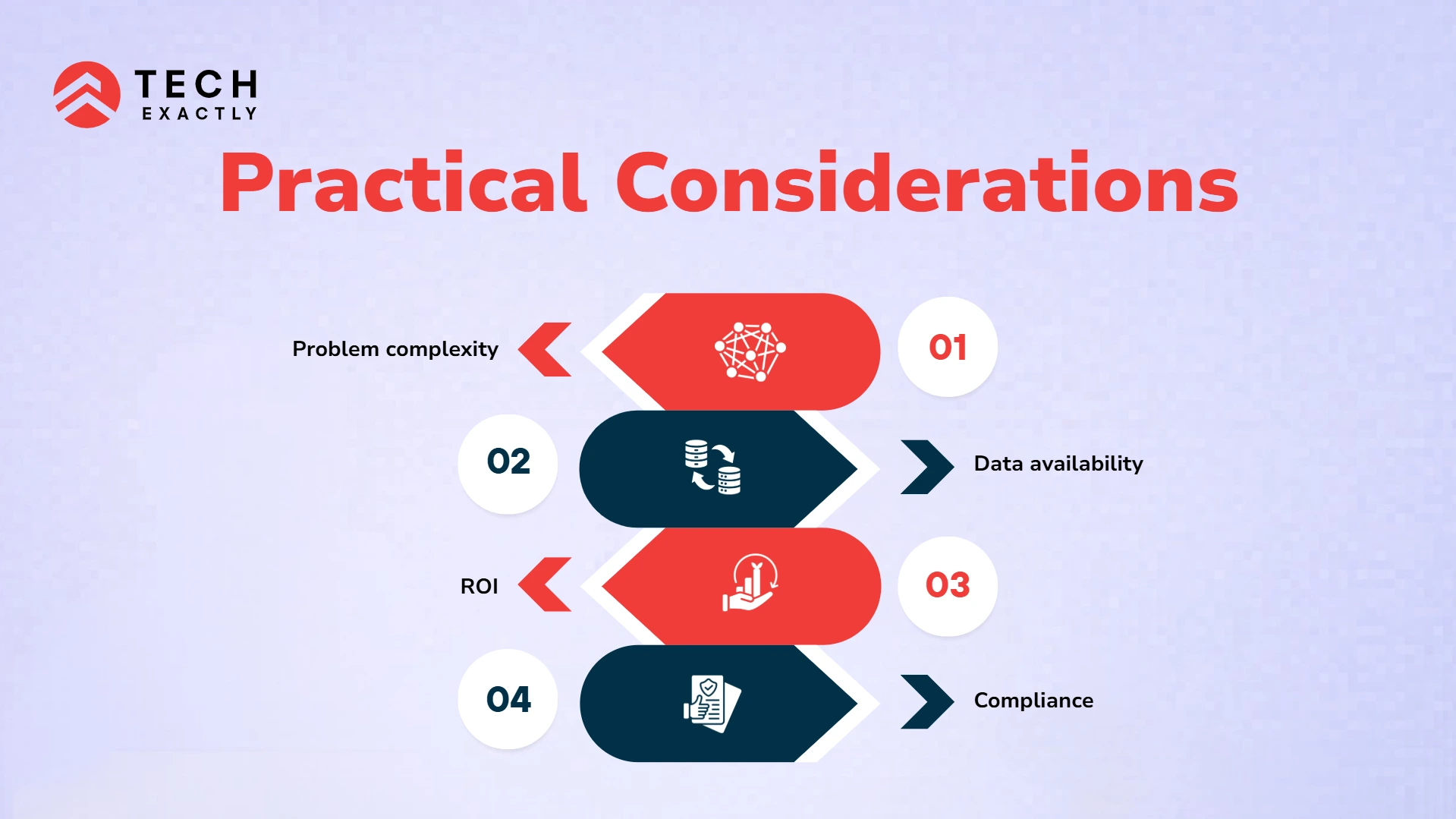
Before deciding whether to integrate AI, evaluate your product across these dimensions:
Complexity of Problem
Is the problem too complex for logic-based reasoning?
Does the problem require pattern identification or predictions?
Yes? → Consider using an AI solution.
Availability of Data
Do you have sufficient and reliable data?
Can you keep collecting and improving on it?
Without data, there is no advantage in using AI.
Cost vs Return on Investment
Does using AI lower costs or increase benefits?
Does it warrant the cost of technology & talent required?
The use of AI should resolve a business problem, not create one.
Regulatory Impact
Does your system require compliance with healthcare rules?
Can you achieve transparency and auditability?
Using AI adds layers of regulatory complexity.
Stages of Product Development
Use AI at the MVP stage only when required
Introduce AI during the Growth phase selectively
Use AI in optimised systems in the Scaling stage
This is the right approach.
Final Thoughts
AI in healthcare technology is potent but not universal. The key lies in the effective utilisation of AI and not random experimentation.
Apply AI in cases where:
Complex data needs processing
Prediction forms the core value
Personalisation and automation become necessary
Don’t apply AI if:
Workflows are simplistic and deterministic
Data and infrastructure are not available
AI interpretability matters a lot
In essence, today’s great healthcare technologies are not “AI first” but “problem first.” AI technology only acts as an aid in solving the problems.
If you want to develop a new technology in the field of healthcare, don’t focus on the question: “How can we use AI?” Focus on the question:
“What is the scope of applying AI in our product?”
This is the distinction between genuine innovations and mere complexities in developing healthcare technologies. Consult experts at AI app development companies like Tech Exactly regarding your mobile healthcare applications.


