


React vs Angular for Building Scalable Healthcare Applications in 2026

The healthcare industry is undergoing a digital transformation at an unprecedented pace. With global healthcare IT spending projected to surpass $974 billion by 2027 (MarketsandMarkets), the pressure on development teams to build robust, scalable, and compliant digital products has never been greater.
At the heart of this transformation lies a critical architectural decision: Angular vs React, and when it comes to healthcare, this choice carries real consequences.
Whether you’re partnering with a Healthcare App Development Company in USA or UK, the framework you choose will shape your product’s performance, security posture, long-term maintainability, and ability to meet regulatory requirements like HIPAA and GDPR.
This article breaks down the Angular vs. React debate specifically through a healthcare lens, so you can make the right call.
Why Framework Choice Matters in Healthcare
Healthcare applications aren’t typical enterprise software. They handle Protected Health Information (PHI), integrate with complex EHR/EMR systems, and must maintain near-perfect uptime. A poorly architected front end can lead to:
- Data breaches: the average healthcare data breach cost $10.93 million in 2023 (IBM Cost of a Data Breach Report)
- Compliance violations under HIPAA, HL7 FHIR, and GDPR
- Poor UX for clinicians, which directly affects patient outcomes
Choosing between Angular and React isn’t just a developer preference, but more of a business-critical decision. That’s why leading healthcare mobile app development services providers like Tech Exactly evaluate both frameworks carefully before committing.
Read: How we developed an IEC 62304-Compliant Mobile App for Accurate Test Interpretation
What is Angular?
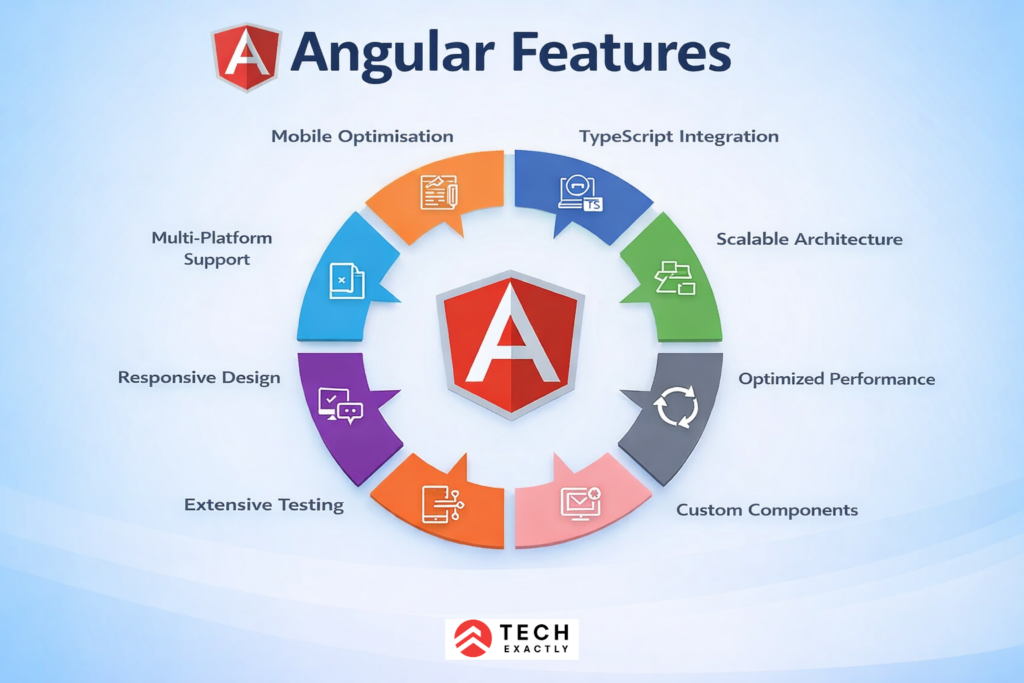
Angular, maintained by Google, is a full-fledged MVC framework that ships with everything out of the box: routing, HTTP client, dependency injection, and form handling. For large healthcare enterprises building complex, multi-team applications, Angular’s opinionated structure is often a major advantage.
Key strengths of Angular in healthcare:
- TypeScript-first: reduces runtime errors in mission-critical flows like medication management or patient data entry
- Enterprise-grade architecture: ideal for large EHR dashboards, hospital management systems, and multi-department portals
- Built-in form validation: crucial for clinical data entry workflows where accuracy is non-negotiable
Angular’s strict component architecture makes onboarding easier in large teams and enforces consistency, something that matters a great deal when multiple development squads are contributing to a shared codebase.
What is React?
React, developed and maintained by Meta, is a UI library rather than a full framework. This distinction gives development teams significant flexibility to assemble their own tech stack. For healthcare startups, patient-facing apps, and rapidly evolving telehealth platforms, React’s composability and massive ecosystem are hard to beat.
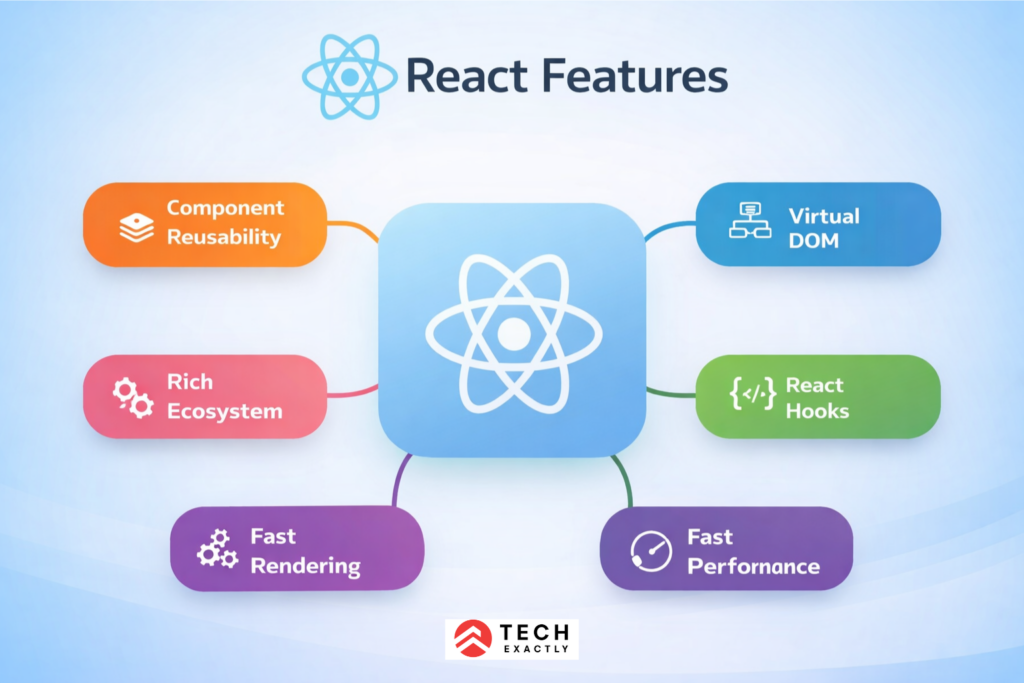
Key strengths of React in healthcare:
- Component reusability: build shared UI libraries for appointment scheduling, vitals dashboards, or prescription management
- Rich ecosystem: integrates easily with Redux, React Query, and healthcare-specific libraries
- Faster initial learning curve: important when you need a react native developer for hire and get them productive quickly
React’s virtual DOM and fine-grained rendering control also make it well-suited for real-time healthcare dashboards, think live patient monitoring, ICU alerts, or telemedicine interfaces.
▶️Tech Exactly has explored this in depth in this case study: One Mobile App to Track 1,500+ Field Workers That Saved Our Client Thousands Monthly
💡 Expert Tip: From a Senior Solutions Architect: “For large hospital networks or insurance platforms with hundreds of internal users, Angular’s rigid structure saves you from architectural drift over time. But for patient-facing consumer apps or MVPs where speed to market matters, React gives you the agility you need. At the end of the day, the best framework is the one your team can execute on confidently, so don’t underestimate that factor.”
Angular vs React: Head-to-Head Comparison for Healthcare
| Criteria | Angular | React |
| Type | Full Framework | UI Library |
| Language | TypeScript (enforced) | JavaScript / TypeScript (optional) |
| Learning Curve | Steeper | Moderate |
| Performance | High (Ahead-of-Time compilation) | High (Virtual DOM) |
| Data Binding | Two-way | One-way |
| Best For | Large enterprise EHR/EMR systems | Patient apps, telehealth, MVPs |
| State Management | Built-in (NgRx, Services) | External (Redux, Zustand, React Query) |
| Testing | Built-in (Jasmine + Karma) | External (Jest, React Testing Library) |
| HIPAA Compliance Support | Strong (strict typing helps audits) | Strong (depends on architecture choices) |
| Community Size | Large (enterprise-focused) | Massive (general + enterprise) |
| Team Scalability | Excellent (enforced patterns) | Good (requires team discipline) |
| Hire Talent | Moderate pool | Very large pool (React developer jobs are abundant) |
| Mobile (React Native) | Not directly | Yes – via React Native |
When to Choose Angular for Development
Angular has long been the framework of choice for teams building complex, large-scale software, and healthcare is no exception. But knowing the right AngularJS moment, that inflection point where your project’s complexity genuinely justifies Angular’s structured, opinionated approach, is what separates well-architected healthcare platforms from ones that quietly become difficult to maintain and scale.
You might like reading how we built a platform to manage and reconcile daily sales of nearly $1,000,000 across 80+ cultural attractions in the USA
Angular is typically the right choice when:
- You’re building an enterprise-scale clinical platform like: hospital management systems, population health dashboards, or multi-tenant insurance portals
- Your team is large and distributed, and you need enforced coding standards across squads
- Your application requires complex form workflows (clinical assessments, intake forms, e-prescriptions)
- Long-term maintainability and enterprise support contracts are priorities
A good example: a major UK-based NHS digital initiative or a US hospital chain building an internal operations platform would likely benefit from Angular’s discipline and predictability. If you’re evaluating a Healthcare App Development Company for such a project, ask specifically about their Angular team depth and experience with NHS digital standards.
When to Choose React for Development
React’s edge lies in its rich React JS UI libraries ecosystem, from Chakra UI and MUI to healthcare-specific component libraries that let teams build polished, accessible clinical interfaces without starting from scratch. This plug-and-play composability makes React the go-to choice when speed, flexibility, and user experience are the driving forces.
Read how we upgraded a ReactJS website to help Australian cricket clubs locate quality players on demand
React tends to win when:
- You’re building a patient-facing consumer app: telehealth, mental wellness, chronic condition management
- Speed to market is critical, and you need an MVP fast
- Your team wants to share code across web and mobile using React Native, including nuanced UI components like the React Native dropdown for medication selectors, diagnosis filters, or appointment type pickers that need to work seamlessly on both iOS and Android
- You need to hire a React developer quickly, and the talent pool is significantly larger
Note: On the hiring front, the volume of React JS developer jobs posted globally has grown year-over-year. This also means more specialized talent- developers with experience in healthcare-specific React builds, HIPAA-aware state management patterns, and telemedicine UI.
Healthcare Compliance Considerations
Regardless of which framework you choose, compliance requirements don’t change. Both Angular and React can support HIPAA-compliant architectures, but how you implement them matters. Key considerations include:
- Data encryption in transit and at rest: framework-agnostic, handled at the infrastructure level
- Audit logging: both frameworks support this, but Angular’s service architecture makes it easier to implement centrally
- Session management and token handling: critical for PHI access control; React’s flexibility here requires more deliberate architecture decisions
- Accessibility (WCAG 2.1): both support accessible component libraries, though Angular Material and React’s ecosystem both offer compliant UI kits
According to the HIPAA Journal, healthcare organizations must conduct regular risk assessments of their software systems, making framework-level decisions part of their compliance posture from day one.
The Talent Factor: React Developer Hiring vs Angular
One underrated consideration is team composition. The availability of react developer for hire options is significantly broader than that of Angular developers. This matters for:
- Faster team scaling during product growth
- Lower recruitment costs
- More competitive salaries (both frameworks pay well, but React talent is more abundant)
If your organization has a strong existing Angular team, the calculus changes. But for net-new projects, React’s talent availability often tips the scales, especially for companies engaging healthcare mobile app development services on a contract basis.
How Tech Exactly Helps You Make the Right Call
Choosing between Angular and React for a healthcare application isn’t a decision that should be made in a vacuum or based purely on developer preference. It requires a deep understanding of your clinical workflows, compliance obligations, team capabilities, and product roadmap. That’s where Tech Exactly comes in.
As an experienced Healthcare App Development Company in USA and UK, we work with healthcare organizations at exactly this crossroads – before the first line of code is written, before the architecture is locked in, and before costly assumptions become expensive rework.
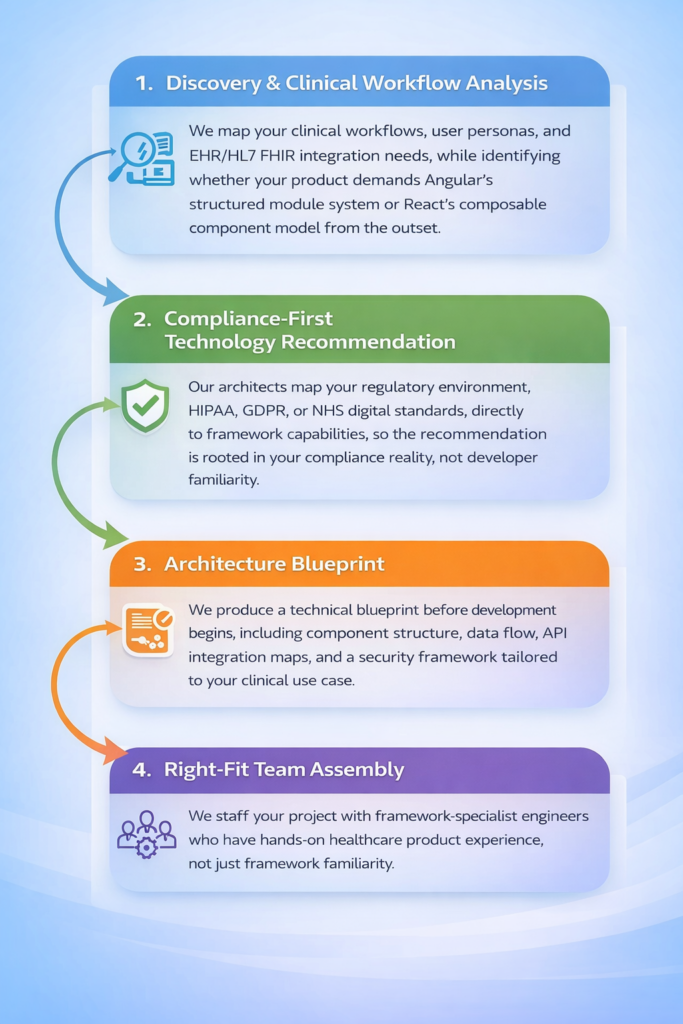
Our engagement starts with a structured discovery process designed specifically for healthcare products.
Final Verdict: Angular or React?
Both Angular and React are production-proven frameworks capable of powering world-class healthcare applications. Not just React or Angular, angularjs vs reactjs debate also doesn’t have a universal winner.
- Choose Angular if you’re building large, multi-team enterprise healthcare systems where consistency, strict architecture, and long-term maintainability are paramount.
- Choose React if you’re building patient-facing products, telehealth platforms, or need to move fast with a flexible and large talent pool.
What matters most is partnering with a team that understands both the technical landscape and the unique demands of healthcare software, from regulatory compliance to clinical workflow design.
Whether you’re working with a healthcare app development company in USA or a healthcare app development company in UK like Tech Exactly, make sure your partner has proven experience in both frameworks and a track record in regulated industries.
The framework is a tool. The expertise behind it is what makes or breaks your healthcare product.
