


FinTech Software Outsourcing: A Founder’s Guide to PCI-DSS and Vendor Risk

Key Takeaways
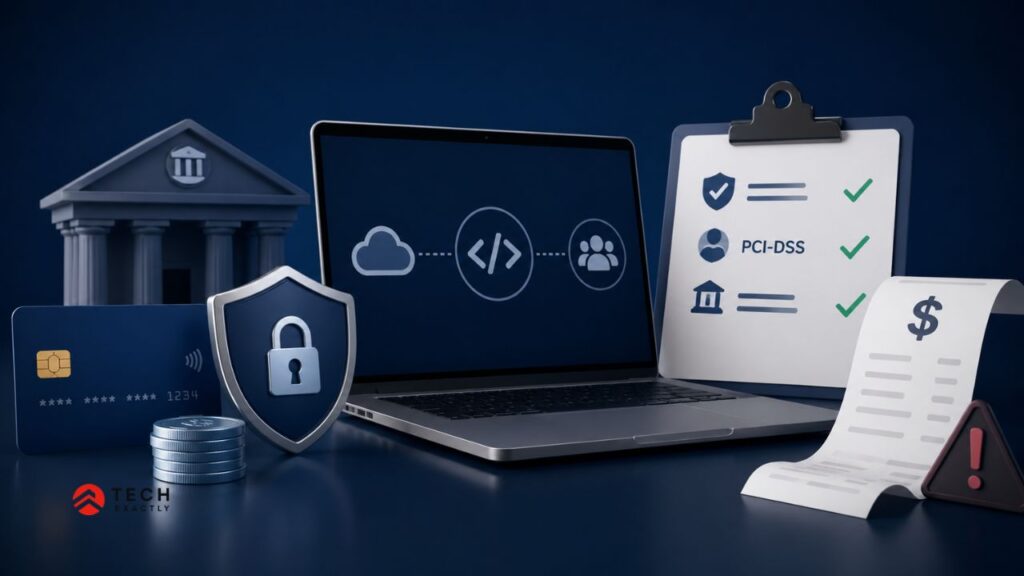
- PCI-DSS doesn’t care where your vendor is located — it cares which of their systems and subprocessors are in scope. Offshore is allowed. Sloppy scope boundaries are what trigger remediation costs.
- SOC 2 Type II is the real fintech vendor gate. Enterprise buyers, banking partners, and most card networks expect it. A vendor without it is a vendor you’ll outgrow inside 18 months.
- OFAC, AML, and KYC logic can be outsourced. The accountability cannot. Your name is on the regulatory filings, not your vendor’s — and generative AI in fintech doesn’t change that calculus; AI-assisted screening adds regulatory complexity, not a liability transfer.
- Real-time payment workloads break the cheap-offshore math. Latency and uptime SLAs make a 4-hour timezone gap expensive in ways the spreadsheet doesn’t show.
- Budget a 15-30% compliance tax over generic software rates. PCI-scoped infrastructure, audit logging, segmented networks, and quarterly ASV scans aren’t optional.
- Pick the vendor for the post-go-live audit, not the pitch deck. The cheapest compliant-on-paper option is the most expensive one when your first SOC 2 review opens.
Most fintech software outsourcing stories sound like fairy tales. The reality hits you six months later when your vendor’s unvalidated subprocessors get flagged by an enterprise client. Your bank partner starts rejecting the offshore IP range, and your AML reviewer demands a SOC 2 Type II report that your team doesn’t have. Additionally, the real-time payment integration runs 200ms over budget because your engineers are on a different continent.
That is the real outsourcing story. This guide is going to explain how to avoid it.
The fundamentals of software development outsourcing sit in a separate piece — start there if you’re new to the topic. This guide picks up where that one stops: what changes when cardholder data, bank integrations, or money movement enter the scope.
The World Fintech Festival mobile app delivery — four live payment integrations, hard event deadline, distributed team — is the production-pressure frame that makes the vendor selection sections below concrete.
Why FinTech Software Outsourcing Is a Different Problem
Generic outsourcing guides treat the decision as a trade-off among cost, quality, and speed. In fintech, three additional axes will sink the project if you ignore them:
Regulatory surface area. PCI-DSS for anything touching cardholder data. SOC 2 Type II for enterprise customer trust. State money transmitter licensing if you’re moving funds across state lines. OFAC sanctions screening, BSA/AML obligations, and KYC requirements that vary by jurisdiction. GLBA for consumer financial data. A vendor without an active compliance program at this scale will not survive your first enterprise customer’s risk review.
Integration gravity. Fintech software doesn’t act solo. You are going through a complex web of dependencies and integrating with partners like Plaid, Stripe, Adyen, an ACH originator, a card network, a core banking platform, a KYC provider like Alloy or Persona, and a fraud system like Sift or Sardine. Most generalist firms claim to have expertise in these areas, but there is a vast difference between a sandbox demo and shipping a regulated product into production.
Latency and uptime realities. In terms of payment processing, a 200ms authorization budget is a hard limit, not a suggestion. When you input a 99.99% uptime SLA, all micro-delays across your system chain compound into a potential failure. Delays caused by offshore setups and timezone gaps result in real transaction and compliance errors.
A vendor who is unfamiliar with these fundamentals will gain experience at your expense.
Let's Start Your Project Today
Ready to start your FinTech software outsourcing journey with us? Reach out now—our experts are just one click away.
The PCI-DSS Question Most Founders Get Wrong
The most common question we get from founders evaluating fintech development outsourcing: “Can I legally use an offshore team for a PCI-scoped build?”
Short answer: yes. PCI-DSS has no geographic restriction. You can sign a vendor in Poland, India, Argentina, or Vietnam, and the standards apply identically.
Longer answer: the legality isn’t the constraint. Scope discipline is.
Here’s what actually matters:
- Which of your vendors’ systems are in scope? PCI scope follows cardholder data — anywhere it’s stored, processed, or transmitted, plus systems that connect to those environments. If your offshore developers have access to a production environment that touches cardholder data, their workstations and the network paths in between are in scope. Most generic offshore shops have neither the segmented networks nor the workstation hardening to support this.
- Are the subprocessors in their stack PCI-validated? Their cloud, their CI/CD platform, their logging tool, their crash reporter. Anything in the data path needs to be either out of scope by design or PCI-validated. Ask for the Attestation of Compliance (AoC) on every subprocessor before signing.
- Can they provide an AoC for their service? If they’re acting as a PCI service provider — which they are, the moment they handle scoped systems — they need their own AoC. “We follow PCI principles” is not an AoC.
- Where does the cardholder data actually live? Most fintech enterprise customers expect US data residency, even though PCI doesn’t require it. Confirm the production region in writing. “We use AWS” is not an answer.
The most efficient fintech partners design for scope discipline before even a single line of code is written. They adopt segmented environments, PCI-validated regions, and tokenization to minimize exposure to compliance scope. Vendors that lack this discipline may pass the sandbox test, only to later watch their architecture fall apart under the requirements of a post-go-live audit.
SOC 2, OFAC, and AML: When FinTech Outsourcing Gets Regulated
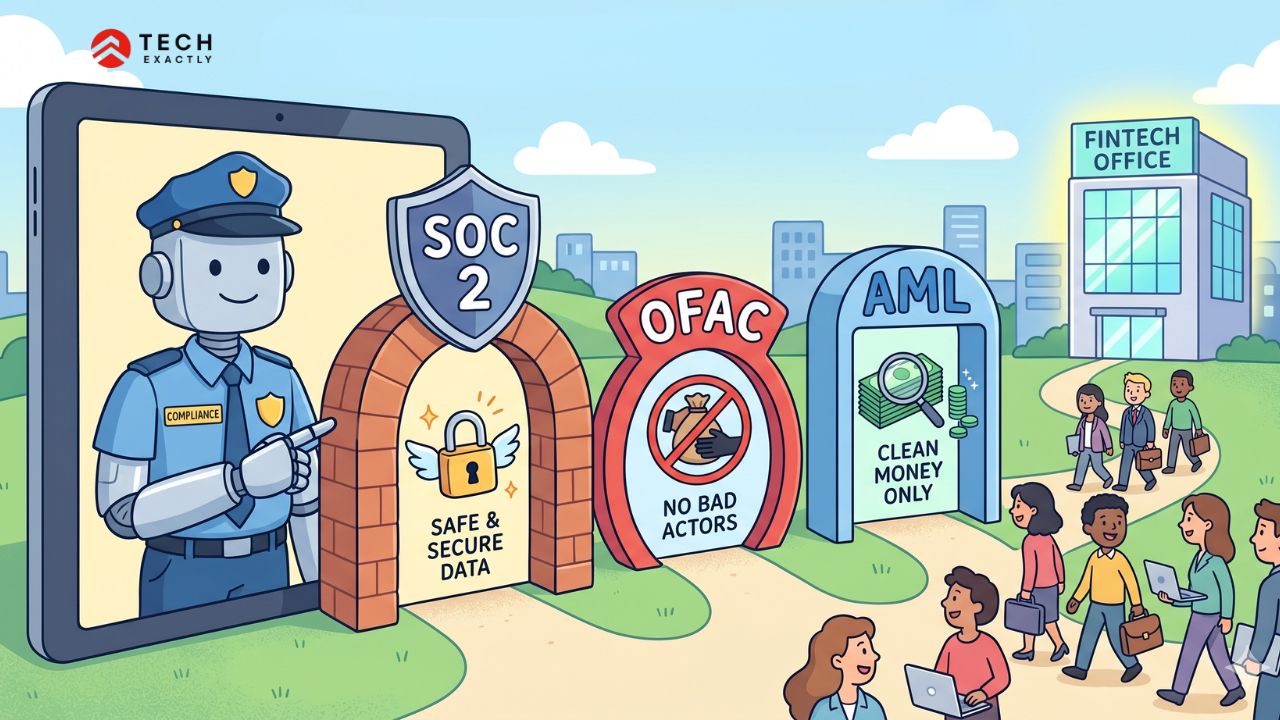
If the platform handles fund movement, payment processing, or lending, outsourcing transitions from a budget-saving strategy to a high-stakes regulatory commitment. At this stage, the vendor is no longer just a service provider; its internal controls and processes effectively become an extension of your own control environment.
Your vendor’s controls become part of your control environment. Specifically:
- SOC 2 Type II. This is the de facto vendor gate for fintech enterprise sales. Type I is a snapshot. Type II is the real one — it covers operating effectiveness over a period (typically 6-12 months). Vendors who say “we’re working toward SOC 2” are vendors who don’t have it.
- PCI-DSS validation level. Level 1 (>6M annual transactions), Level 2, etc. Your transaction volume sets the bar. Your vendor’s services need to meet your level.
- OFAC sanctions screening. Real-time matching against OFAC SDN, consolidated lists, and increasingly EU/UK lists. The screening logic can be outsourced. The accountability for false negatives cannot.
- BSA/AML and KYC. CIP requirements, ongoing monitoring, and suspicious activity flagging. Most of this can be implemented offshore. The compliance officer who signs the SAR cannot be.
- State money transmitter licensing. If you’re moving funds, the licensing burden is yours. Vendor work that touches MTL-regulated workflows needs to be tracked and disclosed in your licensing applications.
Lending-specific obligations compound this further — CIP requirements, ongoing monitoring, SAR filing cadence, and state MTL disclosure requirements go deeper than most outsourcing guides cover; loan and lending app development breaks down the full regulatory surface for those builds.
The outsourcing nuance: vendors who have shipped to a Level 1 PCI environment, supported a SOC 2 Type II audit, or maintained OFAC screening at scale know the difference between “we can build that” and “we can ship that to a regulator.” Vendors who haven’t will learn from your project.
Banking and Payment Integration Outsourcing: What You Can and Can't Hand Off
While you can hand off the complex engineering required to integrate with Plaid, Stripe, and ACH rails to an external team, the legal and operational relationships remain your responsibility. Most payment APIs and banking platforms only grant production access to the regulated entity or merchant of record.
Practically:
- Sandbox depth varies wildly. Plaid and Stripe have rich sandboxes. Many bank-as-a-service providers and core banking platforms have sandboxes that diverge from production in ways that only show up at go-live. Build a synthesized data layer that matches actual production field usage.
- Production access reviews can be slow. ACH originators, card processors, and bank partners do their own vendor risk review on top of yours. Multi-week to multi-month cycles. Build that into your timeline, not around it.
- Real-time payment integration is latency-bounded. Card auth has roughly 200ms of total processing budget. RTP and FedNow have similar tight envelopes. If your offshore vendor is hosting the payment service in a region 150ms from your US merchants, you’ve already burned most of the budget. This is one of the few places where computer geography matters as much as engineer geography.
Let's Start Your Project Today
Ready to start your FinTech software outsourcing journey with us? Reach out now—our experts are just one click away.
Nearshore vs. Offshore FinTech Software Development: The Compliance and Latency Math
Generic builds hinge on cultural fit. Fintech builds introduce tougher realities like uptime and compliance.
Compliance interview velocity. Your SOC 2 Type II auditor will need access to engineers, evidence, and process owners. So will your enterprise customers’ vendor risk teams. So will your bank partner’s risk reviewer. Async, 10-hour-offset engineering teams turn what should be a 30-minute call into a two-week thread.
Production incident response. P1 incidents demand an immediate response. A 14-hour delay between the on-call engineer and the bank’s support team is not just a problem in theory; it is a visible SLA miss.
Model | Hourly Rate | Timezone Overlap (US East) | Compliance Audit Velocity | Real-Time Incident Coverage |
|---|---|---|---|---|
US onshore | $150-250 | Full | Fast | Strong |
LATAM nearshore (Mexico, Argentina, Colombia, Brazil) | $55-90 | 4-6 hours | Fast | Strong |
Eastern Europe (Poland, Romania, Ukraine) | $50-80 | 1-2 hours (morning only) | Medium | Medium |
India offshore | $30-55 | 0-1 hours (late night/early morning) | Slow | Weak |
Philippines / SE Asia offshore | $28-50 | 0-1 hours | Slow | Weak |
The offshore discount between a $40 engineer and a $70 nearshore counterpart disappears the moment compliance or uptime issues require an instant response while your offshore team is asleep.
This is not universal. Offshore fits back-office, reporting, and administrative workloads. However, when it comes to real-time transaction flow or audit evidence handling, a nearshore partner earns back the premium before the first compliance review concludes.
The Compliance Tax: What FinTech Software Outsourcing Actually Costs.
Generic offshore dev shops quote in a $30-60/hour range. FinTech-capable vendors quote $65-130/hour, sometimes higher for PCI Level 1 or money transmission work. The delta isn’t markup — it’s the compliance tax.
What the tax actually pays for:
- PCI-validated cloud environments with segmented networks (typically 20-40% premium over baseline cloud)
- Workstation hardening and access controls that meet PCI scope requirements
- Audit logging and SIEM with retention windows that match your auditors’ expectations
- External penetration testing and quarterly ASV scans on the cadence PCI requires — annual pen test plus quarterly ASV scans minimum
- SOC 2 Type II maintenance — vendor side, not just yours
- Compliance and risk staff on payroll who can answer your enterprise customer’s security questionnaire without three weeks of back-and-forth
- DR/BCP testing that produces real evidence, not a tabletop exercise
For a typical Series A-stage payment or lending build, expect total costs 15-25% above a generic SaaS equivalent. For Level 1 PCI environments or licensed money transmitter platforms, 30-50% above. The cheapest compliant-on-paper vendor is almost always the most expensive once the first audit cycle opens.
Fintech app development cost by app type — payment platform, lending stack, neobank core — is a useful baseline before you model vendor rates against it.
For a sense of how this work shows up in practice, our payment gateway innovation case study walks through one such build, and the loan lifecycle modernization project shows the same compliance posture applied to lending.
The 15-Question FinTech Software Outsourcing Vendor Checklist
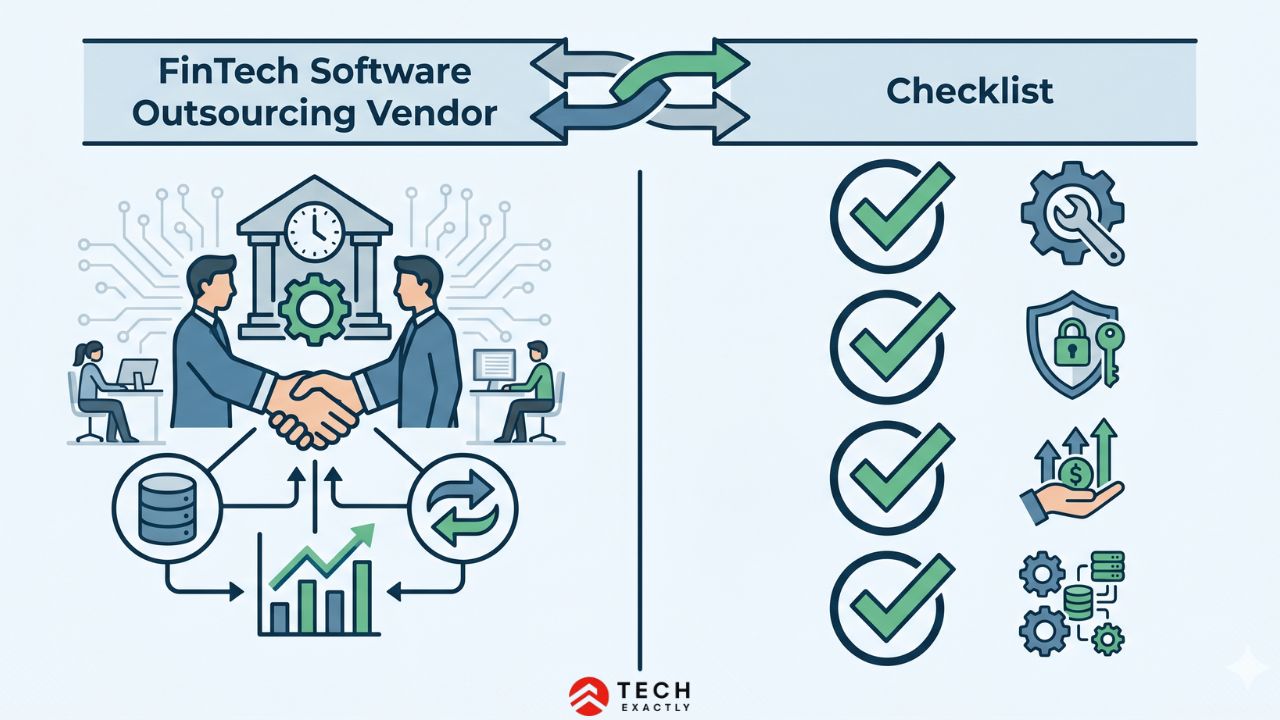
Most vendor-selection checklists ask the wrong questions. “Do you have fintech experience?” gets a “yes” from everyone. The questions that actually reveal fintech-ready vendors involve compliance depth, integration maturity, and uptime accountability.
Compliance posture:
- Show me your most recent SOC 2 Type II report and bridge letter.
- What’s your PCI-DSS validation level, and can I see your AoC?
- Show me your subprocessor list with the validation status of each.
- When was your last external penetration test? Who performed it, and can I see the executive summary?
- Walk me through how you’d keep my codebase out of PCI scope where possible.
Regulatory depth: 6. Name the OFAC, BSA/AML, or KYC integrations your team has shipped to production. 7. Have you worked under a regulated bank partner’s risk program before? Which? 8. What’s your approach to evidence collection during a SOC 2 audit cycle?
Integration experience: 9. Name three core banking, card processing, or payment APIs your engineers have shipped against in production. Not sandboxes — production. 10. Who handles the bank partner relationship for our project — your team, or do we? 11. What’s your approach to synthesized test data when sandboxes diverge from production?
Delivery reality: 12. Who specifically will be on our project — names, not “senior engineers from our pool”? 13. What’s the attrition rate on your fintech accounts over the last 12 months? 14. Show me a case where a fintech project went sideways. What happened? What did you do? 15. What’s your vendor exit plan — if we terminate, what do we get, in what format, by when?
A vendor who answers all 15 questions cleanly is a real candidate. A vendor who dodges on three or more is not credible; it is just a sales pitch.
Right software development partner selection — culture, communication style, scope discipline — runs through a different filter than the compliance checklist above.
The Mistakes That Kill FinTech Outsourcing Projects
The failure patterns are consistent:
Hiring the cheapest compliant-on-paper vendor. Compliance is a maintained state, not a one-time certification. Vendors who got SOC 2 once and let the controls drift will fail your first joint audit cycle.
Treating the subprocessor scope as someone else’s problem. Your vendor’s logging provider, error tracker, and CI tools are a liability for you. If they tend to handle scoped data without validation, your compliance boundary would collapse.
Outsourcing risk and policy decisions. You can outsource the code, but you cannot outsource the judgment. While offshore engineers are capable of implementing the specific KYC guidelines you decide upon, they lack the legal jurisdiction to determine what those guidelines should be.
Skipping the pilot project. Before committing to an 18-month build, run a 6-week scoped pilot—a sandbox integration, a compliance-sensitive feature, or a real production handoff. Force them to demonstrate, not describe, fintech competency. A qualified software development company with fintech experience will welcome a pilot scope — it’s their best proof of capability.
Assuming the vendor owns regulatory risk. They don’t. You do. Your name is on the SOC 2, the MTL application, the SAR, and the breach notification. A good vendor reduces your risk. They never absorb it.
When to Outsource FinTech Software Development vs. Build In-House
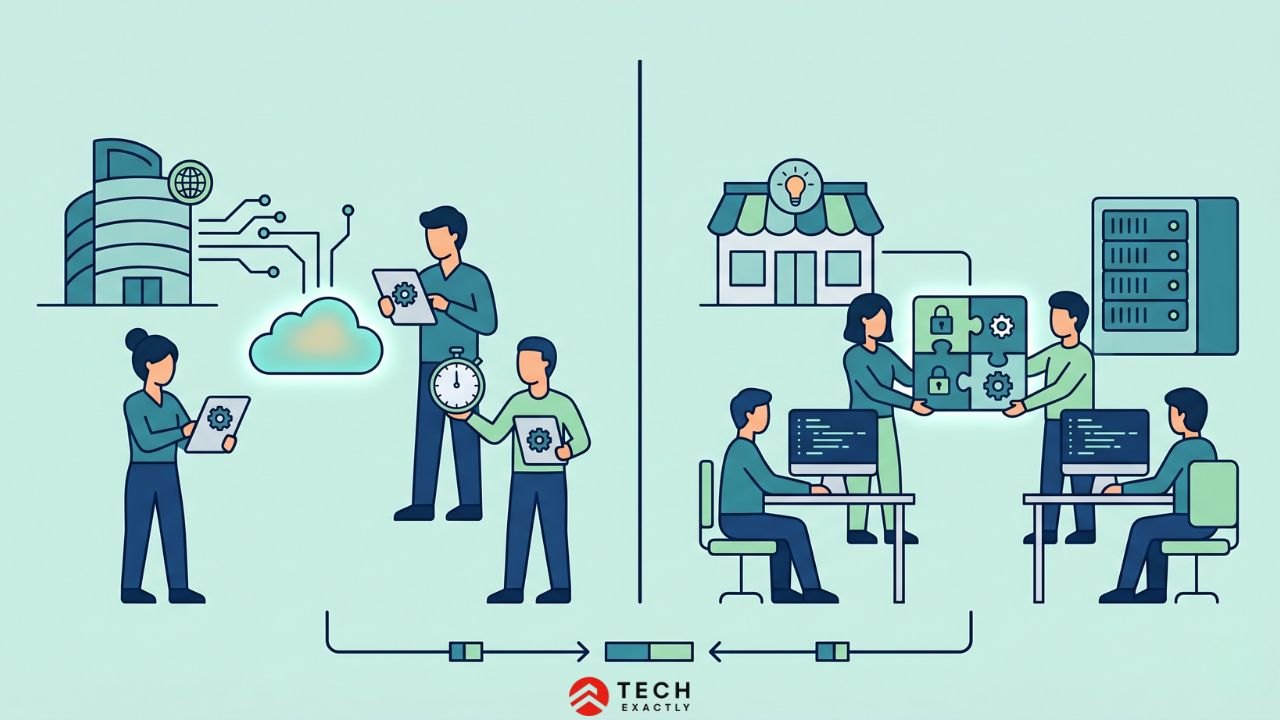
The generic in-house vs. outsourcing software development decision sits in a separate piece. The fintech-specific cut:
Outsource when:
- You need velocity and don’t have payments or compliance engineering on staff
- The work is well-scoped — a defined integration, a specific module, an MVP
- You have internal compliance and risk leadership directing the work
- The platform is under 24 months from MVP to scale
Build in-house when:
- The software is the product, and you’re raising a Series B+ on its strength
- You’re building proprietary risk models, fraud logic, or pricing engines that are your moat
- Regulatory risk is existential — full bank charter applications, money transmitter at scale across many states
- You can actually hire payment-engineering talent (genuinely hard, which is usually why teams end up outsourcing anyway)
Hybrid is the most common right answer. A small in-house core team owning architecture, risk policy, and regulatory strategy. An outsourced delivery team — ideally nearshore — executing against that direction. Tech Exactly’s SaaS development for fintech clients almost always sits in this hybrid shape. The same applies to AI app development at the fintech layer — credit decisioning, fraud detection, KYC automation — where in-house teams own the model governance and the outsourced team handles production integration.
The Takeaway
The real difficulty in Fintech software outsourcing is not that it is harder than generic outsourcing. It is harder because of the compounded demands of regulatory compliance, deep integration, and operational risks that the standard playbooks don’t take into account.
The best vendors charge more and move cautiously during the discovery phase as they assess your control environments as much as you assess their code. A vendor that avoids the hard questions regarding your risk profile today is a vendor that will most likely fail your security review tomorrow.
Pick the vendor for the post-go-live audit, not the pitch deck.
Tech Exactly is a fintech app development company building PCI-aware, SOC-2-ready software for payment platforms, lenders, and digital banks — sometimes as the outsourced team, sometimes alongside in-house engineers. If you’re trying to figure out whether your current vendor is set up for fintech, or you’re about to pick one, come talk to us.
Frequently Asked Questions
Compliance outsourcing means engaging a third-party vendor to implement and maintain regulatory controls — PCI-scoped infrastructure, AML screening logic, KYC workflows, SOC 2 evidence collection — while retaining internal ownership of policy decisions and regulatory filings.
You can outsource the build and ongoing maintenance of a compliance program, but not the accountability. Your compliance officer still signs the SAR, your company still owns the breach notification obligation, and your bank partner holds a relationship with your entity, not your vendor's.
Four risks surface consistently:
- Regulatory accountability: Your name is on the MTL application, the SAR, the breach notification — not your vendor's. A vendor reduces your operational risk; they never absorb your compliance liability.
- Subprocessor exposure: If your vendor's cloud provider, logging tool, or CI platform touches cardholder data without being PCI-validated, your environment isn't validated. Most outsourcing contracts don't specify subprocessor chains in enough detail.
- Data residency gaps: Enterprise buyers and many bank partners expect US data residency even though PCI-DSS doesn't require it. "We use AWS" is not a data residency commitment.
- IP ownership on termination: Confirm in writing that all code, models, and tooling built for your project transfers to you on contract end — in a format you can actually use. Many offshore contracts leave this ambiguous.
At minimum: IP ownership and portability provisions (all code, models, and tooling transfers to you on termination, in a usable format); subprocessor disclosure requirements (vendor must notify you of any changes to their subprocessor chain); data residency commitments in writing, specifying cloud region — not just cloud provider name; SLA terms with measurable uptime and incident response time commitments; PCI and SOC 2 obligations as contractual terms, not just sales representations; and a pilot or milestone-based payment structure that doesn't lock you into 18 months before any proof of delivery.
In fintech, the gap matters more than in generic software development. Nearshore — LATAM, primarily Mexico, Argentina, Colombia, Brazil — gives you 1–6 hours of US timezone overlap, fast compliance audit response, and real-time production incident coverage. Offshore — India, Philippines, Eastern Europe beyond Poland — gives you a lower headline hourly rate and near-zero timezone overlap with US East. For real-time payment systems, SOC 2 audit cycles, and bank partner risk reviews, the timezone gap has a measurable cost. The headline rate saving typically disappears within the first compliance review cycle or the first serious P1 production incident.
It means distinguishing which risks transfer to the vendor and which stay with you regardless of contract terms. Delivery risk — timeline, capacity, engineering quality — transfers. Regulatory accountability does not. Concentration risk — over-dependence on a single outsourced team for mission-critical systems — is itself an auditable risk category. Your board and bank partners will ask about it. Build vendor contracts with exit plans and IP portability requirements that make concentration risk manageable from day one.
Three contract provisions matter most: (1) Work-for-hire assignment — all code written for your project is your property, not the vendor's. Generic boilerplate sometimes leaves model weights, training data, or shared tooling ambiguous. Get it explicit. (2) Portability on exit — you receive all code, documentation, and credentials in a format your own team can operate without vendor involvement. Vendors who resist this provision are signalling dependency risk. (3) Subprocessor data handling — if your vendor uses subcontractors, confirm those arrangements are covered by the same IP terms. Many offshore arrangements use a prime contractor and body-shop model where the IP terms only apply to the prime.

Pallabi Mahanta, Senior Content Writer at Tech Exactly, has over 5 years of experience in crafting marketing content strategies across FinTech, MedTech, and emerging technologies. She bridges complex ideas with clear, impactful storytelling.