


Medical Device Integration with EHR: A 2026 Technical and Compliance Guide


Key Takeaways
- Integration is a classification decision first. Your software may be a Medical Device Data System (MDDS), a SaMD, or non-regulated — and that decision shapes every downstream obligation.
- HL7 v2.x still dominates production traffic. FHIR is the strategic layer, but most live integrations in 2026 still run on v2.x under the hood. Plan for both.
- Epic, Oracle Health, and Meditech each have distinct developer programs, sandbox rules, and approval timelines. Generic “EHR integration” planning fails at the vendor gate.
- Section 524B cybersecurity requirements apply to integration software if it meets the “cyber device” test. Most production integrations do.
- Realistic medical device integration cost: $40K (single device, one hospital, read-only) to $400K+ (multi-device, multi-site, bidirectional, MDDS-classified). Timelines run 3–18 months, depending on scope and EHR vendor.
Smart infusion pumps are installed in roughly 90% of US hospitals. Bidirectional EHR integration is available only in 10–15% of them. This gap, where seven to eight out of every ten pumps can talk to the EHR but don’t, is the clearest single indicator of where medical device integration actually breaks down. It doesn’t break at the protocol layer. It breaks at the deployment layer, where clinical workflow, cybersecurity, vendor politics, and FDA oversight all converge.
This guide is designed specifically for founders and integration leads who are building software that connects regulated medical devices to EHR systems in 2026. Whether that’s a bedside monitor talking to Epic, a remote patient monitoring platform piping readings into Cerner (now Oracle Health), or a novel IoT device trying to land inside hospital networks.
It covers the standards stack (HL7, FHIR, DICOM, IEEE 11073), the FDA classification question most teams miss (MDDS vs. SaMD), vendor-specific realities for the three EHRs that dominate US market share, and the cost and timeline ranges nobody shares specifically.
What Is Medical Device Integration with EHR?
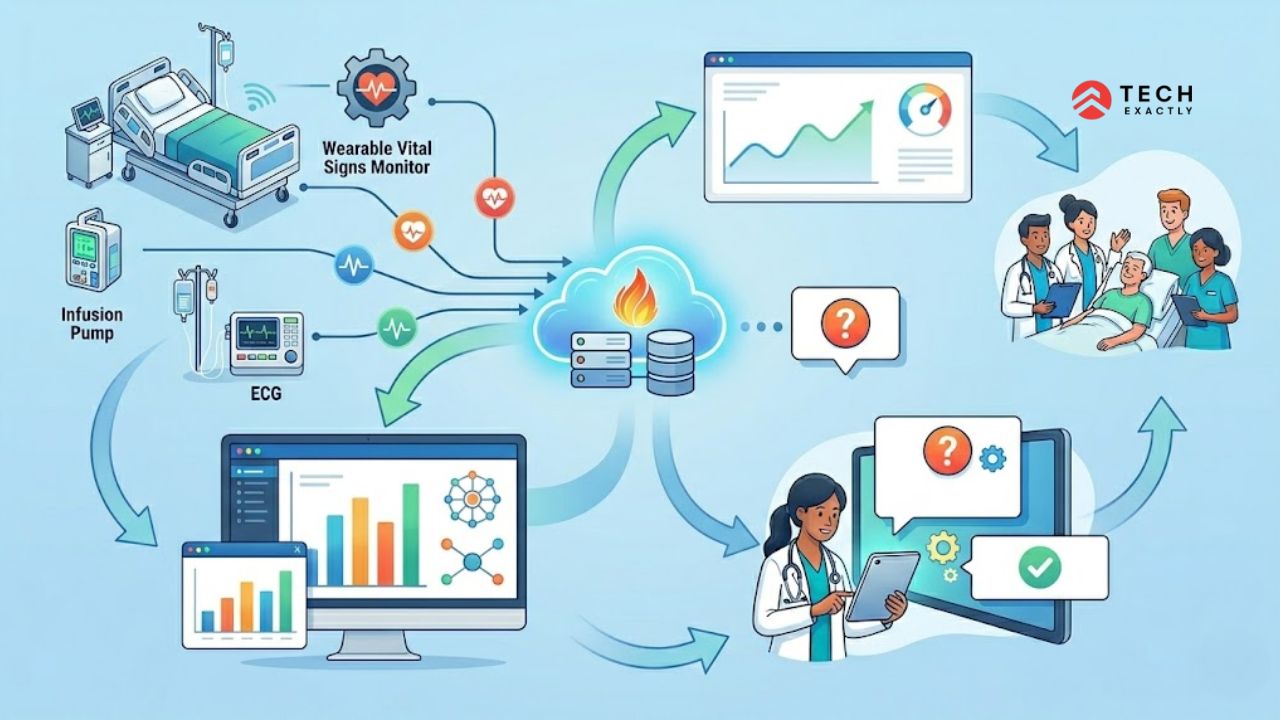
Medical device integration with EHR is the bidirectional exchange of data between a physical or software-based medical device and an electronic health record system, so that vital signs, waveforms, lab results, pump infusion data, or monitor readings flow into the patient chart without manual transcription, and orders or configuration data can flow back to the device.
Three architectural patterns dominate:
| Pattern | Data Flow | Typical Use Case |
|---|---|---|
| Unidirectional (device → EHR) | One-way ingestion of device readings into the chart | Vital signs, CGM readings, pulse oximeter data |
| Bidirectional | Device sends data; EHR sends orders, configuration, or acknowledgments | Smart infusion pumps with order-based programming, ventilators, dialysis machines |
| Gateway / Middleware | Multiple devices aggregate through middleware that then integrates with the EHR | Bedside monitor hubs, capsule technology integration, and enterprise MDI platforms |
Most modern medical device integration projects are bidirectional. Unidirectional is now the older pattern; gateway-based is common in multi-device ICU environments and in bedside medical device integration setups, where a single hub aggregates monitor, pump, and ventilator data before sending it to the EHR.
Concrete medical device integration examples you’ll recognize are having a smart infusion pump receiving order-based programming from Epic and returning infusion records; a CGM device piping readings into the patient chart in near real time; a bedside monitor hub consolidating vitals, waveforms, and alarms into a single HL7 stream; an FDA-cleared AI radiology tool reading DICOM images, producing a triage score, and posting the result back into the imaging workflow.
What Counts as “Integration” for FDA Purposes?
Most founders don’t realize this is where things get tricky. The moment your software moves, transforms, stores, or displays medical device data, the FDA asks whether you’re a Medical Device Data System (MDDS) or crossed into SaMD territory.
- MDDS is a software that transfers, stores, converts format, or displays medical device data without controlling the device or driving clinical decisions. The FDA exercises enforcement discretion on most MDDS. This means you don’t need a 510(k), but the device is still a device, and you still need an ISO 13485 / QMSR-aligned QMS if you want hospitals to buy it.
- SaMD — If your integration software interprets the data (flags sepsis risk, recommends infusion rate adjustments, or triggers alerts based on a predictive model), you’ve left MDDS and entered SaMD. That means 510(k) or De Novo, IEC 62304 safety classification, and the full submission package.
The line between MDDS and SaMD is usually drawn at the features most teams want to add, such as analytics. An integration that just moves data is MDDS. The moment it has a risk-scoring algorithm, it isn’t.
For the full classification logic, medical device software development covers SaMD vs. SiMD vs. wellness in detail.
Let's Start Your Project Today
Ready to build your Medical Device Integration with us? Reach out now – our experts are just one click away.
Medical Device Integration Standards and Protocols
No single standard covers end-to-end medical device integration. You need to use 3–5 of the following in any production build:
| Standard | Purpose | Where It Fits |
|---|---|---|
| HL7 v2.x | Text-based messaging standard | Still the workhorse for ADT, lab results, and device observations. Most hospital interface engines speak v2. |
| HL7 FHIR | RESTful, resource-based API standard | Modern integrations, app-based ecosystems, and mobile device data. Required for many new hospital contracts. |
| IEEE 11073 | Device-level semantic interoperability | Point-of-care device communication: the “device language” layer under HL7 |
| IEEE 11073 SDC | Service-oriented Device Connectivity | Newer subset for plug-and-play device interoperability in ORs and ICUs |
| DICOM | Medical imaging data | Any integration involving radiology, ultrasound, or imaging-capable devices |
| IHE Profiles | Cross-enterprise workflows (PCD, PIV, etc.) | Device domain profiles, patient identification, alert workflows |
| Continua / PCHA | Personal health devices | Consumer wearables, home monitoring gateways |
| AAMI/UL 2800 | Safety of interoperable medical systems | Emerging standard for risk management across integrated device systems |
A realistic stack for a bedside monitor-to-Epic integration in 2026 is the HL7 v2.5.1 for the core observation messages, FHIR R4 for the mobile clinician app layer, IEEE 11073 inside the device gateway, IHE Patient Care Device (PCD) profile for the workflow, and AAMI/UL 2800 risk analysis across the whole chain.
Teams that skip the IHE profiles end up inventing what IHE already specified. On the other hand, teams that skip AAMI/UL 2800 find out during hospital procurement.
HL7 v2.x vs. FHIR for Medical Device Integration: Which Should You Use?
The simple answer is both. The entire picture depends on your position in the integration process and the current capabilities of the EHR vendor.
| Factor | HL7 v2.x | FHIR |
|---|---|---|
| Current production coverage | ~90% of US hospital interface traffic | Growing fast, especially in mobile/cloud contexts |
| Epic support | Mature, pervasive | Expanding (App Orchard / Vendor Services programs) |
| Oracle Health (Cerner) support | Mature | Strong (Cerner was an early FHIR adopter) |
| Transport | MLLP over TCP, typically via the interface engine | REST over HTTPS |
| Data model | Pipe-delimited segments | JSON / XML resources |
| Best for | Core ADT, labs, orders, observations | Mobile/web apps, SMART on FHIR, CDS Hooks, modern APIs |
| Tooling | Mirth, Rhapsody, Cloverleaf | Public FHIR servers, OAuth 2.0 flows |
The 2026 pattern most mature teams use is having the FHIR for new surfaces (apps, portals, AI layers) and v2.x gateway for anything dependent on the legacy interface engine. If you’re building integration software from scratch in 2026, support both; anything else is a bet that the hospital you’re selling into has already retired v2.x, which almost none have.
SMART on FHIR and CDS Hooks for Medical Device Integration
Two FHIR-adjacent standards matter specifically for medical device integration into clinical decision-making. They are:
SMART on FHIR is the launch and authorization framework that lets third-party apps run inside an EHR (Epic, Oracle Health, and Meditech all support it). If your device needs a clinician-facing companion app that pulls FHIR resources and writes back data, SMART on FHIR is the mechanism. It utilizes OAuth 2.0 and OpenID Connect, along with a standardized launch context.
CDS Hooks is the standard for triggering real-time clinical decision support from the EHR. This occurs at specific workflow points like order entry or chart review. If your integrated device or AI layer needs to surface a recommendation inside the clinician’s existing workflow and not in a separate app, CDS Hooks is how it is done. The EHR calls out to your service; your service returns a card with advice.
For device integrations specifically, use SMART on FHIR when you need a persistent clinician-facing view of device data. Use CDS Hooks when you need to inject a decision prompt at a specific EHR workflow moment.
Medical Device Integration with Epic, Oracle Health, and Meditech: Vendor-Specific Realities
The US hospital EHR market share in 2026 is dominated by three vendors. Each has distinct integration requirements, so the idea of figuring it out customer by customer just doesn’t hold up.
| Vendor | Developer Program | SMART on FHIR | Approval Timeline | Notable Gotchas |
|---|---|---|---|---|
| Epic | App Orchard / Epic Showroom, Vendor Services | Yes (extensive) | 4–9 months for app listing; per-site activation extra | Per-customer Epic-side configuration; EpicOnFHIR resource coverage varies by version (Nova, Odyssey, etc.); real-world testing in customer sandbox required |
| Oracle Health (Cerner) | Code (developer.cerner.com) | Yes | 2–6 months | Oracle transition ongoing through 2026; API roadmap still shifting; Millennium vs. CommunityWorks differences |
| Meditech | Greenfield / Expanse Developer Program | Yes (growing) | 3–6 months | Expanse vs. Magic/Client Server product line matters; FHIR coverage still maturing for older deployments |
The pattern we see is that generic EHR integration scoping produces integrations that work in exactly one vendor’s sandbox. Production medical device integration with EHR means planning for at least two of the three, and usually all three, if you’re selling into US hospital systems broadly.
EHR integration costs have a separate breakdown covering where the overruns actually happen.
FDA Classification for Medical Device Integration Software
We briefly covered MDDS vs. SaMD above. Here’s the concrete decision tree for integration software specifically:
- Does your software control the device? (e.g., change infusion rate, trigger therapy). If so, it is likely a medical device itself; classification follows the controlled device’s class.
- Does your software interpret the data to drive clinical decisions? (e.g., sepsis alert, arrhythmia detection) → SaMD. 510(k) or De Novo path.
- Does your software transfer, store, display, or format-convert device data without the above? → MDDS. FDA enforcement discretion applies; still need QMS and risk management.
- Does your software only show dashboards to administrators, never used for clinical decisions? → May be outside FDA scope, but marketing claims and use context still matter.
Most real integrations land in #2 or #3. And the moment you add a predictive insight feature to an MDDS, you’ve pushed yourself into #2, sometimes even without realizing it.
Beyond classification, Section 524B cybersecurity requirements apply to any cyber device and integration software that connects to the internet, and handling validated software almost always qualifies. What it means is SBOM, threat model, vulnerability management plan, and a secure design plan at submission for anything going through 510(k) or De Novo. Tech Exactly’s medical device software development projects run the same Section 524B controls by default.
The Medical Device Integration Implementation Process
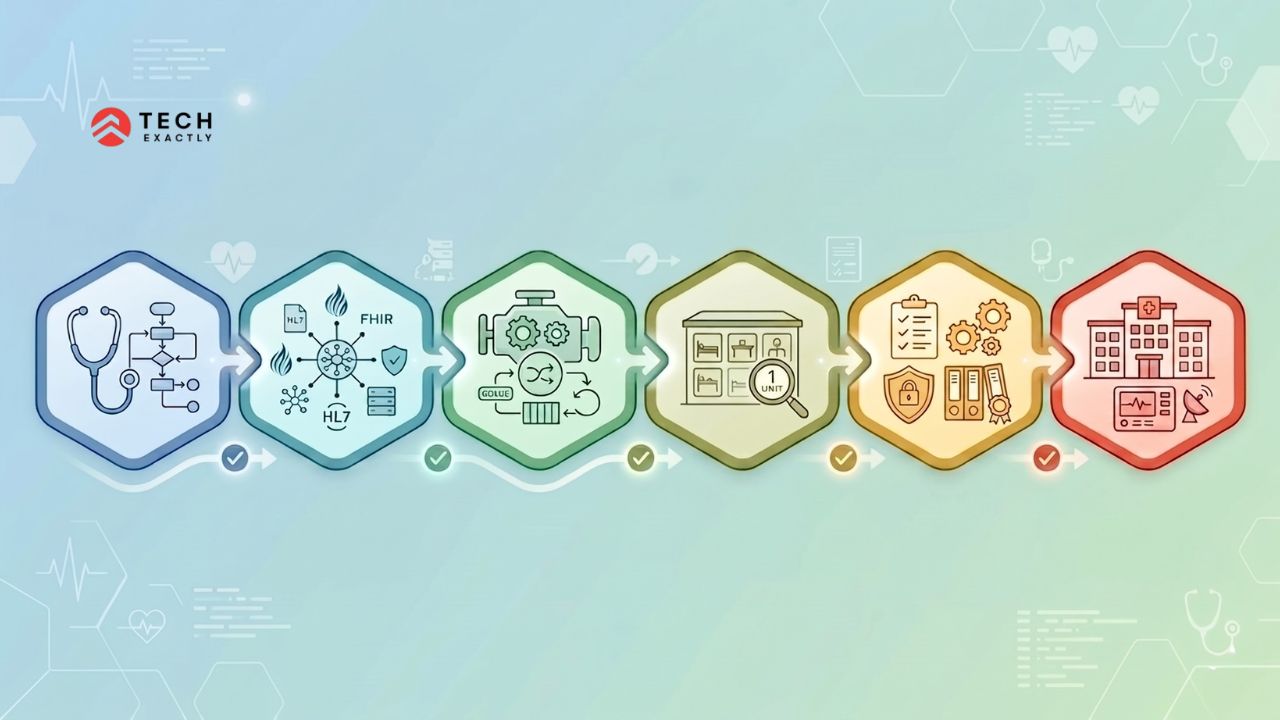
Medical device integration projects that succeed follow a disciplined multi-phase pattern. Projects that fail usually collapse Phase 1 into Phase 3.
Phase 1 — Discovery and Clinical Workflow Analysis
Map every clinical workflow the integration will touch. Which device events feed which chart locations? Who reads them? What decisions get made? What’s the fallback when integration fails?
Common miss is treating this as a technical scoping exercise. It’s a clinical-operations exercise.
Phase 2 — Architecture and Standards Selection
Pick your protocol stack (HL7/FHIR/IEEE 11073/DICOM), your middleware if needed, your security model, and your MDDS vs. SaMD classification. Produce the architecture document the FDA or hospital biomed team will audit.
Phase 3 — Interface Engine / Middleware Setup
Mirth, Rhapsody, Cloverleaf, or modern cloud-native equivalents. Message parsing, transformation, routing, retry, dead-letter queues, and monitoring.
Phase 4 — Sandbox Integration and Unit Pilot
Epic/Oracle Health/Meditech sandbox integration first. Then a live pilot on 1–2 units. Every edge case you didn’t anticipate surfaces here.
Phase 5 — Validation, Verification, and Submission (if regulated)
This phase includes IEC 62304 verification artifacts, risk analysis under ISO 14971, cybersecurity evidence under Section 524B, and IEC 62366 usability evidence. Submission is required if the classification requires it.
Phase 6 — Rollout and Post-Market Surveillance
Hospital-by-hospital activation, training, and go-live support. Post-market focus on complaint handling, vigilance reporting, interface monitoring, and MDR reporting when applicable.
A common mistake is underestimating post-market. An integration doesn’t launch and end. It runs for a decade across firmware versions, EHR upgrades, and protocol changes.
Medical Device Integration Cost and Timeline
Cost ranges for US medical device integration projects in 2026:
| Integration Scope | Pattern | Cost Range | Timeline |
|---|---|---|---|
| Single device type, one hospital, read-only | Unidirectional | $40K–$120K | 3–6 months |
| Single device, multi-hospital, read-only | Unidirectional + multi-tenant | $100K–$250K | 5–9 months |
| Single device, bidirectional, single EHR vendor | Bidirectional | $150K–$350K | 6–12 months |
| Multi-device gateway, single hospital, bidirectional | Gateway/middleware | $250K–$500K | 9–15 months |
| Multi-device, multi-hospital, multi-EHR, MDDS-classified | Enterprise MDI | $500K–$1.5M+ | 12–18 months |
| Integration software with SaMD layer (analytics, decision support) | Regulated SaMD | +$400K–$1M+ on top of above | +6–12 months |
Cost drivers most vendors underquote:
- Each additional EHR vendor needs a plan +$80K–$200K per major vendor (Epic, Oracle Health, Meditech)
- Per-hospital activation costs around $15K–$50K per site for configuration, validation, and go-live support
- Interface engine licensing requires Mirth Commercial, Rhapsody, and Cloverleaf all have per-interface pricing
- Cybersecurity evidence includes pen testing, SBOM tooling, threat modeling documentation
- Regulatory submission prep (if SaMD) costs around $50K–$250K
- Clinical validation and usability studies cost around $30K–$150K
- Ongoing maintenance needs to have a budget of 15–25% of the initial build annually for protocol updates, EHR upgrades, and firmware changes
For context, the healthcare app development cost breakdown shows how these ranges compare to unregulated builds.
Let's Start Your Project Today
Ready to build your Medical Device Integration with us? Reach out now – our experts are just one click away.
Team Composition for Medical Device Integration Projects
Integration projects need different staffing than generic healthcare app builds. The roles that matter:
| Role | Owns |
|---|---|
| Integration Architect | Standards selection, protocol mapping, middleware strategy, end-to-end flow |
| HL7/FHIR Interface Engineer | Message transformation, interface engine configuration, routing logic |
| Clinical Informaticist | Workflow mapping, clinical validation, data mapping to chart locations |
| Biomedical Engineer / Device SME | Device-side protocol, IEEE 11073, physical connectivity |
| Cybersecurity Engineer | Threat modeling, SBOM, pen testing, Section 524B evidence |
| Regulatory Affairs (for SaMD path) | MDDS vs. SaMD classification, submission management |
| QA/Verification Engineer | Test planning, traceability, verification, evidence |
| DevOps / SRE | Interface engine operations, monitoring, and alert pipelines |
| Project Lead with hospital deployment experience | Site-by-site go-live, biomed coordination, EHR vendor management |
Startups and scale-ups rarely staff all nine. The essential team for a first integration: Integration Architect, HL7/FHIR engineer, Clinical Informaticist, DevOps, and a part-time Regulatory Affairs contact. Everything else can be contracted at milestone gates.
Common Failure Modes in Medical Device Integration Projects
The integrations that fail in 2026 fail for predictable reasons. The top five are:
- Scoping too many device types in one phase. Each device family (infusion, monitoring, imaging, ventilator) has its own complexities. It’s better to ship one, stabilize it, and then expand from there.
- Skipping IHE profiles. Teams write workflows IHE already specified; hospital procurement then asks for IHE alignment, and you retrofit.
- Treating cybersecurity as a submission task. Under Section 524B, it’s an architecture task. Retrofitting SBOM, threat models, and patch pipelines late costs around 3–6 months.
Ignoring workflow fallback. When the integration is down, what happens? Most clinical workflows need a manual-entry fallback; teams that forget this get uninstalled. - No MDDS governance. Treating the software as just an integration instead of as a medical device data system with change control, version management, and post-market obligations.
Choosing Medical Device Integration Companies and Vendors
If you’re evaluating medical device integration companies or being evaluated as one, below are some of the screening questions that separate real operators from resellers:
- Can you show redacted architecture diagrams from integrations you’ve deployed?
- Which EHR vendors have you completed sandbox and production integrations with? How many live hospital sites?
- Do you hold HITRUST or SOC 2 for the integration platform?
- What’s your MDDS classification posture? Have you shipped MDDS-classified software before?
- What’s your Section 524B submission experience, or partner network?
- What’s your post-market surveillance pipeline, complaint handling, MDR reporting, and interface monitoring?
- What does your on-call and patch cadence look like?
A medical device integration vendor that answers these concretely is a different operation from one that shows you case studies and moves on. Our IEC 62304-compliant app case study walks through one such build — classification decision, interface engine setup, and Section 524B prep.
How Tech Exactly Approaches Medical Device Integration with EHR
We have worked on device integrations with EHR systems across the US and UK, where we navigated both HIPAA and UKCA expectations. We decide classification early (MDDS vs SaMD), not just as a retrofit. We support both HL7 v2.x and FHIR from the beginning. In addition to this, we align with IEEE 11073 and IHE profiles and build cybersecurity evidence into the architecture, not just add it during submission.
If you’re scoping a medical device integration and want a read on the classification question, the EHR vendor roadmap, or the realistic timeline, we’ll take that conversation. No pitch, just a second opinion before you commit.
FAQs on Medical Device Integration with EHR
It's the bidirectional exchange of data between a medical device and an electronic health record system. Hence, device readings flow into the chart automatically and orders or configurations can flow back to the device. Most modern integrations use HL7 v2.x, FHIR, or both, with IEEE 11073 at the device layer.
Yes, it can be. If it only transfers, stores, or displays device data, it's typically a Medical Device Data System (MDDS) under FDA enforcement discretion. If it interprets data to drive clinical decisions, it crosses into SaMD and requires 510(k) or De Novo submission.
If it is a Single device, for a single hospital and read-only, it takes 3–6 months. If it is a multi-device, for a multi-hospital, multi-EHR with MDDS classification, it takes 12–18 months. If you add a SaMD analytics layer, it adds 6–12 months on top.
In 2026, you will almost always need to support both. v2.x still dominates production interface traffic; FHIR is where modern EHR vendor programs and mobile/cloud surfaces are moving. Supporting only one limits your deployable market.
Each one has a distinct developer program, sandbox model, and approval timeline. Epic App Orchard/Vendor Services runs 4–9 months for listing. Oracle Health (via developer.cerner.com) runs 2–6 months. Meditech's Greenfield/Expanse program runs 3–6 months. Generic EHR integration planning fails at these gates.
Usually, yes. If the integration software meets the cyber device test (connects to the internet, has sponsor-validated software, and has exploitable characteristics), Section 524B cybersecurity requirements apply at submission, including an SBOM, a threat model, a vulnerability management plan, and secure design evidence.

Manas Das, Mobile App Architect at Tech Exactly, has over 9 years of experience leading teams in iOS, Android, and cross-platform development. He specialises in scalable app architecture and GenAI-driven mobile innovation.