


How to Build a Loan Lending App: Features, Compliance, and What It Costs

Key Takeaways
- Loan lending app development costs $80,000–$200,000, depending on loan types, compliance scope, and automation level.
- Compliance isn’t one checkbox; you need state lending licenses, KYC/AML, Truth in Lending Act (TILA), and fair lending laws before processing a single application.
- The features that matter most aren’t flashy: Credit scoring integration, automated underwriting, and repayment tracking drive the business. That’s what drives the business, not just a pretty dashboard.
- Build for the loan lifecycle, not just origination: Most apps perfect application intake but forget collections, reporting, and servicing.
- An MVP with one loan product can launch in 4–5 months for under $100,000. Adding more loan types scales cost linearly.
A lending app without proper compliance is just a lawsuit waiting to happen.
This might sound blunt, but it is real. Without compliance, a lending app won’t survive. We have seen founders build solid products, get early traction, and then run into licensing issues across states. Everything works technically, the app runs smoothly, but the business doesn’t.
Lending is one of the most regulated corners of fintech. It’s also one of the most profitable businesses, if you get the foundation right. At Tech Exactly, a fintech app development company, we re-engineered a loan lifecycle management platform for an NBFC that was scaling across multiple cities. The existing product had speed issues, compliance gaps, and couldn’t handle the growth. We rebuilt it end-to-end. eKYC, bank integrations, regulatory APIs, the full stack.
That experience shapes everything in this guide.
What a Loan Lending App Actually Needs to Do
Most founders start with a list of features. That’s the wrong starting point. Instead, start with the loan lifecycle. Here, every feature should serve a stage in that cycle. The Loan Lifecycle Your App Must Support
Application → Verification → Underwriting → Approval → Disbursement → Repayment → Collections → Reporting
If you skip any stage, you will be back to rebuilding the whole thing within six months. We’ve seen apps that handle origination beautifully but have no system for tracking late payments or generating regulatory reports. Thats not an app. That’s just a demo.

Core Features for Loan Lending App Development
1. User Onboarding and KYC Verification
You have about 90 seconds to win a borrower over. That window decides whether they finish the application or leave. You need:
- Document upload (ID, proof of income, address verification)
- eKYC integration: Automated identity verification through services like Jumio, Onfido, or Aadhaar-based eKYC for Indian markets
- Liveness detection: This prevents identity fraud by confirming the applicant is a real person, not a photo
- CKYC lookup (for Indian lenders): Central KYC Registry check to pull existing borrower records
When we rebuilt the NBFC platform, integrating eKYC and CKYC APIs helped to reduce manual verification time from 48 hours to under 10 minutes. That’s the difference between a borrower completing their application and giving up midway.
💡 Expert Tip: Don’t build your own KYC verification system. The regulatory requirements change constantly. Use a third-party provider and budget $1–$3 per verification. At 5,000 applications per month, that’s $5,000–$15,000.This is far cheaper than building and maintaining in-house.
2. Credit Scoring and Risk Assessment
Your lending app needs to decide who gets approved and at what rate. There are two approaches:
Bureau-based scoring: Pull credit reports from Experian, TransUnion, or Equifax (US) or CIBIL, CRIF (India). Costs $0.50–$3.00 per pull, depending on the bureau and data depth.
Alternative data scoring: For thin-file borrowers (students, gig workers, immigrants), traditional credit scores don’t work. Some lenders use bank transaction history, rent payment records, or even education data to assess risk. This requires more development work but opens up a larger borrower pool.
Most lending products start with bureau-based scoring and evolve from there. The integration itself is manageable, but building solid decisioning logic that converts scores into offers is where things get complex.
3. Automated Underwriting Engine
This is where your lending app either scales or doesn’t.
Manual underwriting means a human reviews every application. That works for 50 applications a day. At 500, you’re hiring a team. At 5,000, you’re drowning. Thus, it’s not practically scalable.
An automated underwriting engine takes the credit data, applies your lending criteria, and produces a decision. This can be approved, declined, or referred for manual review. You get to decide on:
- Minimum credit score thresholds
- Debt-to-income ratio limits
- Loan amount caps by borrower segment
- Geographic restrictions
- Fraud risk flags
Building this engine is typically 20–25% of your total development budget. It’s also the feature that determines whether your lending business is profitable or not.
4. Loan Management and Servicing Dashboard
Once a loan is disbursed, the work isn’t over. You need:
- Repayment tracking: Automated EMI schedules, payment reminders, and receipt generation
- eNACH / ACH integration: Automated recurring debits from borrower bank accounts
- Prepayment and foreclosure handling: Recalculating interest, processing early closures
- Late payment management: Grace periods, penalty calculation, escalation workflows
- Borrower communication : SMS, email, and push notification triggers for payment reminders, overdue alerts, and statements
Startups figuring out app development for the first time, especially skip this part in the MVP. Do not make this mistake. A lending app without loan servicing is just like an e-commerce store without order tracking. It technically works well, but is practically useless.
5. Admin Panel and Reporting
Your operations team needs clear visibility. Lenders and regulators need reliable reporting. The admin panel should include:
- Portfolio dashboard: Total disbursements, outstanding principal, NPA (non-performing asset) rates
- Borrower-level views: Complete loan history, communication logs, payment records
- Regulatory reports: Formatted for submission to relevant authorities (RBI for India, state regulators for the US)
- Audit trails: Every decision, every change, every access logged with timestamps
When we worked on re-engineering the NBFC platform, reporting was one of the biggest pain points. The existing system couldn’t bring together data across loan products. So we rebuilt the reporting layer using updated data sources and added the data points finance teams actually needed.
6. Payment Gateway and Disbursement
Money needs to flow both ways, i.e., from borrowers (repayments) and to borrowers (disbursements). You need:
- Bank account verification (penny drop or instant verification APIs)
- Payment gateway integration for manual repayments
- eNACH / ACH mandates for automatic debits
- NEFT/IMPS/UPI integration for instant disbursements (Indian market)
- ACH / wire transfer for US market disbursements
The payment layer is where security becomes critical. We implemented IP whitelisting, data encryption, and multi-layer authentication on the NBFC platform. This is because a lending app that leaks bank details doesn’t get a second chance.
Let's Start Your Project Today
Ready to build your Loan Lending app with us? Reach out now – our experts are just one click away.
Compliance for Loan Lending Apps: What You Can't Skip
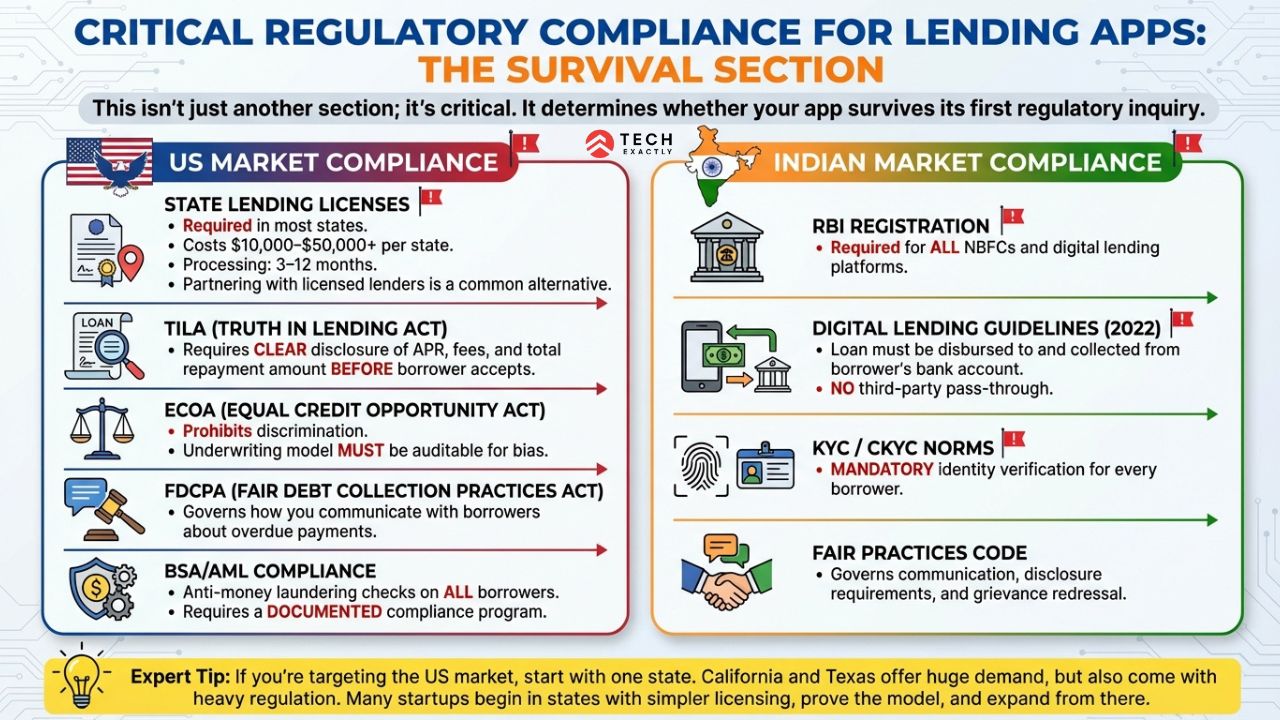
This isn’t just another section; it’s critical. It’s the section that determines whether your app survives its first regulatory inquiry.
US Market Compliance
- State lending licenses: Required in most states. Costs $10,000–$50,000+ per state, and processing takes 3–12 months. Some fintech startups partner with licensed lenders to avoid this.
- Truth in Lending Act (TILA): Requires clear disclosure of APR, fees, and total repayment amount before the borrower accepts.
- Equal Credit Opportunity Act (ECOA): Prohibits discrimination in lending. Your underwriting model needs to be auditable for bias.
- Fair Debt Collection Practices Act (FDCPA): Governs how you communicate with borrowers about overdue payments.
- BSA/AML compliance: Anti-money laundering checks on all borrowers. Requires a documented compliance program.
UK Market Compliance
The UK is one of the most mature lending markets globally. However, FCA authorization is notoriously slow and documentation-heavy.
- FCA authorization: Any entity offering consumer credit must hold Full Permission or Limited Permission from the Financial Conduct Authority. Full Permission covers unsecured personal loans, credit cards, motor finance, and retail finance. Limited Permission applies to narrower activities like interest-free credit.
- Consumer Credit Act 1974: Governs disclosure requirements, affordability assessments, and post-contract borrower communications. Major reform is underway — the government launched Phase 1 consultation in May 2025 to shift from prescriptive statutory rules to a principles-based framework. Expect changes to take effect in late 2026 or 2027.
- BNPL regulation (effective July 2026): If your lending app offers deferred payment or buy-now-pay-later credit, FCA authorization becomes mandatory from July 15, 2026. This is new, as previously BNPL operated in a regulatory grey area.
- Affordability assessments: You must demonstrate robust creditworthiness and affordability checks before disbursing any loan. The FCA scrutinizes this heavily.
- AML/KYC: Standard anti-money laundering and identity verification requirements apply, similar to US BSA/AML but governed under the Money Laundering Regulations 2017.
Middle East Market Compliance (UAE & Saudi Arabia)
The Middle East lending market is growing fast, especially under Saudi Arabia’s Vision 2030 fintech push. But most Western founders are not well-informed about Sharia compliance.
UAE:
- CBUAE license: The Central Bank of the UAE regulates all lending activity at the federal level. A 2025 federal decree expanded the scope to capture financial activities “regardless of the medium, technology or form employed,” meaning app-based lending is explicitly covered.
- DFSA and ADGM sandboxes: If you’re not ready for full licensing, the Dubai Financial Services Authority (DFSA) Innovation Testing Licence or the Abu Dhabi Global Markets (ADGM) RegLab will let you test lending products in a controlled environment before committing to full compliance.
- Sharia compliance: Required for Islamic finance products. You’ll need an independent Sharia oversight board or advisory aligned with AAOIFI standards, full reserve backing, and par-value redemption guarantees.
Saudi Arabia:
- SAMA license: The Saudi Arabian Monetary Authority requires a Finance Company License (minimum paid-up capital of SAR 10 million / ~$2.67 million) or a Consumer Microfinance License for smaller-scale operations.
- Sharia compliance is mandatory: Not optional. All lending activity must align with Islamic principles. Common structures include Murabaha (cost-plus-profit) and Tawarruq (Islamic credit). Your app’s loan product architecture needs to reflect these structures, not just surface-level labeling.
- Microfinance caps: Consumer microfinance loans are capped at SAR 5,000 per borrower (SAR 25,000 for tech-enabled platforms) with a maximum of 12 installments.
- SAMA FinTech Sandbox: Saudi Arabia is actively encouraging fintech entry. 25 fintech companies have been approved through the sandbox, including peer-to-peer lending platforms. This is a viable path for startups wanting to test before scaling.
Indian Market Compliance
- RBI registration: Required for all NBFCs and digital lending platforms.
- Digital Lending Guidelines (2022): The loan must be disbursed to and collected from the borrower’s bank account. No third-party pass-through.
- KYC / CKYC norms: Mandatory identity verification for every borrower.
- Fair Practices Code: Governs communication with borrowers, disclosure requirements, and grievance redressal.
💡 Expert Tip: If you’re targeting the US market, start with one state. California and Texas offer huge demand, but they also come with heavy regulation. Many startups begin in states with simpler licensing, prove the model, and expand from there.
Loan Lending App Development Cost: A Real Breakdown
| Component | Cost Range | Notes |
|---|---|---|
| UI/UX design | $8,000–$20,000 | Borrower app + admin panel |
| Frontend development | $15,000–$40,000 | Cross-platform (React Native/Flutter) |
| Backend + APIs | $25,000–$60,000 | Underwriting engine, loan servicing, payment integration |
| KYC/AML integration | $5,000–$15,000 | Third-party provider setup |
| Credit bureau integration | $3,000–$10,000 | Experian, TransUnion, CIBIL, etc. |
| Payment/disbursement layer | $8,000–$20,000 | eNACH, ACH, payment gateway |
| Admin panel + reporting | $10,000–$25,000 | Dashboard, regulatory reports, audit logs |
| Testing + security audit | $8,000–$20,000 | Penetration testing, compliance validation |
| Total MVP | $82,000–$210,000 | Single loan product, one market |
- Multiple loan products (personal + education + business) add $30,000–$60,000 per product
- Multi-state or multi-country compliance add $20,000–$50,000 per market
- AI-powered credit scoring adds $20,000–$40,000 for ML model development. Finance leaders are already using AI this way.
- White-label lending platform add $40,000–$80,000 for multi-tenant architecture
Ongoing Costs After Launch
- Credit bureau API fees: $0.50–$3.00 per pull
- KYC verification fees: $1–$3 per borrower
- Cloud hosting: $1,500–$6,000/month
- Compliance and audit: $15,000–$40,000/year
- Maintenance: 15–20% of initial build cost annually
How to Build a Loan Lending App: Step-by-Step

Step 1: Define Your Lending Model
Before you write a single line of code, start by answering these:
- What type of loans? (Personal, business, education, payday, BNPL)
- What markets? (Determines compliance requirements)
- What’s your funding source? (Balance sheet lending vs. marketplace model)
- What’s your target borrower? (Prime, near-prime, subprime since each needs different underwriting)
Step 2: Map Compliance First
Identify every license, registration, and regulatory requirement for your markets. Start your applications early, as they take months. Build your tech stack around compliance. It’s just one of the many ways finance teams are modernizing without disruption.
Step 3: Build the Core Loop First
Your MVP should handle one complete loan lifecycle for one loan product:
Apply → Verify → Score → Approve → Disburse → Collect → Report
It’s tempting to keep adding features, but don’t. A lending app that does one loan type really well beats the one that does five loan types with bugs in the collection module.
Step 4: Integrate Third-Party Services
Don’t build what you can buy:
- KYC → Jumio, Onfido, or DigiLocker-based eKYC
- Credit scoring → Bureau APIs + your decisioning rules
- Payments → Razorpay, Stripe, or direct bank integrations
- Communication → Twilio for SMS, SendGrid for email
Step 5: Test as a Regulator Would
Beyond functional testing, you need:
- Security penetration testing: Mandatory for any app handling financial data
- Compliance validation: Does every disclosure appear at the right step? Are APR calculations accurate to the decimal?
- Load testing: What happens when 1,000 borrowers apply simultaneously on a deadline day?
- Audit trail verification: Can you reconstruct every decision for any loan if a regulator asks?
Ready to Build Your Lending App?
The lending market is huge and only getting bigger. However,t when it comes to compliance and security, there’s no room for mistakes. The founders who win aren’t just moving fast; they’re getting it right from day one.
If you’re building a lending app and want a partner who’s already done this before, scaling loan platforms with eKYC, bank integrations, and compliance built in, let’s talk. We’ll scope it honestly and tell you exactly what it’ll take.
Let's Start Your Project Today
Ready to build your Loan Lending app with us? Reach out now – our experts are just one click away.
FAQs on Loan Lending app
An MVP for a single loan product costs $80,000–$210,000. Each time you expand, whether it’s a new loan type, a new market, or AI-based scoring, you are looking at an additional $20,000 to $60,000. Ongoing costs (APIs, hosting, compliance) run $30,000–$60,000/year.
Core features like borrower onboarding with KYC, credit scoring integration, automated underwriting, loan servicing dashboard, repayment tracking with eNACH/ACH, admin panel with regulatory reporting, and payment/disbursement layer.
A focused MVP takes 4–6 months. A full-featured lending platform with multiple loan products and multi-market compliance takes 8–12 months. The number of third-party integrations and compliance requirements are key driver of the overall timeline.
State lending licenses (varies by state), Truth in Lending Act (TILA) disclosures, Equal Credit Opportunity Act (ECOA) compliance, Fair Debt Collection Practices Act (FDCPA) adherence, and BSA/AML anti-money laundering checks. Some startups partner with licensed lenders to simplify this.
White-label platforms get you to market faster but limit customization, especially around underwriting logic and borrower experience. Building from scratch costs more upfront but gives you full control over the product and your competitive differentiators.

Pallabi Mahanta, Senior Content Writer at Tech Exactly, has over 5 years of experience in crafting marketing content strategies across FinTech, MedTech, and emerging technologies. She bridges complex ideas with clear, impactful storytelling.