


Voice AI Integration Cost in 2026: The Budget Guide Nobody Gives You

Key Takeaways
- Voice AI integration costs $15K–$120K depending on what you’re connecting it to: CRM, IVR, healthcare, ecommerce, or loan servicing
- The advertised per-minute rate ($0.05–$0.09) is misleading. Real all-in costs run $0.13–$0.31/min when you stack STT + LLM + TTS + telephony
- HIPAA and FDCPA compliance can add 20–40% to your build cost — but skipping it is a six-figure mistake
- Plan for $2,000–$8,000/month in ongoing costs (platform fees, LLM usage, telephony, maintenance) that scale with call volume
- For most businesses, the “platform + custom integration” path ($15K–$120K) beats both SaaS tools (too rigid) and building from scratch ($80K–$200K+)
Almost every time you will get per minute rate quotation from every AI vendor. Nobody will tell you what it actually costs to connect that agent to your CRM, survive a HIPAA audit, or handle cases that make your callers hang up.
This guide will help you navigate through all these requirements.
Whenever you search for the voice AI integration cost over different platforms, you usually get two kinds of answers. First, it gives you a per-minute quote without any information on the total spend. Second, which gives a range-based quote like $10K-$300K, which doesn’t give a holistic view; it’s similar to saying a car costs somewhere between a Civic and a Lamborghini.
The per-minute rate is the least important number in your budget. What actually determines your cost is what you’re connecting voice AI to, what compliance standards apply, and how complex the conversations need to be.
This guide helps you understand the process by comparing use cases. This is because a CRM integration and a HIPAA-compliant EHR integration are not the same voice AI integration projects, and they shouldn’t carry the same price tag.
Why the Per-Minute Rate Doesn’t Reflect Your Voice AI Integration Cost
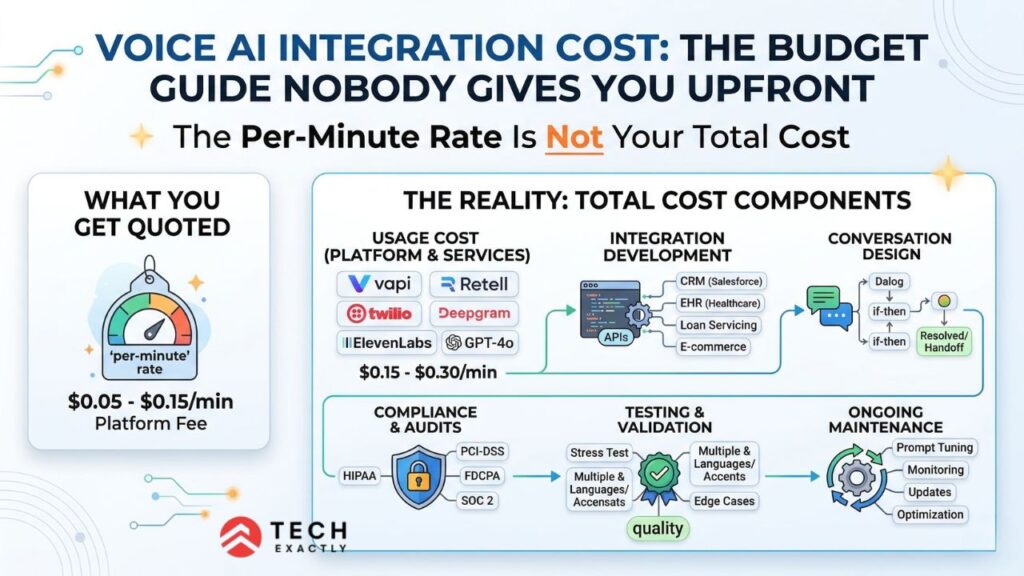
Most voice AI platforms — Vapi, Retell AI, Synthflow, Bland AI — quote something between $0.05 and $0.15 per minute. Some advertise as low as $0.01/min. Those numbers are real. They’re also just the platform fee.
Stack on Twilio for telephony, Deepgram or Whisper for speech-to-text, ElevenLabs for text-to-speech, and GPT or Claude for reasoning — and your actual per-minute cost lands between $0.15 and $0.30 before a single dollar goes toward development.
That’s the usage cost. Here’s what it doesn’t cover:
- Integration development — connecting the voice agent to your CRM, EHR, loan servicing platform, or ecommerce backend
- Conversation design — intent handling, fallback logic, escalation paths, and the branching that separates a functional agent from a frustrating one
- Compliance — HIPAA architecture, PCI-DSS controls, FDCPA/TCPA guardrails, or SOC 2 certification
- Testing — load testing, accent handling, edge cases, and penetration testing
- Ongoing maintenance — prompt tuning, model updates, monitoring, and optimization post-launch
💡 Expert Tip: When evaluating costs, ask for the total cost per resolved conversation — not the platform’s per-minute rate. A $0.05/min platform that needs $80K in custom work isn’t cheaper than a $0.12/min solution that integrates with your CRM out of the box.
Voice AI Integration Cost by Use Case
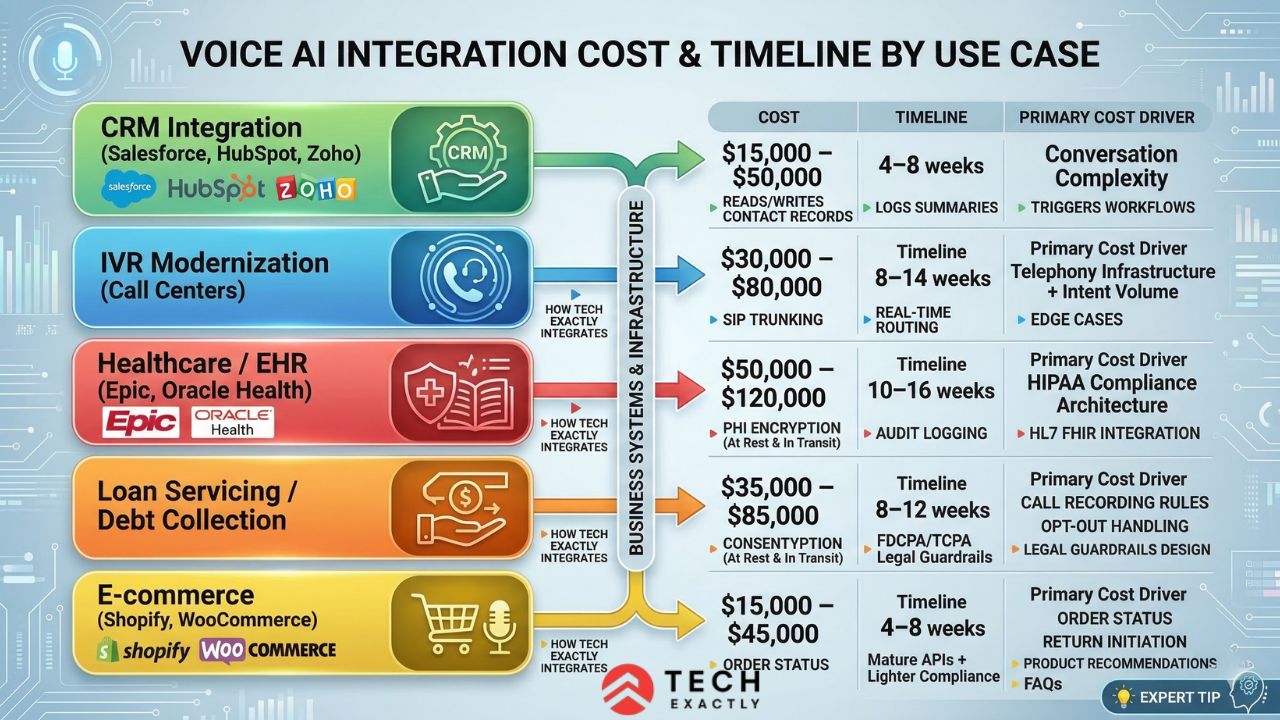
Here’s the quick view before we break each one down:
| Use Case | Cost Range | Timeline | Primary Cost Driver |
|---|---|---|---|
| CRM Integration (Salesforce, HubSpot, Zoho) | $15,000 – $50,000 | 4–8 weeks | Conversation complexity |
| IVR Modernization (Call Centers) | $30,000 – $80,000 | 8–14 weeks | Telephony infrastructure + intent volume |
| Healthcare / EHR (Epic, Oracle Health) | $50,000 – $120,000 | 10–16 weeks | HIPAA compliance architecture |
| Loan Servicing/Debt Collection | $35,000 – $85,000 | 8–12 weeks | FDCPA/TCPA legal guardrails |
| E-commerce (Shopify, WooCommerce) | $15,000 – $45,000 | 4–8 weeks | Simplest — mature APIs, lighter compliance |
Voice AI Integration CRM Integration — $15,000 to $50,000
Connecting voice AI to Salesforce, HubSpot, or Zoho is the most straightforward integration on this list. These platforms have mature REST APIs. The agent reads contact records mid-call, logs summaries after, and triggers workflows based on conversation outcomes.
The cost driver isn’t the API connection — it’s conversation design. How many intents does the agent handle? Does it pull real-time data during the call (account status, last interaction, open tickets)? Does it write back to the CRM afterward? Each layer adds development hours.
A basic setup with 5–10 intents, read/write CRM access, and standard testing runs $15K–$30K. Add complex branching, multi-turn memory, and custom reporting dashboards, and you’re closer to $50K.
▶️ How Tech Exactly integrates AI with existing business systems
Voice AI Integration IVR Modernization — $30,000 to $80,000
This is where the ROI case is strongest. A human call center agent costs $25–$50/hour in the US. A voice AI agent handling the same calls costs a fraction of that per conversation.
But IVR modernization isn’t a plug-and-play job. You’re dealing with telephony infrastructure (SIP trunking, Amazon Connect, or Twilio), real-time call routing, escalation logic for agent handoff, and every edge case your legacy IVR “solved” with 17 layers of menu trees.
The bulk of the cost sits in voice agent development — 15 to 30 intents for a typical call center — plus the telephony integration and load testing before you route real callers through it.
⚠️ Reality Check: Don’t rip out your IVR overnight. Start by offloading one or two high-volume, low-complexity call types — “what’s my balance?” or “where’s my order?” — to the AI agent. Keep humans on everything else. Then expand based on data.
▶️ How intelligent voice assistants give businesses an edge
Voice AI Integration With Healthcare Systems & EHR Systems — $50,000 to $120,000
Healthcare is the most expensive vertical because compliance isn’t a feature — it’s architecturally load-bearing. Every data flow involving PHI needs encryption at rest and in transit, every access event needs audit logging, and every third-party service in the stack — the voice AI platform, the LLM provider, the STT/TTS engine, the telephony layer, the cloud host — needs a BAA (Business Associate Agreement).
EHR integration via HL7 FHIR (Epic, Oracle Health, athenahealth) adds another layer of cost and complexity. These aren’t quick REST calls — FHIR implementations vary by health system, require credentialing, and come with their own testing cycles.
A typical voice AI integration covers appointment scheduling, patient reminders, triage routing, and basic member FAQs. The HIPAA compliance architecture and risk assessment alone account for $10K–$25K of the total.
▶️ How we built a HIPAA-compliant healthcare platform
💡 Expert Tip: If you’re building voice AI for health insurance member services, start with non-PHI interactions — plan information, provider directories, general FAQs. Layer in authenticated conversations (claims status, prior auth) in phase two. This cuts your compliance cost in half for the MVP.
Voice AI Integration With Loan Servicing and Debt Collection — $35,000 to $85,000
Debt collection voice AI is a compliance minefield. The FDCPA restricts what you can say, when you can call, and how you identify yourself. TCPA adds consent requirements for automated calls. State laws pile on top. An agent that violates any of these doesn’t just lose the call — it exposes you to per-violation fines.
The actual API integration with a loan servicing platform is often simpler than CRM or EHR work. The cost here is driven by legal guardrails — consent management, call recording rules, opt-out handling, and the conversation design that keeps the agent within FDCPA boundaries while still being effective.
▶️ How Tech Exactly transformed loan lifecycle operations
Voice AI Integration for E-commerce — $15,000 to $45,000
The lowest-cost integration on this list. Shopify, WooCommerce, and Magento have mature APIs, compliance requirements are lighter (PCI-DSS for payment handling, but most platforms abstract that), and conversation flows are relatively simple. Order status, return initiation, product recommendations, and FAQs cover the vast majority of call volume.
The revenue play is what makes this interesting — voice-enabled shopping reduces friction at the exact moment a customer is ready to buy, but has one question standing in the way.
Let's Start Your Project Today
Ready to add Voice AI integration to your app or service with us? Reach out now – our experts are just one click away.
Build vs. Buy vs. Integrate
This decision determines whether your project costs $15K or $150K.
| Approach | Cost | Best For | The Catch |
|---|---|---|---|
| Buy SaaS (Goodcall, Air AI, CloudTalk) | $350–$2,000/mo | Standardized use cases, no deep integrations | You outgrow it the moment you need real-time CRM access or compliance |
| Build from scratch (WebRTC + open-source STT/TTS + LLM orchestration) | $80K–$200K+ | Truly unique requirements, proprietary data, in-house ML team | 6–12 months of R&D before you handle a single real call |
| Platform + custom integration (Vapi, Retell, Voiceflow + custom dev) | $15K–$120K | Most businesses | You need a mobile app development partner who knows both the platform and your systems |
For most businesses, the third option is the right move. You get a battle-tested voice engine without rebuilding the stack from zero, and your AI development team focuses on connecting it to your actual business logic.
💡 Expert Tip: Even if you buy a SaaS tool, you’ll almost certainly need custom development to connect it to your CRM, EHR, or internal systems. Budget $5K–$15K for integration work on top of the subscription. “No-code” rarely means “no-development.”
Ongoing Voice AI Integration Costs Nobody Budgets For
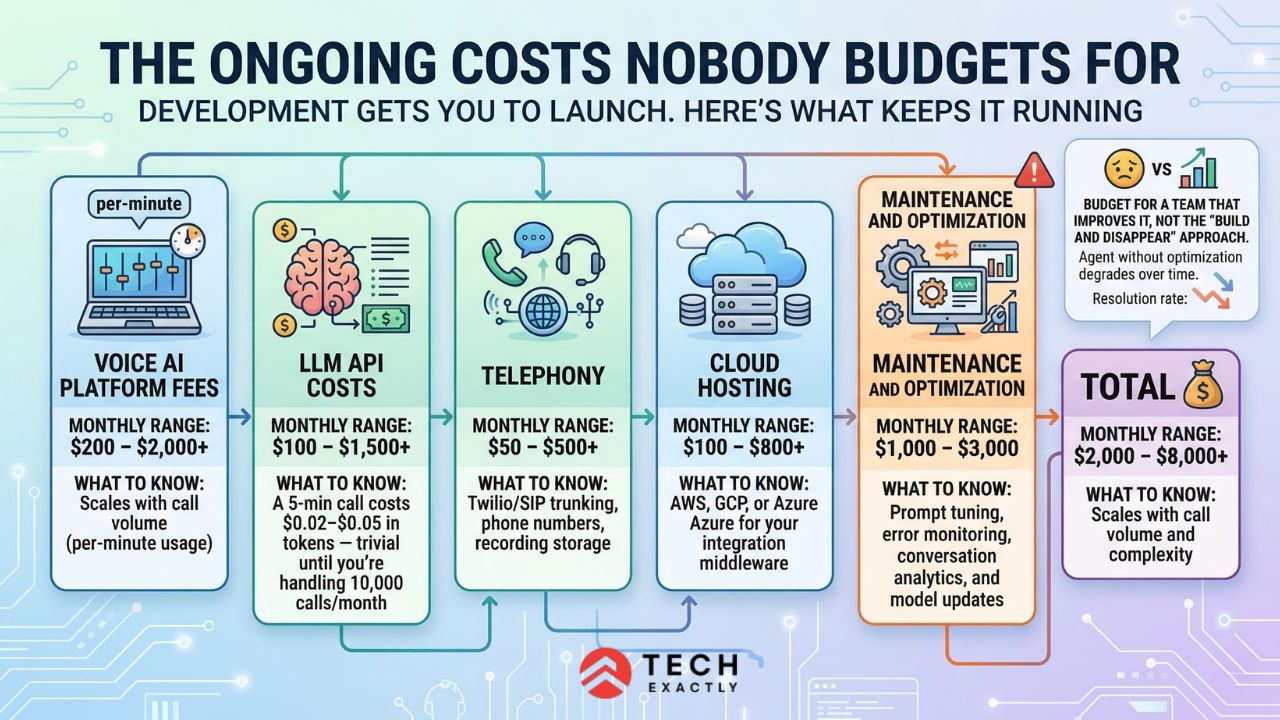
Development gets you to launch. Here’s what keeps it running:
| Ongoing Cost | Monthly Range | What to Know |
|---|---|---|
| Voice AI platform fees | $200 – $2,000+ | Scales with call volume (per-minute usage) |
| LLM API costs | $100 – $1,500+ | A 5-min call costs $0.02–$0.05 in tokens — trivial until you’re handling 10,000 calls/month |
| Telephony | $50 – $500+ | Twilio/SIP trunking, phone numbers, recording storage |
| Cloud hosting | $100 – $800+ | AWS, GCP, or Azure for your integration middleware |
| Maintenance and optimization | $1,000 – $3,000 | Prompt tuning, error monitoring, conversation analytics, and model updates |
| Total | $2,000 – $8,000+ | Scales with call volume and complexity |
The maintenance line is the one most teams skip — and regret. A voice AI agent without ongoing optimization degrades over time. Prompts drift, edge cases accumulate, and call resolution rates drop. Budget for a team that watches the system and improves it, not the “build and disappear” approach.
What Drives Voice AI Integration Cost Up and Where to Cut
The biggest cost multiplier is legacy system architecture. If your CRM or EHR has clean, documented APIs, integration is straightforward. If it runs on SOAP endpoints from 2009, FTP file drops, or undocumented stored procedures, your team has to build middleware just to communicate with your own systems. That alone can double the project cost.
Other drivers: number of intents (5 simple flows vs. 30+ with branching logic), compliance depth (basic encryption vs. full HIPAA/PCI-DSS/SOC 2), language support (English-only vs. multilingual with accent training), and custom voice (off-the-shelf TTS vs. brand-specific voice cloning).
Where to cut? Start with a proof of concept: $5K to $10K for a working prototype on one use case. It tells you whether voice AI can actually handle your specific workflows before you commit $50K+ to a full build. We run discovery and POC engagements specifically for this reason because the cheapest mistake is the one you catch before you scale it.
Ready to Scope Your Voice AI Integration?
Tech Exactly offers voice AI integration services for CRM, IVR, healthcare, fintech, and ecommerce systems. We work across platforms — Vapi, Retell AI, Voiceflow, Amazon Lex, Dialogflow — and every engagement starts with a discovery phase, so you know exactly what you’re paying for before you commit.
Let's Start Your Project Today
Ready to add Voice AI integration to your app or service with us? Reach out now – our experts are just one click away.
FAQs
A basic CRM integration with 5–10 intents, call logging, and simple FAQ handling runs $15,000–$30,000, including conversation design, API work, testing, and deployment. Ongoing costs sit at $1,000–$3,000/mont,h depending on volume.
$2,000–$8,000/month for a production agent. Includes platform fees, LLM API costs, telephony, hosting, and maintenance. The biggest variable is call volume.
It can be — but only if every component is configured for it. The voice platform, LLM provider, STT/TTS engines, telephony layer, and cloud infrastructure all need BAAs. Building HIPAA-compliant applications requires encryption, audit logging, access controls, and a documented risk assessment. Adds $10K–$25K to your integration cost.
CRM integration: 4–8 weeks. IVR modernization: 8–14 weeks. Healthcare with HIPAA: 10–16 weeks. All timelines assume a completed discovery phase.
Unless you have ML engineers, months of runway, and a use case, no platform can serve — use a platform. Vapi, Retell AI, and Voiceflow handle the hard parts so your development partner can focus on integration and business logic.
Ready to Get Started?
Get a free quote and see what we can do for you.

Pallabi Mahanta, Senior Content Writer at Tech Exactly, has over 5 years of experience in crafting marketing content strategies across FinTech, MedTech, and emerging technologies. She bridges complex ideas with clear, impactful storytelling.