

The Future of AI in Healthcare Apps: From Diagnostics to Automation

The way healthcare works is changing now, not incrementally, but structurally. For decades, medicine has been reactive: a patient gets sick, seeks care, receives treatment. AI is flipping that model on its head. Today’s most advanced Medtech platforms don’t wait for patients to show up: they predict, flag, and intervene before symptoms escalate into crises.
The global AI in healthcare market is projected to reach USD 505.59 billion by 2033, growing at a CAGR of 38.90%. But the real story isn’t the market size, it’s what’s happening at the product level. Healthcare startups in New York City or even in London are shipping apps that read lab results, automate clinical documentation, manage medical supply chains, and keep patients adherent to treatment plans.
Here’s what the future of AI in healthcare looks like in practice today:
- A wearable detects irregular heart rhythm patterns and alerts a cardiologist before the patient feels any symptoms.
- An AI scribe transcribes a 20-minute consultation, generates a structured clinical note, and syncs it to the patient’s EHR, while the doctor is still in the room.
- A medical reminder app identifies that a diabetic patient hasn’t logged their insulin dose in 36 hours and triggers a care team alert automatically.
This shift requires more than a good idea. It requires a healthcare app development company with the technical depth to build these systems to clinical-grade standards: compliant, interoperable, and built to scale. That’s what this piece of the article is about.
The Evolution of Medical Mobile App Development
Not long ago, EHR health apps were considered innovative. A clinician could pull up a patient’s records on a tablet instead of flipping through paper files, and that was genuinely transformative. But that bar has moved dramatically.
Today’s medical mobile app development landscape demands far more. Healthcare startups New York City are building platforms where AI analyzes data, identifies patterns, generates clinical summaries, and surfaces recommendations in real time.
The shift is being accelerated by three forces:
- the explosion of wearable health data,
- the maturation of large language models capable of processing clinical notes, and
- a post-pandemic patient base that now expects digital-first healthcare experiences as standard.
Healthcare mobile app development services that don’t account for all three are already behind.
Consider a 58-year-old with hypertension managing his condition through a digital health platform. His wearable flags a subtle but statistically significant shift in his overnight blood pressure readings. The AI surfaces the pattern to his care team before his next scheduled appointment, three weeks away. His medication is adjusted remotely. A potential cardiac event is avoided. No emergency room, no ambulance, no crisis. That’s not a future use case, but it is happening now.
Even for a healthcare mobile app development company in the UK market, this means building with AI as an architectural decision, not a feature added in a later sprint.
You might like reading Generative AI in Healthcare Development
Transforming Diagnostics: Generative AI and Predictive Analytics
Diagnosis has historically been a human-led process constrained by time, cognitive load, and the limits of what a clinician can reasonably review in a single appointment. Generative AI and predictive analytics are removing those constraints, not by replacing clinical judgment, but by giving it far more to work with.
AI-Driven Diagnostics
The most immediate impact of AI in clinical settings is in diagnostics. Machine learning models trained on millions of medical images can now detect early-stage diabetic retinopathy, pulmonary nodules, and skin malignancies with accuracy, and in some cases exceeds specialist physicians.
Read: How to Build an IEC 62304 Compliant Mobile App to Interpret Real Diagnostic Results
But imaging is just the beginning. Generative AI is now being applied to pathology reports, blood work analysis, and genomic data interpretation. Models can cross-reference a patient’s lab results against population-level datasets and surface statistically significant anomalies that a time-pressed clinician might miss during a standard review.
For Medtech companies building diagnostic tools, this creates a compelling product opportunity, but also a serious regulatory one. Any AI that influences a clinical decision in the US must navigate FDA oversight under the Software as a Medical Device (SaMD) framework. Working with a US healthcare app development company that understands this pathway is the difference between shipping and stalling.
Personalized Medicine and EHR Health Integration
The promise of personalized medicine, treatment plans tailored to the individual, not the average patient, has existed for decades. AI is finally making it operationally viable.
By integrating with EHR health systems via HL7 FHIR APIs, AI platforms can pull longitudinal patient data like: medication history, chronic conditions, past procedures, social determinants of health, and generate treatment recommendations calibrated to that specific individual.
A patient with Type 2 diabetes, hypertension, and a documented intolerance to a first-line medication gets a fundamentally different care pathway than the statistical average, automatically.
This is where healthcare mobile app development services with genuine EHR integration experience become critical. FHIR compliance, data normalization across systems, and real-time sync with clinical records are engineering problems that require specialist knowledge, not just general mobile development capability.
High-Efficiency Automation in Healthcare Management
The operational layer of healthcare is filled with repetitive, rules-based workflows that consume skilled human time without requiring skilled human judgment. For healthcare management administrators, AI doesn’t just speed these processes up in many cases, it removes the need for manual handling entirely.
Streamlining Workflows for Healthcare Management Administrators
Healthcare management administrators are drowning in administrative burden. Studies consistently show that clinical staff spend nearly 35% of their working hours on documentation, scheduling, billing, and prior authorization, time that could be spent on patient care.
AI is systematically eliminating this overhead. Ambient clinical documentation tools use NLP to transcribe and structure doctor-patient conversations in real time, auto-populating clinical notes without the physician lifting a finger. Intelligent scheduling systems optimize appointment slots based on acuity, provider availability, and predicted no-show rates. Automated prior authorization engines communicate with insurance systems and flag approval requirements before they become billing delays.
In 2024, Johnson & Johnson and NVIDIA partnered to build an AI-powered digital surgery ecosystem, bringing machine learning directly into the operating room. (Source)
For healthcare management administrators, the ROI is measurable and immediate with reduced overtime, faster billing cycles, and fewer administrative errors that lead to claim denials.
Logistics and Medical Courier Apps
One of the most overlooked applications of AI in healthcare is logistics. Medical courier apps coordinate the time-critical movement of organs for transplant, blood products, chemotherapy agents, and diagnostic samples, where a delay of hours can be the difference between a viable organ and a missed transplant window.
Modern medical courier apps now integrate AI route optimization, real-time temperature monitoring via IoT sensors, chain-of-custody tracking, and predictive ETAs that account for traffic, weather, and handoff delays. For hospital networks, managing complex supply chains across multiple sites is a patient safety system.
Building these platforms requires a development partner like Tech Exactly with experience across mobile, IoT integration, and real-time data infrastructure, a combination that sits squarely in the domain of specialist Medtech engineering.
Enhancing Adherence with Medical Reminder Apps
Non-adherence to medication and treatment plans costs the US healthcare system an estimated $300 billion annually. Medical reminder apps have existed for years, but the next generation is categorically different.
Rather than sending a generic push notification at 8 am, behavioral AI analyzes each patient’s interaction patterns. When they typically engage with the app, which message formats they respond to, what their historical adherence rate looks like and personalizes the reminder strategy accordingly. For chronic disease management, post-surgical recovery, and mental health treatment, this behavioral intelligence can be the difference between a patient who stays on track and one who drops off.
The Next Frontier of Telehealth: HIPAA Compliant and AI-Powered
Online telemedicine platforms have moved from pandemic-era stopgap to mainstream care delivery channel. In 2025, over 116 million telehealth visits were conducted in the US alone. The next evolution is going to be more than just video calls.
AI scribes are now embedded into online telemedicine platforms, transcribing consultations in real time and generating structured clinical notes that sync directly with the patient’s EHR. Natural Language Processing enables virtual assistants to conduct pre-consultation intake, gather symptom history, and flag high-acuity cases for immediate escalation before the physician even joins the call.
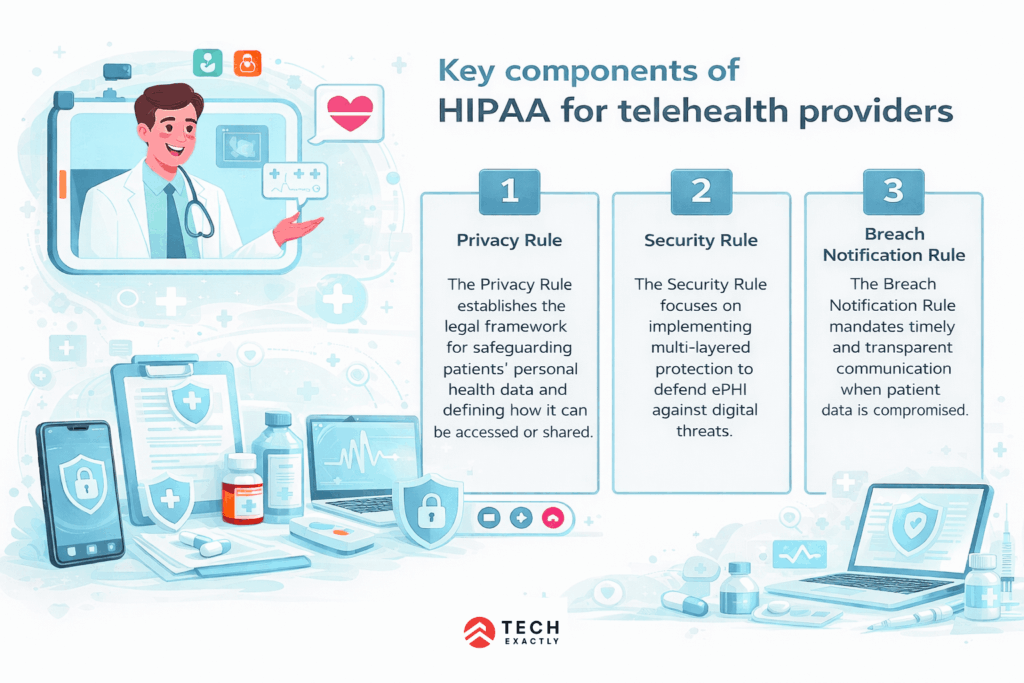
The non-negotiable foundation for all of this is security. Any platform handling protected health information must be HIPAA-compliant by design, not as an afterthought. This means end-to-end encryption, role-based access controls, audit logging, Business Associate Agreements with every third-party vendor, and documented incident response procedures.
Telemedicine software companies that treat HIPAA compliance as a checkbox rather than an architectural principle create enormous liability for the health systems and providers who use their platforms. When evaluating partners, this is the first question you should ask.
Choosing the Right Healthcare Mobile App Development Services
Not every development partner is equipped to build in healthcare. The combination of clinical workflows, regulatory compliance, EHR interoperability, and patient safety requirements makes healthcare mobile app development a fundamentally different discipline from standard app development and the cost of choosing the wrong partner shows up late, when it’s most expensive to fix.
Here’s our guide on choosing the perfect tech stack for a Healthcare App
Why Geography and Regulatory Expertise Matter
For health systems and Medtech companies targeting the US and UK markets, geography is not just a timezone consideration, but a regulatory one. A US healthcare app development company operates within the FDA’s SaMD framework, understands HIPAA’s technical safeguard requirements, and has experience with state-level health data regulations that vary significantly across markets.
A healthcare app development company brings equivalent expertise around NHS Digital standards, CQC registration requirements, MHRA oversight for medical devices, and the UK GDPR framework that governs patient data post-Brexit.
What to Look For in Healthcare Mobile App Development Services
Not all development partners are equal. When evaluating healthcare mobile app development services, look for:
- EHR interoperability experience: Can they build to HL7 FHIR standards and integrate with our system? This is a hard technical requirement, not a nice-to-have.
- Proven medical mobile app development lifecycle: Do they follow IEC 62304 for medical device software development? Do they have documented QA processes that satisfy regulatory audit requirements?
- Track record with healthcare startups: Have they shipped production applications for healthcare startups in New York City, London, or other major Medtech hubs, or are they learning on your project?
- Security architecture capability: Can they demonstrate HIPAA-compliant infrastructure design, not just claim it?
Challenges in AI Healthcare Integration: Security and Ethics
The opportunity in AI healthcare is immense. So are the risks. Patient data is among the most sensitive information that exists, and the consequences of a breach, such as clinical, legal, and reputational, are severe.
Generative AI introduces specific new risks: models trained on patient data that inadvertently memorize and reproduce identifying information, LLM outputs that contain clinical inaccuracies presented with high confidence, and third-party API providers whose data handling practices may not meet telehealth platforms HIPAA compliant standards.
Beyond security, there is the ethical dimension. AI models trained on historically unrepresentative datasets can encode and amplify health disparities, producing less accurate diagnostic outputs for underrepresented populations. Building responsible AI in healthcare means auditing training data, testing for bias across demographic groups, and maintaining human clinical oversight at every decision point that affects patient outcomes.
Conclusion: Partnering for a Smarter Healthcare Future
AI is the most powerful tool the healthcare industry has ever had access to, but tools don’t build themselves into safe, effective, compliant products. Human-centric design, regulatory expertise, and deep engineering capability are what turn a promising AI concept into a platform that clinicians trust and patients benefit from.
If you’re building in the Medtech space and need a development partner who understands both the technical and regulatory complexity of medical mobile app development, Tech Exactly has the experience to take you from concept to production. Get in touch with our team to start the conversation.