


How To Build a Generative AI Model: Full Guide

According to Accenture, 97% of executives believe generative AI will transform their businesses. Yet, 65% admit they lack the expertise to lead in that area. This means most leaders see the opportunity, but few know where to begin. Why does this matter?
Because generative AI is about:
- Faster innovation.
- Personalized experiences.
- New revenue streams.
Think of constructing a skyscraper; you cannot start with the top floor. You need the right foundation, blueprints, materials, and a phased plan. The same applies to AI.
But here is the catch: off-the-shelf tools will not get you there. Success comes from building tailored, scalable models aligned with real business needs.
In this guide, we will break down the step-by-step process of building a generative AI model. You will learn the fundamentals, how to collect and prepare data, choose the right architecture, train and fine-tune effectively, and finally, deploy and scale for measurable results.
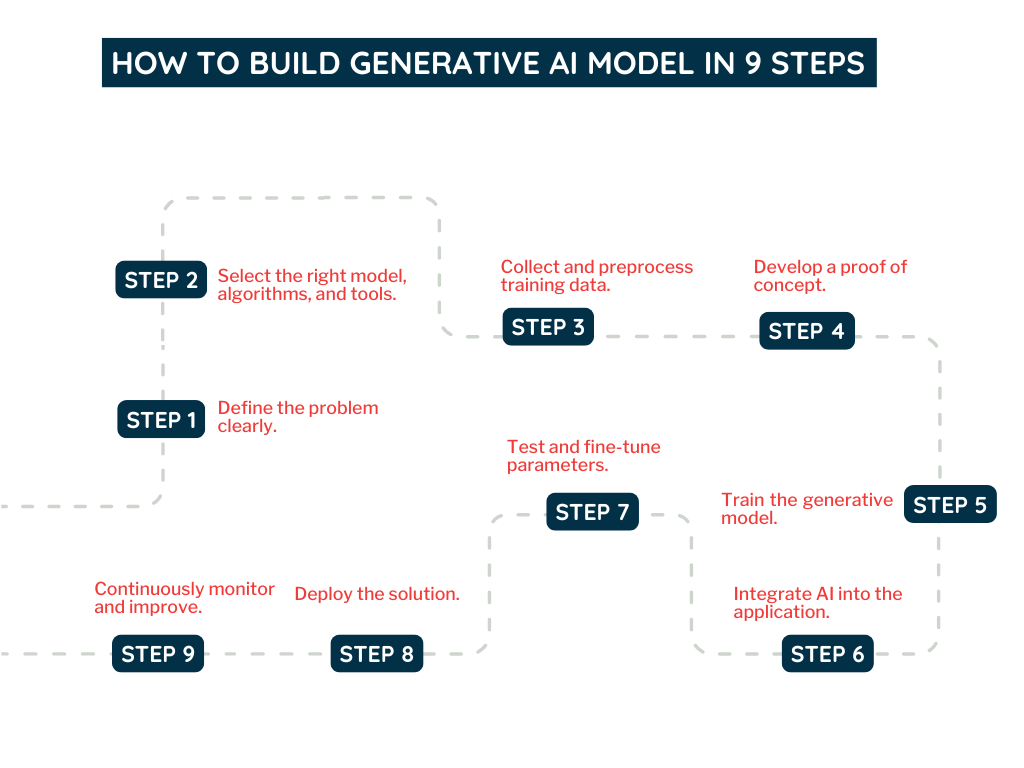
How to Create Generative AI in 9 Steps
Before we jump into the nuts and bolts, let’s pause for a second. Why does learning how to develop an AI even matter for businesses right now?
Here’s a hint: companies that figure out how to create generative AI effectively are not just adding shiny tech; they are unlocking new capabilities and even opening up fresh revenue streams. On the flip side, those who rush in without a roadmap often burn money, waste time, and lose trust. 42% of startups fail because they create something nobody wants.
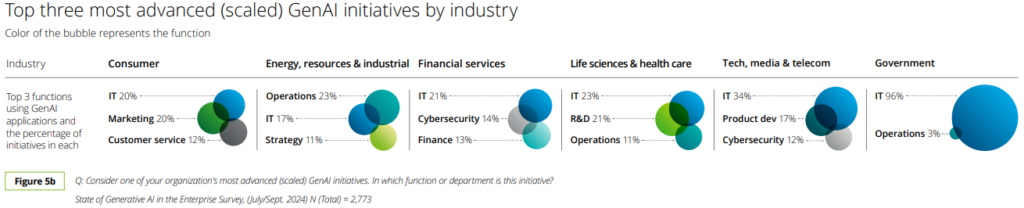
GenAI offers a path to avoid this pitfall by allowing companies to track real-time trends and consumer demand, ensuring they create products that actually resonate with their target audience.
Tesco uses advanced AI algorithms to forecast what customers want, allowing them to optimize their distribution, pricing, and promotions.
So, there needs to be a process:
- Foundation → define the problem.
- Coaching → select the right models and tools.
- Practice → collect and prepare quality data.
- Competition → deploy, test, and improve.
Whether you are a startup founder, a product manager, or part of a large company exploring AI solutions development, these steps will show you how to move from raw potential to measurable performance.
Step 1: Define the problem clearly
Every successful Gen-AI project begins long before the first line of code is written. Too often, companies get excited by the hype, jump straight into model selection, and end up solving the wrong problem. The truth is, clarity upfront saves months of wasted effort later.
Ask yourself: is the goal to improve efficiency, reduce costs, unlock new revenue, or enhance customer experience? Each of these directions demands a different AI design, dataset, and training approach. A lack of focus at this stage is one of the biggest reasons projects stall after heavy investment.
Before writing a single line of code, ask:
- What business challenge am I solving?
- What type of content/output do I expect? (text, images, code, audio)?
- What does success look like?
💡 Example:
- A healthcare startup might use generative AI to create synthetic patient data, enabling predictive models without breaching privacy.
- A retail company could deploy it for personalized product descriptions to increase conversions.
Both are valid, but their models, tools, and costs will differ dramatically.
Step 2: Select the right model, algorithms, and tools
Once you know your business problem, the next step is choosing the right generative AI architecture. To understand how to create an AI from scratch, this decision shapes everything that follows, from training costs to the quality of outputs. Pick the wrong foundation, and you risk building a house on sand.
Here are the main categories to consider:
- GANs (Generative Adversarial Networks): Ideal for generating realistic images or videos.
- Transformers (GPT, BERT, LLaMA): Best for natural language, code, and text-driven applications.
- VAEs (Variational Autoencoders): Useful for anomaly detection, structured data, or personalized recommendations.
You also need the right tools and frameworks to operationalize these models:
- TensorFlow or PyTorch: model development and training.
- Hugging Face: pre-trained models and fine-tuning.
- LangChain: building applications with large language models.
Use Case:
GitHub Copilot + Accenture — Developer Productivity Boost
GitHub teamed up with Accenture to measure real-world impact of using Copilot in enterprise engineering. They found that with Copilot, developers coded up to 55% faster and 85% of them felt more confident about their code quality.
Some key outcomes:
- Over 80% of participants adopted Copilot and used it regularly.
- Developers reported better job satisfaction and more time to focus on higher-value work.
This shows how selecting the right model/tool combo (in this case, a transformer-based AI assistant plus tight integration into developer workflows) delivers measurable gains in speed and confidence.
Partnering with Tech Exactly, a generative AI development company, you can hire AI developers to ensure your generative AI roadmap is scalable from day one.
Step 3: Collect and preprocess training data
If models are the brain of generative AI, then data is the oxygen. Without high-quality data, even the most sophisticated algorithms will produce mediocre or worse, biased results. In fact, a study listed in Forbes found that up to 80% of AI project time is spent on data preparation rather than actual training. That should tell you just how crucial this step is.
Tip for teams: The saying “garbage in, garbage out” applies more strongly here than anywhere else. Before asking how to build a generative AI model, first ask whether your data is clean, diverse, and representative.
The process involves:
- Collecting: Use internal sources (customer records, product data) and augment with public or licensed datasets.
- Cleaning: Remove duplicates, errors, or irrelevant records to prevent noise.
- Labeling: Ensure accuracy where supervised learning is required.
- Balancing: Avoid skewed datasets that could lead to biased outputs.
Example: In logistics, generative AI can forecast supply chain disruptions or optimize routing by training on historical transport, inventory, and weather data, as shown in our article on revolutionizing logistics and harnessing the power of generative AI in supply chains. This is a prime example of how to create an AI model that delivers real-world operational efficiency and resilience.
Step 4: Develop a proof of concept
Think of a Proof of Concept as your low-risk test flight. Instead of pouring budget into a full-blown system, you create a compact version to see if the idea flies in real business conditions. The focus is speed, validation, and learning.
Some effective ways teams build PoCs:
- Reuse existing models: Fine-tune a pre-trained LLM instead of training from scratch.
- Keep scope narrow: Pick one workflow (say, automated compliance reporting) rather than trying to “AI-enable” the entire department.
- Integrate just enough: A simple API hook into your CRM or ERP is often enough to show value.
Case Study Spotlight:
Tech Exactly built a Gen-AI-powered Nature Identification App for nature lovers worldwide. Starting with a PoC on a small set of plant species, the team refined accuracy and feedback before scaling. This community now supports 2,000,000+ biodiversity enthusiasts in exploring and learning with confidence.
Hence, instead of thinking “How do we scale this immediately ?”, the right question is: “Can this small-scale test prove the ROI ?”
Step 5: Train the generative model
This is where your generative AI project starts to take shape. Training is the process of feeding your preprocessed data into the chosen architecture and allowing the model to learn patterns through repeated iterations. The right approach here determines whether your AI delivers meaningful outcomes or drains resources.
Think of it like configuring a cloud server cluster: you do not just spin up machines and hope for the best. You carefully assign workloads, optimise performance, and monitor results until the system runs smoothly. Training a generative model works the same way – iterative, resource-intensive, but essential for stability and scale.
Step 6: Integrate AI into the application
Once your AI model is trained, the next milestone is embedding it into a real-world application. This step transforms your machine learning project from an experimental model into a business-ready solution.
Integration ensures your AI capability is not just theoretical but accessible for actual users. For instance, connecting a text-generation model to a customer support chatbot or embedding an image-generation tool into an e-commerce design platform.
Key integration pathways include:
- APIs: Expose your model through REST or GraphQL for seamless communication with existing business systems.
- Custom applications: Build apps where the AI is embedded natively, tailored to workflows.
- Cloud deployment: Host on AWS, Azure, or GCP for scalability and real-time performance.
💡A fintech company can integrate generative AI into its compliance workflow, automatically drafting regulatory reports. This is a direct example of how to create generative AI that enhances efficiency and reduces repetitive manual work.
Step 7: Test and fine-tune parameters
Testing and tuning is where you push your AI through rigorous scenarios to see how it holds up under business conditions. Without this stage, you risk underperforming results or worse, model failure in production. When you know how to build a generative AI model from scratch, fine-tuning ensures reliability, precision, and business fit.
The process involves:
- Stress testing to evaluate performance under heavy workloads.
- Parameter tuning, adjusting hyperparameters such as learning rate, dropout, or optimization algorithms.
- Feedback loops to gather user feedback to refine outputs and improve usability.
Case Study: GenAI Loan Servicing Agent
One of our ongoing fintech projects addresses a common borrower pain point: getting quick and accurate answers about loan terms. Borrowers often struggle with details like repayment dates, interest clauses, or outstanding amounts. Traditional support teams must manually search through contracts, which slows response times and increases operational costs.
To solve this, we are building a GenAI-powered loan servicing agent designed to make borrower interactions seamless.
Here is how the solution works:
- Natural Language Understanding (NLP): The voice AI agent interprets borrower questions.
- Contract Parsing (Automation): A rules-based parser pinpoints the relevant contract section.
- Generative AI (Core Role): GenAI takes that raw data and rewrites it into clear, conversational responses that borrowers can instantly understand.
- Voice Delivery: With ElevenLabs integration, the answer is spoken back to the borrower in real time.
The generative AI component transforms dense, legal-heavy text into simple, human-like explanations. This reduces confusion, eases support workload, and ensures borrowers get accurate, friendly answers on demand.
Step 8: Deploy the solution
Deployment is the turning point where your model graduates from the lab to production. At this stage, scalability, resilience, and security matter more than raw performance.
Key deployment models:
- On-premises for industries needing strict data privacy, such as healthcare.
- Hybrid cloud for balancing sensitive data with scalable resources.
- Fully cloud-based for startups and digital-first businesses prioritizing agility.
One thing to remember here is: deployment is not “set and forget.” You need CI/CD pipelines, version control, and automated monitoring to ensure smooth rollouts. Partnering with a generative AI development company helps businesses manage this complex process.
Step 9: Continuously monitor and improve
AI is not a static product. But a living system that evolves with new data, regulations, and business needs. Continuous monitoring ensures your model remains accurate, ethical, and valuable.
You can monitor and improve it by:
- Drift detection: Spotting when models deviate due to changing data patterns.
- Performance tracking: Measuring accuracy, latency, and resource usage.
- Governance: Applyingg generative AI for compliance to meet ethical and legal standards.

Technical Factors to Consider When Developing GenAI Models
When exploring how to create AI models, technical decisions shape the long-term success of your business. These factors are not just checkboxes but practical steps that guide the way you develop an AI responsibly and effectively.
- MLOps and the role of operational AI
Setting up MLOps pipelines helps automate repetitive tasks like data ingestion, training, deployment, and monitoring. For example, using Kubernetes with TensorFlow Serving allows you to scale models in production without manual intervention. This ensures your AI solutions development runs smoothly and adapts quickly to changing requirements.
- Governance, compliance, and responsible use of AI
Defining clear rules for access, model versioning, and audit trails is essential. Implementing governance frameworks early reduces risks of accidental misuse and ensures your application aligns with internal policies and external regulations.
You might like reading “How WestRock Implemented Responsible Governance for Generative AI in Internal Audit.” They established rules that all AI-generated audit output must go through human review before being used or published, essentially an “audit trail + human in the loop” approach.
- Data privacy and regulatory compliance
If you want to build a generative AI model from scratch for healthcare, you need to anonymize sensitive datasets while complying with HIPAA. In finance, GDPR and FCA rules mean you must design your process to protect customer data. This is about embedding privacy at every stage, not just at deployment.
You might like reading how we built an IEC 62304-Compliant Mobile App for Accurate Test Interpretation.
- Ethical use of AI
To prevent biased outputs, diversify your training datasets and conduct bias audits during the learning phase. For example, balancing input data across demographics ensures fairer recommendations in a retail product recommendation engine.
How Much Does it Cost to Build a Generative AI Solution?
Often a question without a single answer. The cost to build a generative AI solution depends on multiple factors – the complexity of the model, the scope of features, data requirements, compliance needs, and the need to hire AI developers(optional).
According to industry research, developing a basic AI application may start at $30,000–$50,000, while enterprise-grade AI solutions development (with custom models, integrations, and regulatory compliance) can cross $500,000 or more. Cloud providers like AWS, Azure, or Google Cloud also influence costs with their pay-as-you-go pricing for compute and storage.
Ballpark Cost Estimates
Here are rough cost ranges companies are seeing when they build a generative AI model or develop custom AI solutions in 2025.
| Level of Complexity | Examples of Use Case | Estimated Cost (USD) |
| Basic / Low Complexity | Simple content/text generation, small-scale chatbot, minimal integration | $20,000 – $150,000 |
| Medium Complexity | NLP engines, image-gen modules, and custom model fine-tuning | $100,000 – $300,000+ |
| High / Enterprise Grade | Full generative AI or LLM integration, custom data pipelines, real-time services, complex UI | $300,000 – $500,000+ (even up to ~$1,500,000 depending on scale) |
In-House vs Outsourced vs Hybrid
- If you build in-house, expect higher fixed costs (hiring, infrastructure, salaries, training). More control and better alignment, but slower ramp.
- If you work with a generative AI development company like Tech Exactly, you trade off some control but often reduce time-to-market, get broader expertise, and can manage costs more flexibly.
- Hybrid models are also common: build critical parts in-house; outsource supporting tasks (data labeling, UI, non-core tools) to reduce overhead.
Conclusion
Learning how to build a generative AI model is not just a technical exercise. From defining clear problems to training, integration, and ongoing monitoring, every step plays a vital role in ensuring real-world impact.
The companies that succeed in this journey are the ones that combine strong data foundations, responsible AI governance, and the right talent. Whether you are exploring how to make generative AI for customer engagement, product innovation, or operational efficiency, the opportunity is clear: scalable, ethical, and profitable transformation.
If your business is ready to move beyond experimentation, partner with a trusted generative AI development company like Tech Exactly, which can help you create AI models tailored to your needs and future-proof your growth.
