


Fitness App Development Cost in 2026: Features, Tech Stack & Pricing


Key Takeaways
- A competitive fitness app costs $50,000–$200,000+, depending on AI features, wearable integrations, and platform choices. MVPs start around $25,000–$40,000.
- Wearable integration isn’t optional anymore. Apple Health, Google Fit, Fitbit, Garmin — users expect their fitness app to talk to their hardware from day one.
- Fitness apps now handle health data. Heart rate, sleep patterns, calorie tracking, and biometric data trigger compliance requirements that most app development agencies ignore.
- AI-powered personalization is the retention lever. Apps with dynamic workout adjustments consistently outperform static content libraries on retention.
- Your development partner matters more than your feature list. The difference between a $40K app that ships and a $120K app that doesn’t is almost always the team, not the scope.
Most fitness apps don’t fail because of bad workout content. They fail because the team that built them had never handled real-time wearable data, HIPAA-adjacent health information, or subscription billing at scale.
The failure pattern is very consistent. A founder builds with a generalist agency, launches something that looks impressive, picks up a few thousand early users, and then retention dies within two weeks. Not because the idea was wrong. Because the team does not have any experience in solving the hard problems in fitness apps before: frictionless workout logging, reliable wearable sync, and recommendations that genuinely adapt to user behavior. Those problems might look simple from the outside. They are not.
The global fitness app market hit $12.1 billion in 2025 and is projected to reach $33.6 billion by 2033. That is real money, but the apps that are taking the majority of it are not simple workout trackers. They are platforms that are built around AI coaching, wearable ecosystems, and handling health information that regulators have started paying much closer attention to every year.
At Tech Exactly, a mobile app development company, we have built a smart fitness app that works as a personal trainer. It has AI-driven workout recommendations, real-time tracking, and gamified progression. It is not just a template. It is a product that has to handle user health data responsibly while keeping people engaged enough to open it daily.
This comprehensive guide is going to break down the reality of building a fitness app from the core features and realistic costs to navigating strict compliance mandates. Most importantly, we are going to show you how to vet a fitness app development company before you even sign on the dotted line.
If you are thinking of scoping an MVP fitness app, digitising a studio’s offerings, or plugging fitness API’s into a wider health platform, the execution is pretty much the same. You need to forget the surface-level tutorials. The main focus needs to be on the critical path decisions that will ensure that the codebase actually ships, the UX eliminates friction to prevent churn, and the backend architecture doesn’t trigger a compliance nightmare six months into production
The Fitness App Market in 2026: What's Actually Changed
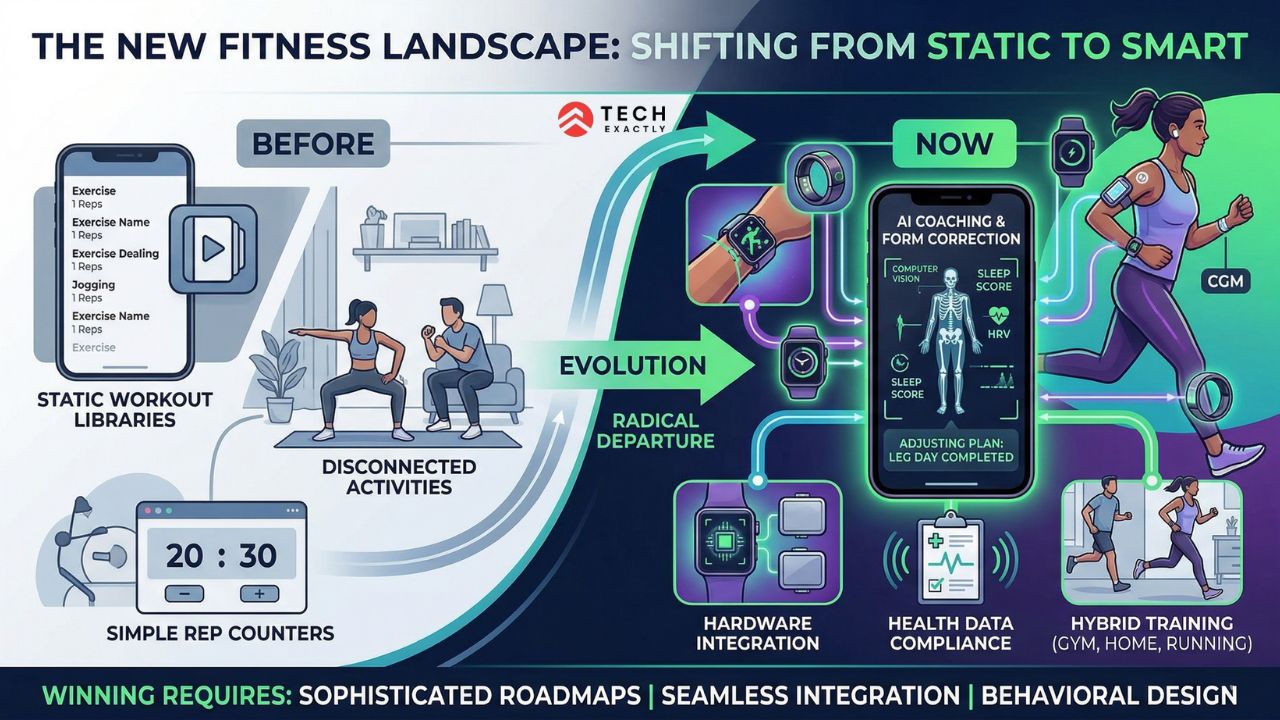
The 2026 digital fitness ecosystem represents a radical departure from the market dynamics of 2023. It is driven by the static content to actionable, AI-driven intelligence; the criteria for success have fundamentally changed.
Today, there are exactly three major shifts that dictate which products actually gain traction and, more importantly, which ones will secure funding:
1. AI coaching replaced static workout libraries. Users are not looking for just a list of exercises anymore. They are looking for something that really pays attention. The app should notice they skipped leg day twice, check their sleep score from last night, look at this morning’s heart rate variability, and mend their training plan accordingly. LLM-powered coaching and computer vision form correction have stopped being selling points anymore. They are starting points.
2. Wearables created a data integration problem. Smart rings (Oura, RingConn), CGMs (continuous glucose monitors), and smartwatches now feed biometric data into fitness apps. This is powerful for personalization — but it also means that your app is now going to collect, store, and process health data. That changes the compliance picture entirely.
3. Hybrid training is the default. No one is looking for just a gym app, a home workout, and a running app anymore. They want one single app that can handle all of it without breaking a sweat. It might sound like a simple feature request, but in reality, there are three completely different architecture patterns living inside a single product. Most development teams do not even realize this until they are already mid-build.
These shifts matter because they directly affect what you’ll spend, what you’ll need from a development team, and how long it’ll take to launch.
The technical threshold for shipping a competitive fitness app has changed drastically. In 2023, you could easily deploy a simple relational database of exercises hooked up to a basic UI, and you could attract users. In 2026, that is not a product; it is just an API endpoint in a modern fitness stack.
Winning products now require a sophisticated roadmap, seamless hardware integrations, and behavioural designs into daily user workflows. Engineering this kind of multi-layered, stateful system is a fundamentally different beast than coding a rep counter. It requires engineers with deep domain-specific expertise.
Types of Fitness Apps Worth Building
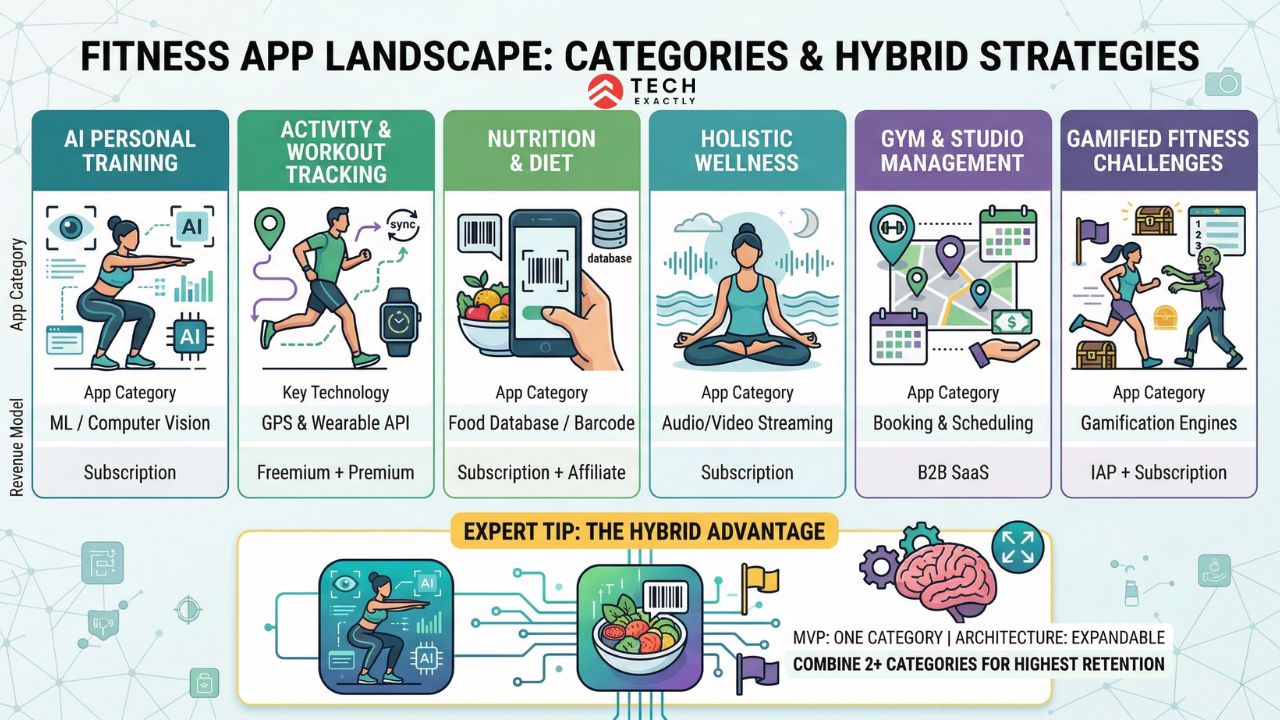
Before scoping features or talking to a healthcare app development company that also handles fitness builds, you need to know which category you’re building in — because each has different technical requirements, monetization models, and competitive dynamics.
| App Type | Examples | Core Tech Challenge | Monetization Sweet Spot |
|---|---|---|---|
| AI Personal Training | Freeletics, Future | ML models for adaptive programming, computer vision for form analysis | Subscription ($15–$30/mo) |
| Activity & Workout Tracking | Strava, Strong | GPS tracking, wearable API integrations, real-time data sync | Freemium + premium tiers |
| Nutrition & Diet | MyFitnessPal, Cronometer | Food database (500K+ items), barcode scanning, macro calculation engines | Subscription + affiliate |
| Holistic Wellness | Calm, Headspace | Audio/video streaming, sleep tracking, mood journaling | Subscription ($10–$15/mo) |
| Gym & Studio Management | Mindbody, ClassPass | Booking systems, payment processing, and multi-location scheduling | B2B SaaS per-location pricing |
| Gamified Fitness Challenges | Zombies Run!, Habitica | Gamification engines, social features, and leaderboards | In-app purchases + subscription |
💡 Expert Tip: The highest-retention fitness apps combine at least two categories. An AI personal training app with nutrition tracking and gamification elements will outperform a single-category app every time. Plan your MVP in one category, but design your architecture to expand into adjacent ones.
Let's Start Your Project Today
Ready to build your Fitness app with us? Reach out now – our experts are just one click away.
Core Features for a Fitness App That Retains Users
You don’t need 40 features at launch. You need the right 12. Here’s what separates fitness apps people use from fitness apps people uninstall after a week.
The stats are really brutal: 77% of fitness app users vanish in three days, and 90% are usually gone within a month. This has nothing to do with a lack of features or bad content. These attrition rates point to systematic failures in user onboarding and habit information.
The core development metric should be whether a new feature facilitates or hinders a user’s second workout. Marketing gets them to open the app for the very first time. Your product is what gets them to come back, and that battle is won or lost before even a single line of code is written.
TE has a detailed breakdown of 25 must-have features for fitness and gym apps. Below is the condensed version, organized by what matters for your MVP versus what you add in v2.
MVP Features (Launch With These)
- User profiles and onboarding — Fitness level, goals, equipment access, injuries, schedule preferences. This data drives everything else.
- Workout library and plans — Pre-built routines with video demonstrations, filterable by muscle group, duration, and equipment.
- Activity tracking — Reps, sets, weight, duration, distance. Integrate with Apple HealthKit and Google Fit from day one — the same wearable data sync patterns used in remote patient monitoring apps apply here.
- Progress dashboard — Visual charts showing streak data, personal records, and body metrics over time.
- Push notifications — Workout reminders, streak warnings, and milestone celebrations. This is your retention engine.
- Social features (basic) — Activity sharing, friend connections, and optional workout partners. Even lightweight social features meaningfully improve retention.
- Subscription and payment — Stripe, Apple IAP, Google Play Billing. Build this right the first time — migrating payment systems mid-growth is expensive.
V2 Features (Add After Product-Market Fit)
- AI-powered workout recommendations — Adaptive programming that adjusts based on user performance, recovery data, and goals. Requires AI and ML integration expertise.
- Wearable deep integration — Beyond basic step counts. Pull heart rate zones, HRV, sleep stages, and blood oxygen from Garmin, Fitbit, Apple Watch, Whoop, and Oura.
- Computer vision form analysis — Camera-based rep counting and form correction using pose estimation models. Add $20,000–$40,000 to your budget.
- Live and on-demand video classes — Requires video streaming infrastructure (AWS IVS, Mux, or Agora), which adds complexity and cost.
- Voice AI coaching — Hands-free workout guidance and real-time feedback during exercises. Increasingly expected in premium fitness apps.
- Community and challenges — Leaderboards, team challenges, and social feeds. Think Strava’s segment competition model.
Tech Stack Decisions That Affect Everything Downstream
Your tech stack is not just a technical decision; it also determines how fast you can really build, what it costs, who you can hire, and whether your architecture can even hold up when you start to scale up. For fitness apps specifically, three decisions will shape all of that more than anything else.
Native vs. Cross-Platform
| Approach | Best For | Cost Impact | TE Recommendation |
|---|---|---|---|
| React Native | MVPs, startups with limited budgets, apps that don’t need heavy native sensor access | 30–40% cheaper than dual native | Best for most fitness app MVPs |
| Flutter | Visually rich apps, custom animations, startups that want one codebase | Similar savings to React Native | Strong alternative — growing ecosystem |
| Native (Swift + Kotlin) | Apps requiring deep wearable SDK access, real-time sensor data, AR/VR features | 1.5–2x the cost of cross-platform | Only if you need features that cross-platform can’t handle well |
Backend Architecture
- Real-time sync (workout tracking, live classes) — Use WebSocket connections or Firebase Realtime Database
- AI/ML services — Separate microservice for model inference. Don’t couple it to your main API.
- Media storage — AWS S3 or Cloudflare R2 for workout videos. CDN is non-negotiable for streaming quality.
- Database — PostgreSQL for structured data, Redis for caching and leaderboard rankings
Third-Party Integrations
Budget for these — they’re not free, and some charge per API call:
- Apple HealthKit / Google Health Connect — Free but complex to implement
- Fitbit Web API — Free tier available, rate-limited
- Garmin Health API — Requires partnership application
- Stripe — 2.9% + $0.30 per transaction
- OpenAI / Anthropic API (for AI coaching) — ~$60/month at 100K responses
Let's Start Your Project Today
Ready to build your Fitness app with us? Reach out now – our experts are just one click away.
Fitness App Development Cost: A Realistic Breakdown
You need to forget those $5,000 “budget” quotes from offshore template shops; here is what it really costs to build a fitness app that does not fall apart.
| App Complexity | Cost Range | What You Get | Timeline |
|---|---|---|---|
| Basic MVP | $25,000–$50,000 | Single platform, core workout tracking, basic social, no AI | 3–4 months |
| Mid-Range App | $50,000–$120,000 | Cross-platform, wearable integrations, subscription billing, progress analytics | 4–6 months |
| AI-Powered Platform | $120,000–$200,000+ | Adaptive AI coaching, computer vision, live video, and deep wearable integration | 6–9 months |
Where the Budget Actually Goes
| Phase | % of Budget | What It Covers |
|---|---|---|
| Discovery & UI/UX Design | 10–15% | User research, wireframes, visual design, prototype testing |
| Frontend Development | 25–30% | All user-facing screens, animations, offline mode |
| Backend & API Development | 25–30% | Server logic, database, authentication, third-party integrations |
| AI/ML Integration | 10–20% | Model selection, training data, inference pipeline (if applicable) |
| QA & Testing | 10–15% | Device testing, wearable compatibility, load testing |
| Deployment & DevOps | 5–10% | CI/CD, app store submission, and monitoring setup |
The Costs Nobody Warns You About
- App store commissions — Apple and Google take 15–30% of subscription revenue. At $15/month per user, that’s $2.25–$4.50 per subscriber going to platform fees. Some apps now handle subscriptions via their website to avoid this.
- Ongoing API costs — AI inference, wearable APIs, video streaming CDN, and push notification services all bill monthly. Budget $500–$3,000/month depending on user volume.
- Annual maintenance — Plan for 15–20% of your original build cost per year. Bug fixes, OS updates (iOS and Android push major updates annually), security patches, and API version changes.
- Content creation — Workout videos, exercise demonstrations, and nutrition databases aren’t engineering costs — but they’re real costs. Professional workout video production runs $5,000–$15,000 for a starter library.
💡 Expert Tip: You should not increase your workload by launching on iOS and Android simultaneously. Start with iOS to capture the higher spending power, then iterate fast. You can use that initial revenue to bankroll your Android expansion later without worrying about the massive QA headache of managing two codebases at once.
Compliance: Why Fitness Apps Can't Ignore Health Data Regulations
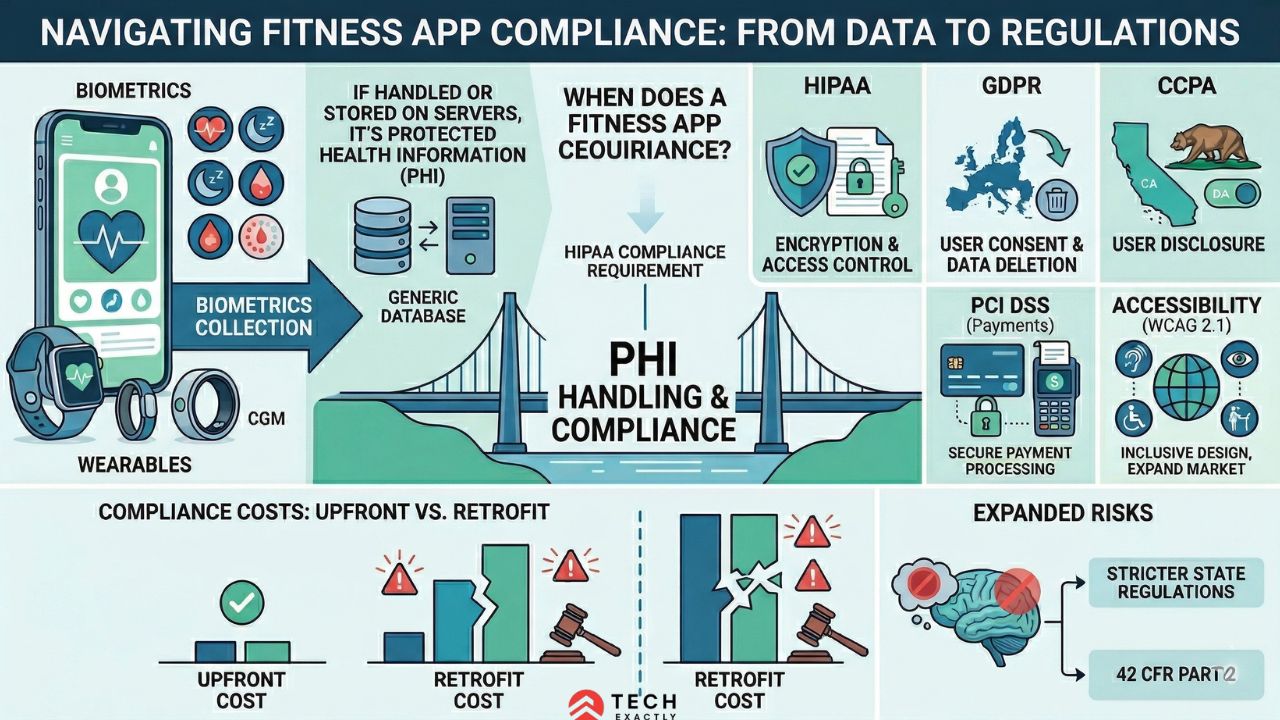
Here’s where most fitness app development services get it wrong. They treat fitness apps as purely consumer products with no regulatory requirements. That was true five years ago. It’s not true now.
When does a fitness app need HIPAA compliance?
The second your app starts collecting health data like heart rate, sleep patterns, blood oxygen, menstrual cycles, or any personal biometric data. You are probably handling what is called Protected Health Information, or PHI, in legal language. If you are pulling that data from a smartwatch or fitness tracker and saving it to a server, then you are surely handling PHI.
Key compliance areas for fitness apps:
- HIPAA — Required if handling PHI. Encryption at rest and in transit, access controls, audit logging, BAA agreements with cloud providers.
- GDPR — Required for EU users. Right to deletion, data portability, and explicit consent for data collection.
- CCPA — Required for California users. Disclosure of data collection practices and opt-out mechanisms.
- PCI DSS — Required if processing payments directly (Stripe handles most of this for you).
- Accessibility (WCAG 2.1) — Not legally required for all apps, but increasingly expected — and it expands your addressable market.
Building regulatory-compliant apps from the start costs 10–15% more upfront. Retrofitting compliance after launch costs 3–5x, with the legal exposure in between being extra.
When the fitness applications expand to include holistic wellness features, they frequently encounter complex regulatory environments concerning mental and behavioral health data. Developers need to recognize that there are many state regulations that impose stricter privacy safeguards on mental health information than on general health metrics.
If you go a step further into behavioral health or addiction recovery, you might hit 42 CFR Part 2, which dictates data-sharing restrictions that significantly exceed standard HIPAA compliance. It is important to obtain formal regulatory guidance before development, as these strict mandates need to dictate the foundational data architecture before the model is even locked in.
Monetization Models That Actually Work
The fitness app market has spoken. Here’s what generates revenue:
| Model | Revenue Potential | Best For | Watch Out For |
|---|---|---|---|
| Subscription | $$$$ | AI coaching, premium content, personalized plans | The dominant revenue model for fitness apps. This is the default. |
| Freemium + Premium Tier | $$$ | Activity trackers, workout libraries | Free tier must deliver real value or users won’t convert. Aim for 5–10% conversion. |
| In-App Purchases | $$ | One-time workout plans, nutrition guides, cosmetic items | Works as a supplement, rarely as a primary model |
| Corporate Wellness (B2B) | $$$$ | Employee wellness platforms | Longer sales cycle but higher contract values ($5–$50 per employee/month) |
| Affiliate & Partnerships | $$ | Supplement recommendations, equipment links, insurance wellness rewards | Regulatory gray area if recommending health products |
The top-grossing fitness apps — Calm, Peloton, SWEAT — all run subscription models with annual discount incentives. If you’re building a fitness app in 2026, subscription is your primary revenue model, everything else is supplementary.
How to Evaluate a Fitness App Development Company
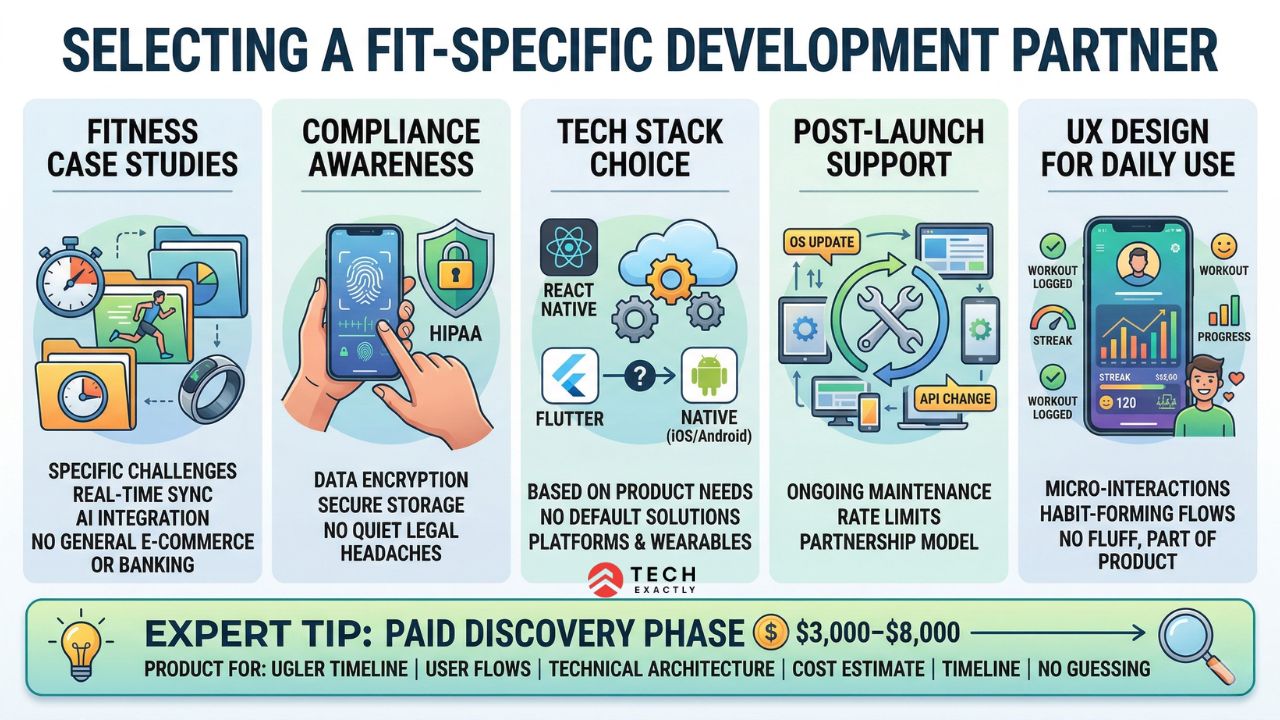
Let us be honest, most founders can handle this part in about 20 minutes. All it takes is a quick Google search, a scroll through some portfolio pages, and suddenly, you have picked your development partner. It all feels decisive and rarely ends well. There is a smarter way to go about it:
1. Ask for fitness-specific case studies. Not healthcare. Not e-commerce. Fitness. The technical challenges — wearable integration, real-time data sync, video streaming, AI integration — are specific to this category. A team that’s built a great banking app may still struggle with Garmin API quirks.
2. Check their compliance awareness. You can ask them a question: “How would you handle heart rate data from an Apple watch?” It sounds quite simple, but it is the answer that reveals everything. If their answer doesn’t cover how the data gets encrypted, where and how it’s stored, and at least nods to HIPAA, then that’s your answer. A lot of agencies are great at building apps that will look stunning but will quietly become your biggest legal headache.
3. Look at their tech stack recommendations. A good software development company will ask about your target platforms, wearable partnerships, and AI ambitions before recommending the tech stack. If they recommend something before understanding your product, they’re selling you their default, not your solution.
4. Ask about post-launch support. Fitness apps require ongoing maintenance — OS updates break wearable integrations, API providers change rate limits, and app store policies shift. Ask what their maintenance and support model looks like and what it costs.
5. Evaluate their UX design portfolio. A fitness app is not something that people use only once and then forget; it has to earn a place in their daily routine. Every micro-interaction counts, how quickly a workout gets logged, whether progress feels visible, whether notifications help or are just a nuisance. That is not all fluff; it is your product. So, do not just ask to see the finished work, but also to see how they got there.
💡 Expert Tip: Request a paid discovery phase ($3,000–$8,000) before committing to a full build. Any reputable development partner will scope your app in 2–3 weeks such as — user flows, technical architecture, cost estimate, and timeline. If a company gives you a fixed quote without a discovery phase, they’re guessing.
Ready to Build Your Fitness App?
The fitness app market is growing massively. Users have seen a lot of polished apps buy now that their standards have quietly shifted. AI coaching, syncing with your watch, handling your health data responsibly. All of this felt like extras a couple of years back. But today? People are expecting them to be there, and if they are not, the users will notice that and leave.
If you’re looking for a fitness app development company that’s already built and shipped fitness products — with AI-driven workout recommendations, real-time tracking, and the technical infrastructure to scale — let’s talk. We’ll scope it honestly and tell you exactly what it’ll take.
Let's Start Your Project Today
Ready to build your Fitness app with us? Reach out now – our experts are just one click away.
FAQs on Fitness App Development
A basic fitness app MVP costs $25,000–$50,000 for a single platform. Mid-range apps with wearable integrations and subscription billing run $50,000–$120,000. AI-powered platforms with computer vision, adaptive coaching, and live video can reach $200,000+. Post-launch maintenance adds 15–20% of your build cost annually.
It takes about 3-4 months to build an MVP while a much more complex app could take about 6-9 months. But the truth is that the biggest risk to your launch date is not a slow developer; it is when the scope starts creeping up mid - build. If you want to stay on track, then you need to lock in your "must-haves" and stick to them strictly until your first version is out.
If your app collects, stores, or transmits health data — heart rate, sleep patterns, blood oxygen, biometric data from wearables — it likely falls under HIPAA. Most fitness apps with wearable integrations handle PHI, whether the founders realize it or not. Build compliance from the start.
Most MVPs will thrive on a React Native/Flutter and Node.js/Python combo, as it is one of the most efficient paths to cross-platform launch. But if you are planning to build something highly specialized or AR, then go Native. Don't build your business around the developer forum hype; you should build it around your real requirements and how much runway you even have.
In the fitness world, the real deal is the subscriptions. Most of the successful apps fall under the $10–$30/month bracket, which are usually even paired up with a discounted yearly plan. If you’re leaning toward a freemium model, then you need to be sure that the free version feels like a complete product because that’s what actually earns the upgrade. If you’re looking for a real competitive edge, pivot toward B2B. Corporate wellness channels are less crowded, and they tend to offer significantly higher revenue per user.
Start with iOS. Fitness app users on iOS generally spend more on subscriptions, and Apple's HealthKit integration is better documented than Google Health Connect. Use iOS revenue to fund your Android expansion. The exception: if your target market is primarily Android users (common in Southeast Asia, parts of Europe, and corporate wellness deployments).

Pallabi Mahanta, Senior Content Writer at Tech Exactly, has over 5 years of experience in crafting marketing content strategies across FinTech, MedTech, and emerging technologies. She bridges complex ideas with clear, impactful storytelling.