

The UAE & KSA Digital Health Guide: Choosing a Right Tech Partner


A hospital develops an app for patient engagement. A clinic adopts telemedicine consultation services. An organization focuses on deploying AI powered diagnostics. In paper, everything seems very modern.
However, in reality, physicians still switch between multiple systems, fragmented medical records, the administrative workforce still manages everything manually, and patients face delays despite having new technologies.
It’s a scenario which is commonly seen within healthcare institutions in the UAE and Saudi Arabia. And the challenge is no longer whether digital health is important.
Healthcare leaders have accepted this long ago. So, the real question is:
How will you choose a technology partner capable of developing solutions that will improve healthcare delivery?
The answer is more complex than comparing development costs or feature lists.
In the recent past, we have witnessed healthcare organizations in UAE and Saudi Arabia transitioning from posing the question, “Should we invest in Digital Health?” to posing another one which reads, “How fast can we deploy it?” We are no longer discussing whether we need digital transformation in the healthcare sector. Rather, we are trying to identify a reliable healthcare software development company.
This guide highlights the aspects healthcare decision-makers should take into account when searching for a healthcare software development company in the UAE and KSA region.
Understanding the Landscape of Dubai’s Healthcare Technology
The healthcare industry in both the UAE and Saudi Arabia is experiencing some of the quickest digital transformation in the region.
Governmental projects, smart hospital projects, healthcare strategies at the national level, and increasing patient demands are driving the use of healthcare technologies. It’s no longer that healthcare organizations are adopting technological solutions just to make their services more advanced. Healthcare organizations are now adopting technological solutions to enhance delivery of services, make the services more accessible, utilize resources efficiently, and enhance patients’ experience.
The emirate has established itself as one of the most innovative healthcare environments in the Middle East thanks to its strong commitment to innovations in the healthcare sector, smart hospitals, and digital health technologies.
The region is steadily moving toward a connected healthcare ecosystem where hospitals, clinics, physicians, insurers, and patients can exchange information seamlessly.
This shift creates enormous opportunities for healthcare organizations willing to invest in digital platforms such as:
- Telemedicine solutions
- Patient engagement platforms
- Remote patient monitoring systems
- Healthcare analytics tools
- AI-powered clinical support systems
- Integrated care management platforms
However, technology investments only deliver value when they are designed around healthcare workflows rather than simply adding another standalone system.
With more and more healthcare organisations embracing digital innovations, there are numerous opportunities for technology firms engaged in developing healthcare software, mobile applications, and AI powered healthcare software solutions.
Why are UAE and KSA Healthcare Organisations Adopting Digital Health?
When we spoke with healthcare leaders across the UAE and Saudi Arabia, the conversation didn’t start with technology. It usually starts with the operational challenges.
While speaking with healthcare leaders we often notice that the challenge is rarely a lack of technology. Most hospitals and clinics already use healthcare IT solutions. The real challenge is that these systems are not connected properly with each other. The following are some of the reasons for adopting digital health services:
- Patients usually struggle with disconnected healthcare systems.
- Patients have increased expectations in terms of speed and convenience in their healthcare experience.
- The costs of running healthcare systems are increasing.
- There is a lack of doctors, nurses, and other health professionals.
- There is a problem of integration between many healthcare systems and platforms.
- There is an increase in demand for online health services.
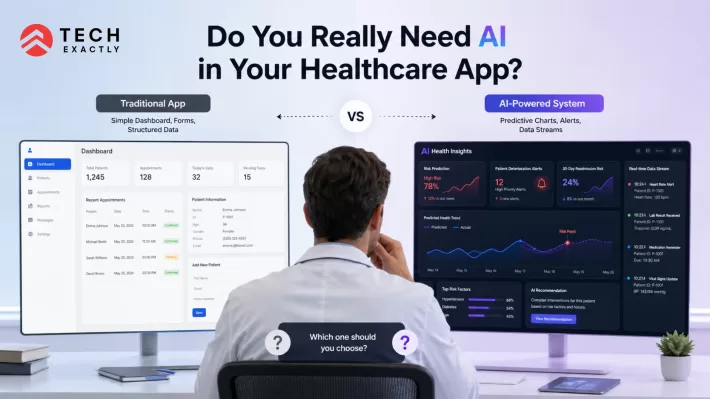
- AI technology in the healthcare sector is becoming popular.
Doctors spend valuable time switching between platforms, administrative teams deal with manual processes, and patients experience delays. Digital transformation works best when it creates a connected ecosystem rather than adding another standalone tool.
What Happens If You Choose Wrong Technology Partner?
One of the biggest mistakes that healthcare companies make is choosing a software provider based mainly on development expenses. On the surface level, this sounds like a sensible choice to make. The software is developed and the deployment is done within schedule. But then the real trouble begins.
Integration problems arise. The compliance gap comes into play. The performance issues become apparent as the platform is used increasingly. The security concerns become more serious. Changes in regulatory requirements necessitate changes in the architecture of the system.
This results in having another investment cycle which will be much more costly than doing everything properly from the start.
Healthcare software development in UAE is quite different from the development of a typical business application. The technology company can be very proficient at software engineering but have no idea about patient flows, healthcare processes, compliance, interoperability and all that.
The actual cost of the healthcare solution is not dictated by its development expenses. It is determined by how effectively the platform supports healthcare delivery over time.
Factors to Consider When Selecting a Healthcare Software Development Company
Most health-care organizations start their vendor-selection process with comparisons of project estimates.
It’s easy to see why.
Healthcare IT purchases require substantial investment, and the executive team wants to know about budgeting before committing. But the success or failure of a health-care software project isn’t typically determined by its development cost alone.
Based on our experience, the future success of a health-care system depends much more on architecture, compliance planning, integration, scalability, and usability rather than on the number of screens and functionality available in the initial release.
While development costs of a health-care software system in the UAE and Saudi Arabia may vary from AED 147,000 to AED 1,800,000+ ($40,000 to $500,000+) according to complexity, an organization should pay more attention to choosing a partner who will be able to help not only with current but also with future needs.
The following topics are worth focusing on while choosing a vendor.

Arabic-First User Experience
The most common mistake that is being made in many regional healthcare applications is approaching Arabic language support as translation. Healthcare organizations have a tendency to believe that translating their English text into Arabic is enough.
It is not.
Creating an Arabic-first healthcare experience needs a deliberate approach to designing from the very start. Navigation flow, interface design, hierarchy of content, placement of buttons and patient interaction need to be designed with right-to-left interactions in mind.
It is crucial in healthcare because trust plays a big part in adoption. People tend to use systems that are intuitive and familiar to them culturally.
Thus, a good healthcare technology partner must know about:
- Right-to-left interface design
- Arabic-first navigation flow
- Medical terminology in Modern Standard Arabic
- Patient interaction for local audience
- Accessibility considerations for various age demographics
- UX design for multilingual systems
Our task is not to just provide Arabic language support. Our task is to create a healthcare system that was designed with Arabic patients in mind from the very start. Opt for a healthcare app development company that does not create messy apps like localised apps since Arabic script demands more room than Latin letters.
Strong Security
Trust of patients relies on data security. Alas, conversations about security start much too late in the development cycle. At times, healthcare businesses emphasize features, integrations, and deadlines and assume that security can be addressed later.
In truth, decisions related to healthcare security impact the architecture right from the very start. All decisions regarding patient information, access, cloud architecture, integrations, third-party services have an impact on the security of the platform.
Important aspects of security include:
- Patient data protection
- Role-based authorisation
- Encryption of information both in transit and at rest
- Auditing and tracking of activities
- Monitoring and threat detection
- Infrastructure security
- Interoperability standards for health care data
- Compliance with telemedicine laws
- Privacy-by-design security approach
When it comes to health care, security does not only involve information technology. Security involves building trust with patients. Just one breach can harm your organization’s reputation and bring about many more problems.
If you think about security right from the start, you save yourself from having to fix your mistakes later.
AI-Powered Clinical Support
Artificial intelligence has emerged as one of the hottest topics within the realm of healthcare technology. But the successful healthcare organizations approach AI in ways very different from how many headlines imply.
They don’t deploy AI merely because it’s currently popular. They deploy AI because it helps to address certain practical issues within their operations.
The successful applications of AI usually relate to such areas as:
- Clinical decision support
- Automation of patient engagement
- Predictive analytics
- Population health management
- Clinical documentation
- Symptom assessment processes
- Risk detection and monitoring
The issue is making sure that those solutions based on artificial intelligence would continue to work reliably, transparently, and according to the best practices of healthcare.
The technology partner should recognize the fact that the AI suggestions should not exist by themselves but be seamlessly integrated into the existing process and help healthcare professionals instead of complicating things.
In case of successful deployment, AI becomes an operational advantage. Otherwise, it becomes just another system hard for the clinicians to trust.
Expertise in Regulatory and Compliance
Compliance in healthcare is sometimes poorly understood by many. To many firms, compliance is seen as a list that needs to be checked off prior to launch. However, compliance impacts almost all technical decisions during the entire process of development.
It has influence on:
- Data storage mechanisms
- Architecture infrastructure
- Access mechanisms
- Logging audits
- User Authentication
- Integration design
- Security policies
- Data retention policy
Healthcare providers working in the UAE and Saudi Arabia have to contend with several regulatory frameworks. So they must evaluate an AI software development partner and make sure that the partner is aware of all the requirements for compliance with the regulations in each market they serve.
For instance:
- The UAE’s healthcare providers will have to look at the regulations issued by MOHAP at National Level.
- Dubai’s healthcare providers must comply with the guidelines laid out by DHA.
- Abu Dhabi’s healthcare providers will have to be guided by the DoH regulations.
- Healthcare providers in Saudi Arabia must adhere to the guidelines of MOH and NPHIES.
Compliance is frequently seen as merely a list of checks to be ticked, but in practice, it impacts product architecture, information storage choices, access controls, auditing measures, and integration practices. Those healthcare companies that focus on compliance right from the start tend to have easier sailings thereafter.
Domain Expertise
Good software developers can create applications. A good healthcare software development company in UAE knows how healthcare organizations work.
This distinction matters.
Healthcare software operates in an ecosystem with clinicians, nurses, administrators, patients, payers, compliance personnel, and government entities. A vendor without healthcare knowledge could create software that works on a technical level but doesn’t work operationally.
In reviewing potential partners, consider their experience creating:
- Telemedicine platforms
- Patient engagement software
- Remote patient monitoring software
- Healthcare analytics software
- AI-enabled healthcare software
- Clinical workflow software
- Care coordination software
Healthcare software must support healthcare objectives. This requires a partner who understands both healthcare and software development.
User-Centric Design and Patient Engagement
Dubai’s Vision 2040 emphasizes a patient centric approach by designing applications having user-friendly interfaces and interactive features.
There is one lesson which stays the same in healthcare projects. Even the most advanced technology does not work if it is not used by people. Many healthcare software platforms fail as they concentrate more on functionality and ignore usability.
Healthcare professionals work under stress conditions. Patients are usually using healthcare applications in stressful situations or when they are ill. Inconvenient interfaces cause friction. A user-centered approach helps to solve this problem.
A good healthcare software development company should concentrate on:
- Simplification of user journeys
- Elimination of unnecessary steps
- Making the interface accessible for all people
- Support of patients in multiple languages
- Patient engagement
- Intuitive workflow
People use technology more when they can see that it makes their lives easier.
Questions One Should Ask Before Choosing the Best Healthcare Software Development Company
The medical professionals are gradually becoming more dependent on health apps in order to provide patients’ services effectively. Once you have analysed all the major aspects, then the next thing for you to do is confirm them through discussion. This will enable you to choose the right health app developers in Dubai.
Have you ever used DHA compliant healthcare software before?
At Tech Exactly, we build compliance at the architecture level itself. Our experienced personnel design the system keeping the needs of DHA at bay. They make sure that all features are aligned with compliance requirements. This way, there is no need to implement compliance separately later on.
Do you have a solution to UAE data residency and security concerns?
We create compliant cloud infrastructure for the region, including AES-based encryption and backups. Our engineers are also prepared for the worst-case scenarios and thus, regularly perform disaster recovery tests and security audits to ensure continuous uptime of services.
How do you validate AI-driven features in clinics?
For us, AI in healthcare means putting a patient first. This includes providing medical use cases before training an AI model, validation of data by a caregiver, and use of AI algorithms to explain every conclusion made by an AI system.
What performance benchmarks do you follow for healthcare software?
To deliver better patient outcomes, we stress test and audit the health application performance. This enables us to optimise for faster data retrieval.
What sort of post-launch support can you give?
Tech Exactly is run on a well-defined governance structure. We ensure continuous monitoring for compliance, security auditing, regulation changes, and performance tuning that keep healthcare applications ready for Dubai’s changing market environment.
Want to Create a DHA-Compliant and Future-Friendly Health Application in Dubai?
Within the UAE and Saudi Arabia, digital health is no longer considered a future-oriented trend. Instead, it is becoming a crucial element of healthcare service delivery.
Organizations driving change are not only putting their resources into the technology. They are putting resources into the technology that corresponds to the workflow, regulations, needs, and goals of the organization.
Finding the right partner for the healthcare software development is thus a healthcare rather than procurement decision.
A true partner understands that the success of the platform is not only dependent on the code. It is also dependent on patients, clinicians, regulatory professionals, administrators, and other stakeholders all working towards improvement in the area.
This is the approach that is followed at Tech Exactly.
Our mission is not limited to developing applications for our clients. We are here to help healthcare organizations deliver safe, reliable, and scalable digital health solutions in line with the needs of the ever-evolving healthcare ecosystem within the UAE and Saudi Arabia.
If your organization is considering an implementation of a healthcare technology project and wants to understand the practical side of it, then it is time to talk to us. Schedule a strategy call now and get to know the benefits we can offer you.